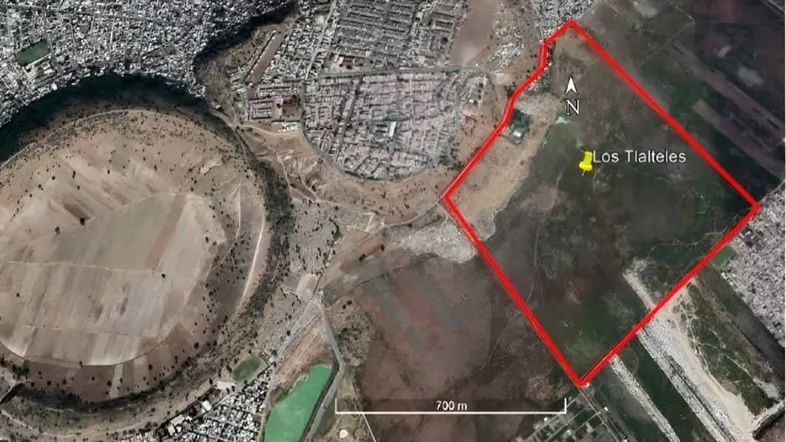
A pre-Hispanic archaeological site in México state has been reduced to a fraction of its original size by years of looting, unauthorized development and illegal land sales — and researchers say government inaction has made things far worse.
The site, Los Tlateles, sits on the former lakebed of what was once Lake Chalco, roughly 30 kilometers (19 miles) from Mexico City. It originally covered more than 200 hectares (nearly 500 acres) but has been whittled down to between 10 and 20 hectares today. About 150 earthen mounds remain, but archaeologists warn that even those could disappear within the year.
Ceramics, bones, skulls — taken daily
Archaeologist and independent researcher Ricardo Arredondo estimates that roughly 70% of pre-Columbian pieces currently listed on Facebook Marketplace and Mercado Libre originate from Los Tlateles. The citizen group Frente Común Tlalteles says ceramics, bones and sculptures are removed on a near-daily basis, calling the pattern of official inaction an “irreparable” failure.
History and archaeology influencer Señor Blue — whose real name is Yaotzin Nell Mejía — documented irregular excavations at the site on video, showing bone fragments, pottery and skulls bearing stone tooth inlays that may indicate high-ranking Prehispanic burials. Outsiders with specialized equipment reportedly travel to the site specifically to pillage it.
Among the most significant recent losses: a Prehispanic offering possibly dedicated to Tláloc, the rain deity, that reportedly included braziers, shells, obsidian figurines and human remains. According to local accounts, those objects quickly wound up on Facebook, offered for sale by a private individual.
Why INAH can’t — or won’t — step in
The National Institute of Anthropology and History (INAH) faces a legal tangle of its own. Residents have filed amparos — injunctions under Mexican law — blocking archaeologists from accessing the site. The cases are tied up before a federal district judge in Nezahualcóyotl. INAH has also acknowledged that Los Tlateles has never been officially declared a protected archaeological zone, which limits its legal tools.
On its website, the agency posted an undated legal-defense text arguing that the site is being ravaged by unauthorized construction and looting on ejido (communally held) land, and that court orders, vandalism and internal legal shortcomings have all constrained its ability to act. As of this week, INAH had issued no public statement responding to the most recent accusations.
Blame directed at specific officials
The INAH labor union’s Commission for the Protection and Legislation of Archaeological, Historical and Paleontological Heritage went further, naming two officials directly. It accused Salvador Pulido, INAH’s director of archaeological salvage, and Nahúm Noguera, director of INAH’s México state office, of being “responsible for all the damage and looting caused to the archaeological heritage,” saying the two had failed to act under existing law and had in some cases authorized work that damaged protected monuments.
Arredondo places the site’s occupation from roughly 2050 BCE to 1521 CE. He describes it as a precursor to the chinampa system — the network of artificial islands and canals later used in the Aztec capital of Tenochtitlán, precursor to present-day Mexico City. That lineage makes what’s happening at Los Tlateles all the more significant, say researchers tracking the illegal antiquities trade.
Selling archaeological artifacts is a federal crime in Mexico and can carry penalties of up to 10 years in prison, but enforcement at Los Tlateles has remained essentially nonexistent.
At a Glance
- Site: Los Tlateles, Chalco municipality, México state
- Original size: More than 200 hectares (nearly 500 acres)
- Current size: 10–20 hectares, with further loss expected this year
- Occupation period: Approx. 2050 BCE to 1521 CE
- Status: Not officially a protected archaeological zone
- Items stolen: Ceramics, bone fragments, skulls, obsidian objects, human remains
- Online sales: An estimated 70% of pre-Columbian pieces on Facebook Marketplace and Mercado Libre traced to this site
- Legal barrier: Community-filed amparos block INAH access; cases pending in federal court
Sources: Excélsior, El Informador, La Voladora Noticias