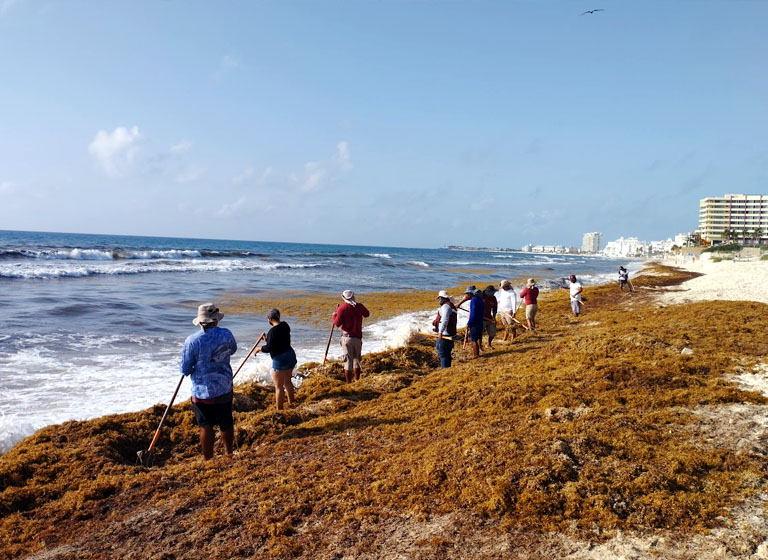
Playa del Carmen has become one of the most affected destinations in Mexico by the massive influx of sargassum, which this year has been worse than ever.
Aside from its foul smell and serving as an obstacle to entering the ocean, sargassum is now presenting a new problem: skin conditions.
As sargassum rots, it releases compounds like hydrogen sulfide and ammonia. Direct contact with the decaying algae can cause skin redness, itching, rashes, and irritation, especially in individuals with sensitive skin or eczema.
José Gómez Burgos, president of the Cooperativa Turística del Mar Caribe, stated that an increasing number of fishermen and tourists have been presenting skin issues, despite navigating and swimming in areas away from the coast where sargassum concentrates.
“We already have colleagues with skin issues — they go into the sea and have to board their boats in that condition. It’s a serious problem that causes skin irritation lasting several days, but we have to keep working,” Gómez Burgos told Sipse.
Making matters even worse is the fact that even contact with dry sargassum on beaches can have adverse effects, as it contains small, rough, calcified structures that can scratch or chafe the skin, leading to minor cuts or abrasions. These breaks in the skin can then become entry points for bacteria or other pathogens.
Medical experts advise avoiding direct skin contact with washed-up sargassum, wearing protective clothing and gloves during cleanup, rinsing immediately with fresh water and soap after exposure, and seeking medical attention for persistent rashes or signs of infection.
Evidence suggests that those most at risk for developing health issues related to sargassum are not tourists, but rather the large number of people employed by private companies and governments to collect it for disposal or processing.
The Inter-American Development Bank estimates that Mexico’s Caribbean region in the state of Quintana Roo has suffered economic losses of nearly 12% due to declining tourism. The hotel sector spends approximately 135 million dollars annually on beach cleaning. By July 2025 alone, 44,000 tons of sargassum had been removed from beaches and coastal waters in Quintana Roo
Despite ongoing efforts, authorities warn that the arrival of sargassum will not disappear anytime soon. On the contrary, it is expected to increase due to ocean currents and weather conditions as temperatures continue to rise over the next few weeks.
Sargassum and Its Effects Beyond Mexico
At the regional level, Caribbean nations are moving toward coordinated action. In October 2025, the Association of Caribbean States established a Sargassum Sub-Commission, the first intergovernmental mechanism with a regional political mandate to comprehensively address sargassum impacts on ecosystems, public health, the economy, and coastal communities.
The Sub-Commission will guide the formulation of a Regional Plan for Sargassum Management, defining common approaches to monitoring, prevention, mitigation, and sustainable use.
The United Nations Environment Programme is also advocating for strengthening regional action plans, early warning systems, and sustainable response strategies.
West Africa, while less studied, faces significant but underreported impacts. Scientific research indicates that West African countries, including Ghana, Nigeria, and Senegal, experience substantial sargassum inundations that affect fisheries, tourism, and public health.