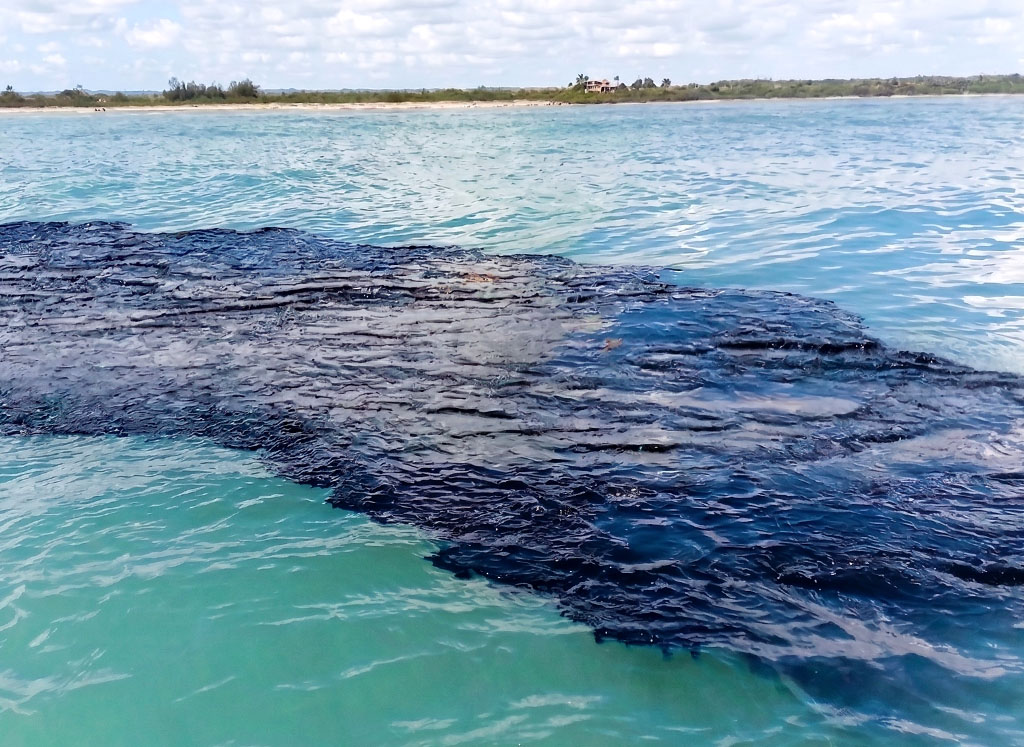
For two months, the Mexican government maintained a steadfast narrative: the oil staining hundreds of miles of Gulf coastline was the result of an illegal ship dump and natural seabed seeps. But on April 16, that narrative collapsed.
Federal authorities were forced to admit that a decaying 36-inch pipeline owned by state oil giant Pemex, located within the Cantarell complex off the Campeche coast, was the source of a disaster that has quietly grown into one of Mexico’s most significant environmental crises in years.
The admission of what occurred at Cantarell has torn open a widening gap between the government’s initial assurances of limited damage and the stark reality of a “continuous fallout.” Evidence now confirms that previously unaffected areas along the Gulf are showing signs of toxicity as the slick continues to expand, threatening the delicate ecological balance of protected wetlands and coral reefs.
Cantarell: The Perfect Storm of Negligence
The accident did not occur suddenly. According to the investigation released by the federal Interinstitutional Group, the rupture began as early as Feb. 4 near the Abkatún platform. While an aerial survey spotted hydrocarbons on Feb. 6, a chaotic chain of operational failures ensued.
It took divers 48 hours to locate the breach in the labyrinth of seabed pipes at Cantarell. Even then, the response was hobbled by what Pemex Director General Víctor Rodríguez described as a “chain of specific misconduct.” Senior management was not informed of the severity of the leak. Critically, the main pipeline valve was not shut until Feb. 14—eight days after the leak was detected—allowing crude to billow into the Gulf virtually unchecked.
Internal reports indicate that at least 350 cubic meters of oily water recovered by containment barriers were deliberately hidden from records. When tar balls began washing ashore in Veracruz and Tabasco in early March, officials denied a pipeline breach, instead blaming a “mystery ship” and natural “chapopoteras.”
Expanding Fallout and Ecological Devastation
The delay in response at Cantarell allowed the slick to metastasize. Satellite imagery and drift models show that the spill has now impacted more than 600 kilometers of coastline, stretching from Tamaulipas down through Veracruz and Campeche.
More alarmingly, the contamination is reaching regions previously untouched by the initial wave. Environmental groups report that the toxic sheen has infiltrated seven federally protected natural reserves, including the Los Tuxtlas Biosphere Reserve and the Veracruz Reef System, a UNESCO-recognized biosphere that is home to the most biodiverse marine ecosystems in the western Atlantic.
Oceana and local environmental organizations have documented the deaths of sea turtles, a manatee, and dozens of fish species. The economic fallout is equally severe; fishing cooperatives have been paralyzed, and the tourism industry along the once-pristine beaches is facing an existential threat as cleanup crews dig tar out of the sand.
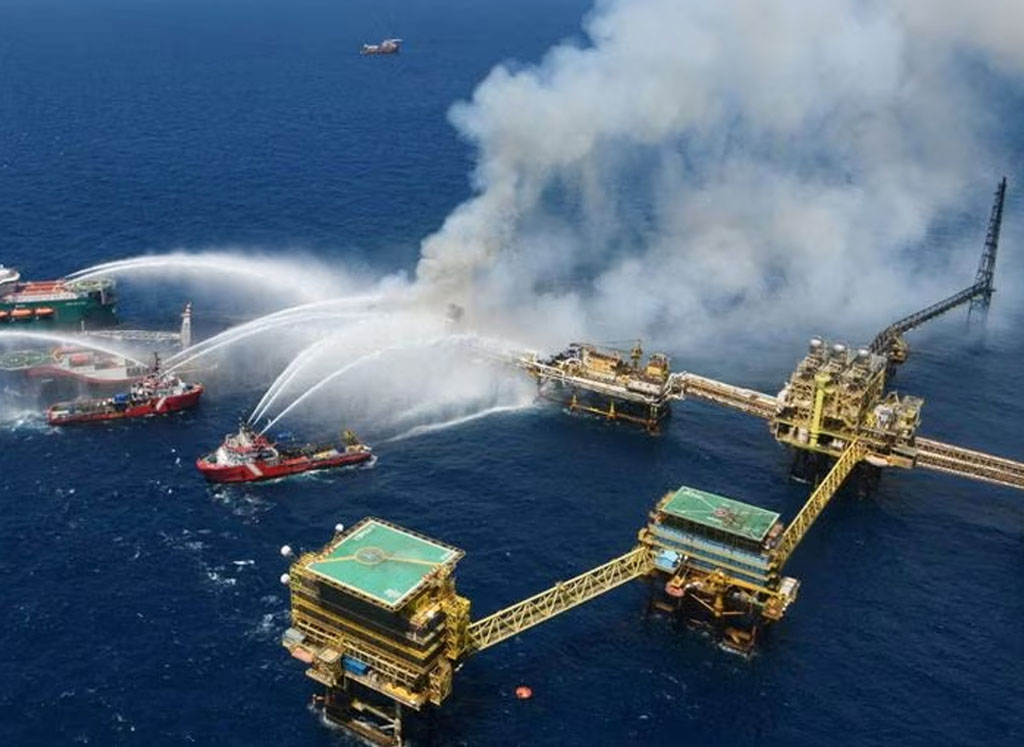
Shifting the Blame over Cantarell
Mexico has mobilized a massive, albeit belated, force. Over 3,000 military and cleanup personnel, 47 vessels, and thousands of meters of containment barriers have been deployed along the affected shores.
President Claudia Sheinbaum, who as recently as March 31 defended Pemex and denied a pipeline leak at Cantarell, has pivoted to damage control. Officials announced a 30-million-peso fund to support displaced fishermen and insisted that beaches remain safe for tourists. However, environmentalists argue these measures are superficial. Greenpeace and other organizations have lambasted the government’s approach, stating that financial aid does not equate to ecosystem restoration, especially when the total volume of oil spilled remains unknown.
As the cleanup continues, the federal government has promised to create a permanent environmental observatory to monitor the Gulf. But for the coastal communities of Campeche, watching the black tide rise against their shores, the promise feels hollow.
With Information from Reforma.