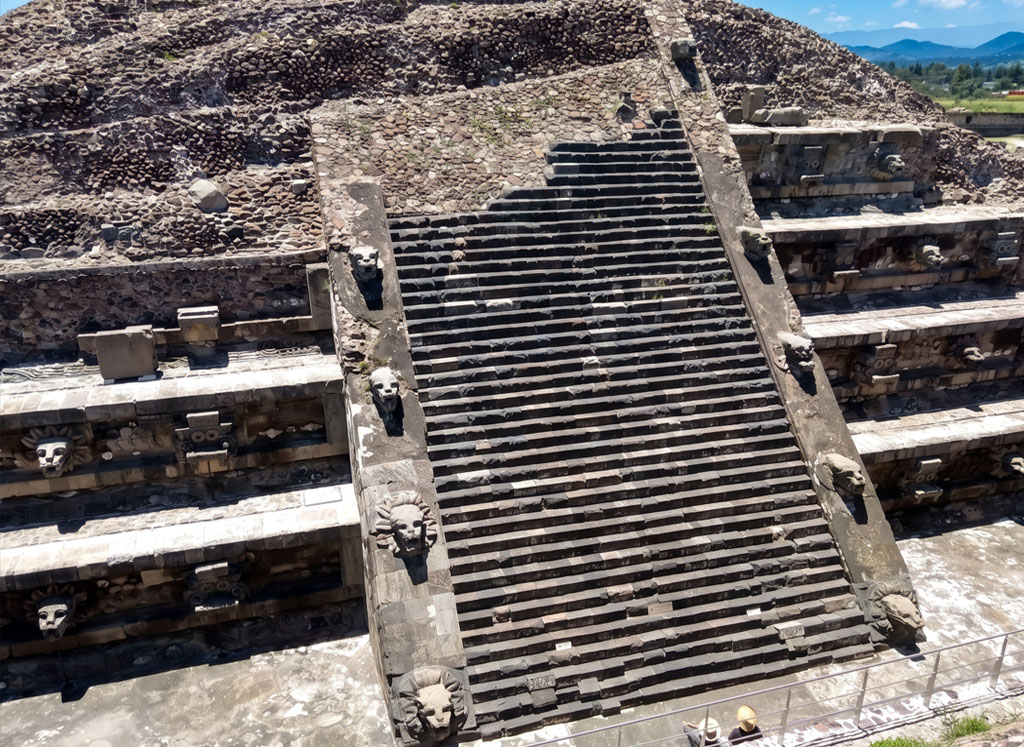
In the fall of 2003, archaeologist Sergio Gómez Chávez arrived at work after a heavy rainstorm to find a sinkhole had opened at the foot of the Temple of the Feathered Serpent in Teotihuacán.
The three-foot-wide collapse was an accident that led to one of the most significant discoveries of his career: a tunnel system that ran hundreds of feet below the pyramid. But today, what Gómez Chávez sees when he looks at the same temple is not just an opportunity for discovery, but the slow, steady disintegration of the building itself. He now warns that the structure could disappear almost entirely within a century.
The Temple of the Feathered Serpent at Teotihuacán, also known as the Temple of Quetzalcóatl, is the third-largest pyramid at Teotihuacán, a Prehispanic archaeological site located in central Mexico. Built between 150 and 200 CE, the pyramid consists of seven stepped bodies with a talud-tablero architectural style and features one of the most complex sculptural programs of its time.
The pyramid in Teotihuacán takes its name from the numerous representations of the feathered serpent deity that cover its sides, which are among the earliest-known depictions of a figure later associated with the Aztec (Mexica) god Quetzalcoatl.
The four sides of the structure were originally covered in stone reliefs depicting multi-colored feathered serpents that appear to slide among seashells. Alternating with the serpent heads are large sculptures of a separate figure with prominent fangs and two rings on its forehead, which some researchers have interpreted as the rain god Tlaloc or other deities.
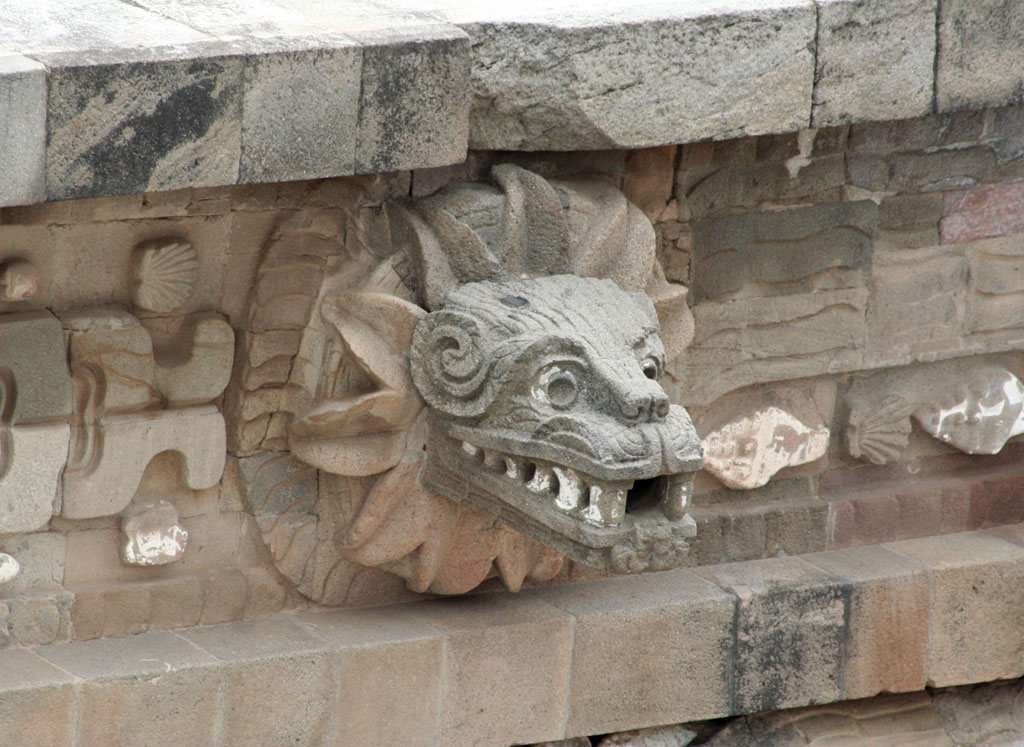
The pyramid was originally hidden behind a later construction known as the Adosada platform, and the sculptures that were once visible were intentionally destroyed or covered, a fact that paradoxically helped preserve the rest. The temple also sits within the Ciudadela, a massive walled courtyard capable of holding the estimated 100,000 inhabitants of Teotihuacán at its peak.
In May 2026, Gómez Chávez told La Jornada that the Temple of the Feathered Serpent at Teotihuacán “could cease to exist in about 100 years” due to “very severe” damage. The primary cause of the deterioration is moisture accumulation. Studies conducted with scanning electron microscopes have revealed that the stone is in a critical process of disintegration and sandification.
The moisture penetrates the subsoil and then rises into the structure through capillary action, fracturing the stone and causing it to lose its cohesion. Temperature fluctuations in the region, ranging from freezing to over 30 degrees Celsius in a single day, exacerbate the problem, as do constant humidity levels around 65%. The damage is not always visible to the naked eye, but particles of the original material are now detaching from the temple daily.
The origins of the moisture problem are partly modern. Gómez Chávez noted that when Manuel Gamio first excavated the temple in Teotihuacán in the 1910s, he altered the original platform structure, creating openings that allowed water to filter into the subsoil. The tunnel discovered beneath the temple in 2003 has also become an entry point for humidity. Further compounding the problem, conservation interventions in the 1940s and 1980s inadvertently damaged the stone. In the 1980s, a chemical product was applied to the facade to protect it, but it instead accelerated the stone’s deterioration.
An international competition was held to evaluate proposals, and one was selected, but it was the cheapest option and did not actually solve the underlying problem. Gómez Chávez told La Jornada that the project was evaluated, postponed, and ultimately forgotten as administrations changed at the National Institute of Anthropology and History.
“We have taken photographs with scanning electron microscopes, where you can see that the stone is completely disintegrated—that is, turned to sand. For this reason, we called attention to the need to address this problem,” Gómez Chávez said. “An international competition was held where many proposals were presented, of which one was selected that did not solve the problem, but it was the cheapest; the issue is that nothing has been done yet; the temple continues to be damaged, and the deterioration process cannot be stopped”.
In October 2024, the INAH and its board launched a campaign called “Let’s Save the Feathered Serpent Pyramid” to raise funds for a fluoropolymer roof over the west facade. The roof would cover 700 square meters. But even that effort remains preliminary, with the INAH stating that studies of soil mechanics and other projections are still required before any installation can take place.
Gómez Chávez has noted that the solution he proposed was to cover only the facade, discreetly, restoring the building’s original shape. But bureaucratic inertia has left the temple exposed. “The solution that was proposed some time ago, to reduce the temple’s deterioration, was to place a roof; the project was evaluated, postponed, and finally forgotten as administrations changed at the National Institute of Anthropology and History,” he said.