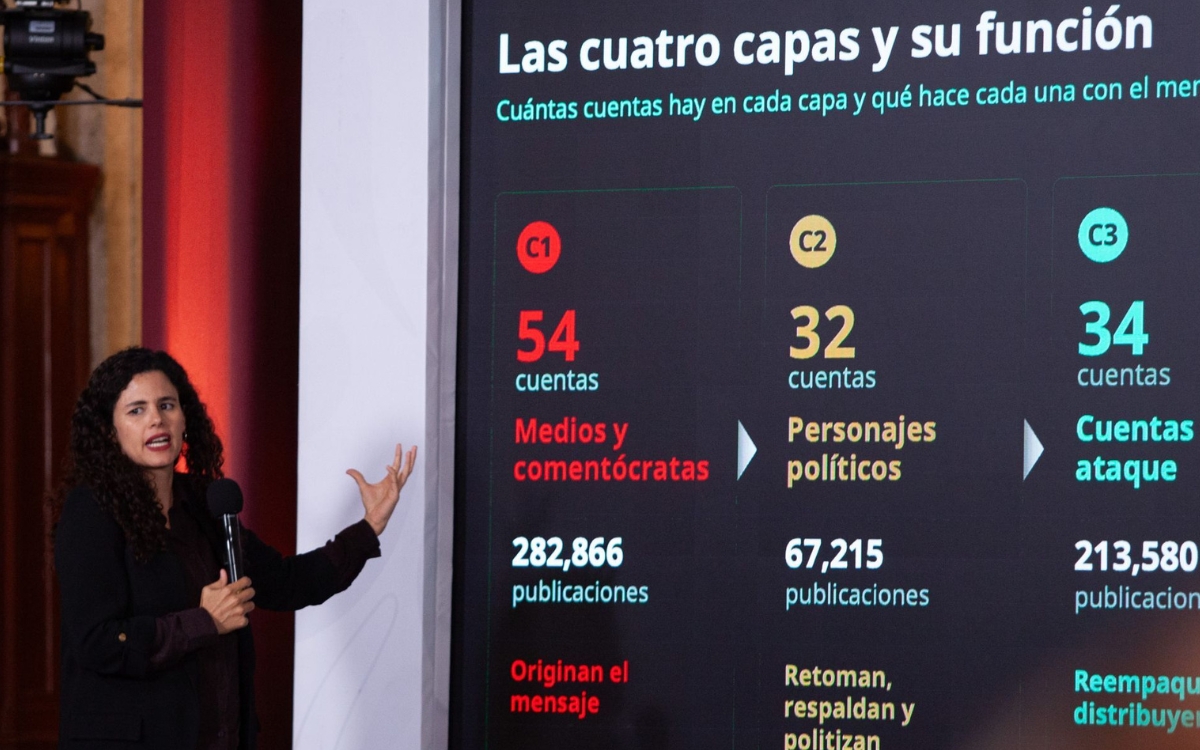
Mexico’s presidential legal counsel, Luisa María Alcalde Luján, published a list of 86 journalists, commentators and politicians this week, saying they form part of a coordinated network that amplifies criticism of the federal government. The disclosure triggered immediate backlash from many of the people named.
Alcalde presented the list Wednesday during “Derecho de Réplica,” a weekly government briefing held at the National Palace where officials respond to news coverage they consider unfair. She described it as an analysis of a “digital amplification ecosystem,” not a blacklist.
Four Layers of a Network
According to Alcalde, the network breaks down into four layers. The first, made up of 54 accounts belonging to media outlets and commentators, “originates” critical messages, she said. Among those named were Carlos Loret de Mola, Denise Dresser, Ciro Gómez Leyva, Jorge Ramos and Leticia Robles de la Rosa, along with outlets including El Universal, Latinus and Aristegui Noticias.
A second layer of 32 accounts belongs to politicians who pick up and spread the message further, Alcalde said. That group included former President Felipe Calderón, 2024 presidential candidate Xóchitl Gálvez, and National Action Party figures such as Jorge Romero and Santiago Taboada.
A third layer of 34 anonymous accounts, which Alcalde called trolls, repackages the content and distributes it. A fourth layer, an “amplification ring” of more than 500,000 bot accounts around the world, pushes the messages until they resemble organic conversations involving millions of posts, she said. The analysis covered seven months, from Jan. 1 to Aug. 8.
Comparisons to Blacklists
The reaction was swift. Journalist Carmen Aristegui compared the list to those compiled by the Gestapo, the Soviet government under Josef Stalin and the Khmer Rouge in Cambodia, and asked whether President Claudia Sheinbaum’s government was drawing up its own list of enemies.
Lorenzo Córdova, a former president of Mexico’s National Electoral Institute, wrote online that he’s been showing up on similar lists for years. Pascal Beltrán del Río, director of Excélsior, said the presentation stigmatized journalists without proving any coordinated campaign exists. Calderón resurfaced a past interview in which Sheinbaum herself said compiling lists is “a fascist thing to do.”
Alcalde Pushes Back
Facing criticism online, Alcalde posted a video Thursday denying she had released a blacklist of government enemies. Appearing in the network doesn’t mean a person or outlet is part of any operation, she said; what matters is what happens afterward, when anonymous accounts pick up the content and connect it to a coordinated narrative.
She also defended making the findings public. “There’s people financing this, and people deserve to know,” Alcalde said, without identifying who she believes is funding the bot network. Latinus host Claudio Ochoa, who was named on the list, told her directly to own her role in presenting it.
The dispute lands amid a broader fight over press freedom in Mexico. Sheinbaum’s government has floated new media rules requiring outlets to label opinion separately from news, a plan critics call vague and open to abuse. A similar proposal, to criminalize unauthorized memes of public officials, drew similar warnings from digital rights groups. Mexico currently ranks 149th out of 180 countries on Reporters Without Borders’ press freedom index.
At a Glance
- Who: Luisa María Alcalde Luján, presidential legal counsel
- What: List of 86 journalists, commentators and politicians tied to an alleged “digital amplification ecosystem”
- When: Presented Aug. 12 during the weekly “Derecho de Réplica” briefing
- Where: National Palace, Mexico City
- Data window analyzed: Jan. 1 to Aug. 8, 2026
- Alleged bot network: More than 500,000 accounts worldwide
Source: Proceso, El Universal