Category: News

  • Alcalde’s List of 86 Critics Draws Comparisons to ‘Enemies’ Lists

    Alcalde’s List of 86 Critics Draws Comparisons to ‘Enemies’ Lists

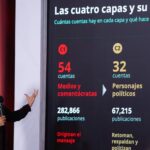
    Mexico’s presidential legal counsel, Luisa María Alcalde Luján, published a list of 86 journalists, commentators and politicians this week, saying they form part of a coordinated network that amplifies criticism of the federal government. The disclosure triggered immediate backlash from many of the people named.

    Alcalde presented the list Wednesday during “Derecho de Réplica,” a weekly government briefing held at the National Palace where officials respond to news coverage they consider unfair. She described it as an analysis of a “digital amplification ecosystem,” not a blacklist.

    Four Layers of a Network

    According to Alcalde, the network breaks down into four layers. The first, made up of 54 accounts belonging to media outlets and commentators, “originates” critical messages, she said. Among those named were Carlos Loret de Mola, Denise Dresser, Ciro Gómez Leyva, Jorge Ramos and Leticia Robles de la Rosa, along with outlets including El Universal, Latinus and Aristegui Noticias.

    A second layer of 32 accounts belongs to politicians who pick up and spread the message further, Alcalde said. That group included former President Felipe Calderón, 2024 presidential candidate Xóchitl Gálvez, and National Action Party figures such as Jorge Romero and Santiago Taboada.

    A third layer of 34 anonymous accounts, which Alcalde called trolls, repackages the content and distributes it. A fourth layer, an “amplification ring” of more than 500,000 bot accounts around the world, pushes the messages until they resemble organic conversations involving millions of posts, she said. The analysis covered seven months, from Jan. 1 to Aug. 8.

    Comparisons to Blacklists

    The reaction was swift. Journalist Carmen Aristegui compared the list to those compiled by the Gestapo, the Soviet government under Josef Stalin and the Khmer Rouge in Cambodia, and asked whether President Claudia Sheinbaum’s government was drawing up its own list of enemies.

    Lorenzo Córdova, a former president of Mexico’s National Electoral Institute, wrote online that he’s been showing up on similar lists for years. Pascal Beltrán del Río, director of Excélsior, said the presentation stigmatized journalists without proving any coordinated campaign exists. Calderón resurfaced a past interview in which Sheinbaum herself said compiling lists is “a fascist thing to do.”

    Alcalde Pushes Back

    Facing criticism online, Alcalde posted a video Thursday denying she had released a blacklist of government enemies. Appearing in the network doesn’t mean a person or outlet is part of any operation, she said; what matters is what happens afterward, when anonymous accounts pick up the content and connect it to a coordinated narrative.

    She also defended making the findings public. “There’s people financing this, and people deserve to know,” Alcalde said, without identifying who she believes is funding the bot network. Latinus host Claudio Ochoa, who was named on the list, told her directly to own her role in presenting it.

    The dispute lands amid a broader fight over press freedom in Mexico. Sheinbaum’s government has floated new media rules requiring outlets to label opinion separately from news, a plan critics call vague and open to abuse. A similar proposal, to criminalize unauthorized memes of public officials, drew similar warnings from digital rights groups. Mexico currently ranks 149th out of 180 countries on Reporters Without Borders’ press freedom index.

    At a Glance

    • Who: Luisa María Alcalde Luján, presidential legal counsel
    • What: List of 86 journalists, commentators and politicians tied to an alleged “digital amplification ecosystem”
    • When: Presented Aug. 12 during the weekly “Derecho de Réplica” briefing
    • Where: National Palace, Mexico City
    • Data window analyzed: Jan. 1 to Aug. 8, 2026
    • Alleged bot network: More than 500,000 accounts worldwide

    Source: Proceso, El Universal

  • Pope Leo XIV Won’t Visit Mexico Despite Sheinbaum’s Push

    Pope Leo XIV Won’t Visit Mexico Despite Sheinbaum’s Push

    Pope Leo XIV
    Pope Leo XIV has no plans to visit Mexico during his Latin American tour.

    President Claudia Sheinbaum said Wednesday she will keep pressing the Vatican for a papal visit to Mexico, even as Pope Leo XIV confirmed a November tour of South America that leaves the country off the itinerary.

    “We’re going to insist on the pope’s visit to Mexico,” Sheinbaum told reporters during her morning press conference at the National Palace, hours before receiving Vatican Secretary of State Cardinal Pietro Parolin. Mexico’s government sent a formal invitation in May 2025, at the start of Sheinbaum’s administration, and she said she raised it again personally during a phone call with the pope on Dec. 12.

    Skipping Mexico

    The Holy See announced Wednesday that Leo XIV will travel to Uruguay, Argentina and Peru from Nov. 6 to 17, his first papal trip to Latin America and the sixth international journey of his pontificate. The pope will visit Montevideo, Paysandú and Florida in Uruguay, then Buenos Aires, Córdoba and the Marian shrine of Luján in Argentina, before ending in Peru with stops in Lima, Chiclayo, Cusco and Pucallpa.

    Peru holds particular significance for Leo XIV, who spent decades there as a missionary and later served as bishop of Chiclayo before becoming pope in 2025. He also holds Peruvian citizenship. The visit will additionally mark the first papal trip to Argentina and Uruguay in nearly 40 years, and the first time a pope has set foot in Argentina since Pope Francis, who was born in Buenos Aires but never returned home during his 12-year papacy.

    Mexico last hosted a pope in 2016, when Francis toured several cities, including a stop in Chiapas. The invited the pope to Yucatán back in 2021, when Cardinal Parolin made an earlier visit to the region, though that trip never materialized either.

    Why Mexico Isn’t on This Itinerary

    The Vatican has given no official explanation for leaving Mexico off the schedule, and nothing in the announcement suggests the country was deliberately passed over. A few factors help explain the choice of destinations instead.

    Peru, Argentina and Uruguay each carry a personal or symbolic pull that this particular trip was built around. Leo XIV’s decades-long history in Peru made a return there something close to inevitable. Argentina’s inclusion closes a gap left by Pope Francis, who never managed a homecoming trip during his own papacy. And Uruguay, where Catholics make up a smaller share of the population than anywhere else in the region, hasn’t had a papal visit in decades.

    Mexico, by contrast, appears to be a matter of timing rather than exclusion. In November 2025, Leo XIV told reporters that the Marian shrine of Guadalupe was among his top destinations, alongside Peru, Argentina and Uruguay. Asked when a Latin America swing might happen, he said travel planning would ramp up gradually the following year, citing a full calendar of Vatican commitments. That suggests Mexico could still get its turn on a future trip rather than having been ruled out.

    The Pope’s Stance on AI

    Sheinbaum argued that a visit from Leo XIV would carry weight beyond religious circles, pointing to the pontiff’s writings on artificial intelligence as a reason his voice matters in Mexico’s own policy debates. She cited the encyclical “Magnifica Humanitas,” published in May, in which the pope addresses protecting individuals as AI technology expands.

    According to Sheinbaum, the document has become an international reference point for questions about who controls digital platforms, how algorithms function and who benefits from their use.

    “It’s a very important debate globally, and one that we’re having in Mexico too,” she said, adding that Leo XIV has called for public regulation of artificial intelligence and closer scrutiny of its effects — a discussion she linked to Mexico’s own conversations about social media and content moderation.

    Church and State

    Despite her praise for the pope’s positions, Sheinbaum reiterated that Mexico will maintain the separation of church and state, saying it’s still worthwhile to weigh in on the pope’s views on AI and other humanitarian issues. She noted that any papal visit would carry deep meaning for millions of Catholic Mexicans, even as she framed the invitation as being about more than religion.

    No new date has been set for a Mexico stop, and the Vatican has not indicated one is under discussion for the current tour.

    Fast Facts

    • Mexico’s invitation to Pope Leo XIV dates to May 2025.
    • Sheinbaum discussed the invitation with the pope by phone on Dec. 12.
    • The pope’s South America tour runs Nov. 6-17, 2026.
    • Stops include Uruguay, Argentina and Peru, but not Mexico.
    • Leo XIV has named Mexico’s Guadalupe shrine among his desired destinations.
    • Pope Francis last visited Mexico in 2016.

    With reporting from Diario de Yucatán and the Vatican confirms itinerary announcement.

  • Mexico’s Power Outages Expose a Grid Held Together by Patchwork Repairs

    Mexico’s Power Outages Expose a Grid Held Together by Patchwork Repairs

    power
    The CFE argues it is working hard to improve Mexico’s power grid. But they may not be up to the task.

    Across Mexico, homes and businesses have been plunged into darkness with alarming frequency in recent weeks. 

    A wave of blackouts, power outtages and voltage fluctuations has affected at least 20 states, leaving residents without power for hours during some of the hottest months of the year. The outages have disrupted daily life, damaged appliances, spoiled food, and forced businesses to halt operations, resulting in millions of pesos in losses. 

    While the Federal Electricity Commission (CFE) has insisted there is no national crisis, the evidence on the ground tells a different story: Mexico’s electrical system is struggling to keep up, and the root of the problem lies not in a lack of power plants but in a transmission and distribution network that has been neglected for decades.

    Widespread Power Outages Across Multiple Regions

    The blackouts have been felt in nearly every corner of the country. One of the regions hardest hit includes the states of Morelos, Hidalgo, Puebla, Veracruz, Querétaro, and San Luis Potosí. The northern states of Tamaulipas, Nuevo León, and Coahuila have also experienced significant disruptions. 

    In Monterrey, authorities have attributed the outages to the advanced age of transformers. In Matamoros, residents have taken to the streets to protest the widespread blackouts, and the mayor has publicly demanded that CFE provide a solution. Other affected cities include Reynosa and Nuevo Laredo.

    The situation is equally dire in the southeast. In Tabasco, where temperatures regularly exceed 35 degrees Celsius, users have staged demonstrations over power suspensions. An incident at the Dos Bocas Refinery, which experienced a fire caused by a power outage, underscored the cascading effects of these failures. 

    The Yucatán Peninsula, including Quintana Roo, Campeche, and Yucatán itself, has also seen widespread failures. The director of Yucatán’s Energy Agency has pointed to disorderly urban growth and excessive demand as key pressures on the network. In Baja California Sur, residents of La Paz and Los Cabos have faced daily interruptions, with experts linking the outages directly to a deficient distribution network that has not received sufficient maintenance.

    Power a Problem of Distribution, Not Just Generation

    CFE has publicly rejected the idea that Mexico is facing a generalized electrical crisis. In a statement, the company argued that the interruptions are localized, with causes, scopes, and durations that vary by region. According to CFE, the primary triggers include extreme weather events such as storms, lightning, high winds, and high temperatures; contact with animals or vegetation; damage caused by third parties; and equipment in need of maintenance or replacement.

    But this official explanation does not fully account for the persistence of the problem. Experts and analysts have pointed to a more fundamental issue: while CFE has focused on expanding generation capacity, it has neglected the infrastructure that actually delivers electricity to consumers. 

    The Center for Renewable Energies and Environmental Quality, known as CERCA, has been particularly vocal on this point. According to the organization, the blackouts are not occurring because demand exceeds production, as was the case in previous years. Instead, the problem is that the distribution network, which includes substations and transformers, has not received adequate maintenance to operate efficiently. “Despite the investment in generation, we have the same problem: a lack of infrastructure throughout the electrical network,” the organization stated.

    Aging Infrastructure and Decades of Neglect

    The condition of Mexico’s electrical grid is the result of years of underinvestment. In 2025, CFE’s physical investment fell by 24% in real terms compared to the previous year. The decline in investment in power plants during the previous administration has also been cited as a factor contributing to current failures. 

    But the more pressing issue is the age of the distribution equipment. Much of the network relies on transformers and other components that are decades old and have been subjected to repeated repairs rather than full replacement. In some cases, the state of the infrastructure has become so degraded that maintenance crews have resorted to makeshift solutions, with modules held together by little more than tape to keep the system operational.

    This patchwork approach has left the grid vulnerable to even minor disruptions. When a transformer fails, it can knock out power to an entire neighborhood or city block, and because the equipment is often obsolete, replacements are not readily available. The result is a cycle of breakdowns and temporary fixes that do nothing to address the system’s underlying deterioration.

    Economic and Social Consequences

    The impact of power outages extends far beyond inconvenience. For households, the loss of power means spoiled food, damaged electronics, and an inability to cope with extreme heat. For small businesses, the interruptions can be catastrophic. Restaurants lose inventory, shops cannot process payments, and manufacturers are forced to halt production lines. In a country where many workers are paid by the day, a power outage can mean a lost day of wages.

    The problem has also begun to affect larger economic ambitions. Analysts have warned that the energy crisis is slowing investment in nearshoring and the expansion of data centers, both of which require reliable and abundant electricity. Without a stable grid, Mexico risks losing out on opportunities that could drive growth and employment.

    A Long Road to Resolution

    CFE has announced plans to modernize the grid, proposing to build 6,000 kilometers of new transmission lines over five years, representing more than 50% of the current infrastructure. The government has also pledged to spend more than $8 billion to upgrade the network. But these projects will take years to complete, and in the meantime, the existing grid continues to deteriorate.

    The situation is further complicated by the fact that the problems are not uniform across the country. Each region faces its own combination of challenges, from extreme weather to outdated equipment to rapid urban growth. This means that a one-size-fits-all solution is unlikely to work, and addressing the crisis will require sustained investment and coordination at both the federal and local levels.

    For now, Mexicans in affected areas are left to endure the uncertainty of an electrical system that has become increasingly unreliable. The blackouts of 2026 are not a temporary phenomenon. They are the predictable result of years of neglect, a grid held together by patchwork repairs, and a system that has prioritized generation over distribution. Until that imbalance is corrected, the lights will keep going out.

  • Mexico Weighs Bid to Host 2029 FIFA Club World Cup

    Mexico Weighs Bid to Host 2029 FIFA Club World Cup

    Mexico could be in line for another shot at global soccer glory, just three years after wrapping up the 2026 World Cup.

    Claudia Sheinbaum
    Claudia Sheinbaum. File photo

    President Claudia Sheinbaum confirmed this month that her government is looking at a bid to host the 2029 FIFA Club World Cup. She said any decision would depend on whether the deal makes sense for the country financially.

    The push is coming from the Mexican Football Federation, led by Mikel Arriola, which wants Mexico to serve as the sole host this time around. That would be a change from 2026, when Mexico shared World Cup hosting duties with the United States and Canada.

    Sheinbaum has asked the Tourism Department to put together a report on how the 2026 tournament affected tourism, the economy and Mexico’s international image. That analysis is expected to guide her administration’s final call.

    A Familiar Stadium in the Spotlight

    If Mexico lands the bid, Estadio Azteca in Mexico City is the favorite to host the opening match and the final. The stadium, which holds more than 80,000 fans, was a centerpiece of the 2026 World Cup and hosted five matches during that tournament.

    Other venues under consideration include stadiums in Monterrey and Guadalajara, both of which also hosted 2026 World Cup games. Mexico’s federation is pitching the plan as a way to reuse infrastructure — stadiums, transit upgrades and hotel capacity — built for last summer’s tournament rather than start from scratch.

    The Club World Cup itself has changed shape recently. FIFA moved the competition to a four-year cycle and expanded it to 32 clubs, with some reports suggesting the field could eventually grow further.

    Stiff Competition for Hosting Rights

    Mexico won’t have a clear path to hosting. Brazil, Qatar and the United States have all shown interest, and Spain and Morocco are working on a joint bid, according to a Yahoo Sports report on the process.

    Sheinbaum has been cautious about committing federal support. “We need to see the conditions — it always has to be favorable for Mexico,” she told reporters at her morning press conference, according to Milenio.

    FIFA has not set a timeline for choosing a host, and no formal Mexican bid has been submitted yet.

    What It Could Mean for Yucatán

    The Yucatán Peninsula didn’t host any 2026 World Cup matches, but the region still felt the tournament’s ripple effects. Mérida leaned on its flight connections to pitch itself as a base for fans traveling between host cities, an between-matches strategy that drew mixed results — hotel occupancy across the state came in below expectations once the tournament actually kicked off.

    A 2029 Club World Cup, even without matches in the Yucatán Peninsula, would likely bring another wave of visitors passing through the region on their way to and from host cities.


    At a Glance

    • Mexico is weighing a solo bid to host the 2029 FIFA Club World Cup
    • The Mexican Football Federation, led by Mikel Arriola, is driving the proposal
    • Estadio Azteca is the favorite to host the opening match and final
    • Brazil, Qatar, the U.S. and a Spain-Morocco bid are also in the running
    • Sheinbaum has requested an economic impact report before backing the bid
    • FIFA has not set a date for choosing the 2029 host

    Reporting based on statements from President Claudia Sheinbaum and coverage from Yahoo Sports and Milenio.

  • Mexican Army Exonerated in 12-Year-Old Ayotzinapa Mass Disappearance Case 

    Mexican Army Exonerated in 12-Year-Old Ayotzinapa Mass Disappearance Case 

    ayotzinapa
    Monuments demanding the return of the 43 of Ayotzinapa have been installed across Mexico’s cities and towns.

    Mexico’s Human Rights Commission released a new recommendation on the Ayotzinapa case, which has fundamentally altered the trajectory of one of Mexico’s most enduring human rights crises.

    Nearly 22 years after the disappearance of 43 students from the Raúl Isidro Burgos rural teachers’ college, today’s CNDH report has absolved the Mexican armed forces of direct responsibility, directly contradicting the findings of international experts and sparking outrage among the victims’ families and human rights organizations.

    Ayotzinapa and The Night of Sept. 26, 2014

    The events of Sept. 26 and 27, 2014, in Iguala, Guerrero, have become a symbol of state violence and impunity in Mexico. 

    On that night, students from the Ayotzinapa rural teachers’ college commandeered buses to travel to Mexico City for an annual protest commemorating the 1968 student massacre. 

    Local police, allegedly in collusion with the Guerreros Unidos drug cartel, opened fire on the students. Six people were killed, including three students, and 43 young men were taken into custody by police officers and never seen again.

    The official investigation into the events of Ayotzinapa, led by the then Attorney General’s Office, produced what became known as the “historical truth.” This version claimed that the students had been murdered and their bodies incinerated at a garbage dump in Cocula. 

    This narrative surrounding Ayotzinapa was widely discredited by international experts and human rights organizations. The Interdisciplinary Group of Independent Experts (GIEI), established by the Inter-American Commission on Human Rights to assist in the investigation, repeatedly challenged the official account and documented grave irregularities in the government’s handling of the case.

    ayotzinapa
    Human rights groups have denounced the growing militarization of Mexico, arguing that their unchecked power leads to abuses.

    The 2026 CNDH Recommendation

    The CNDH’s new recommendation regarding the Ayotrzinapa case represents a significant departure from previous findings. The document, which runs for more than 800 pages, acknowledges grave human rights violations against 92 students, an increase from the 83 documented in the commission’s 2018 recommendation. 

    It identifies 40 cases of forced disappearance, six extrajudicial executions, and numerous instances of torture, arbitrary detention, and cruel treatment. 

    However, the most contentious aspect of the new recommendation is its treatment of the Mexican armed forces. Unlike the 2018 recommendation, the 2026 document explicitly excludes the Secretariat of National Defense (Sedena) and the Secretariat of the Navy (Semar) from responsibility. 

    The CNDH concluded that while military personnel were present on the streets of Iguala on the nights of September 26 and 27, “there was no participation of Defense elements in any of the violent events against the students, much less the existence of a ‘counterinsurgency’ plan or a general strategy against the normalistas.”

    At most, the commission acknowledged acts of omission by individual soldiers, with 20 military personnel currently facing criminal proceedings for organized crime and forced disappearance.

    Rejection of the Ayotzinapa Findings

    The CNDH’s recommendation has been met with widespread condemnation. 

    The families of the 43 disappeared students have long insisted that the military was involved in the disappearances and have demanded access to military archives. 

    For them, the commission’s exoneration of the armed forces represents a profound betrayal. The commission’s rejection of the GIEI’s findings, which the families had come to trust as an independent and credible source of investigation, has been particularly devastating.

    Human rights organizations have also expressed alarm. The recommendation effectively dismantles the narrative that the Mexican state, through its security forces, was complicit in the disappearances. 

    Critics argue that the commission has not only failed to advance the cause of justice but has actively undermined it by validating the military’s version of events. The fact that the CNDH, a state institution, has chosen to absolve the armed forces while criticizing international experts has raised serious questions about the commission’s investigation’s independence and integrity.