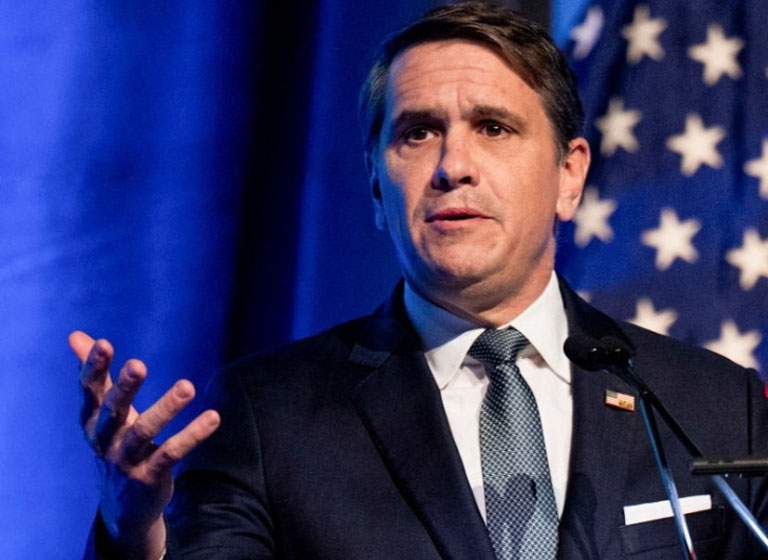
Todd Blanche, acting Attorney General of the U.S., announced that the indictment of Sinaloa’s governor is just the beginning, as tensions over sovereignty escalate between the Trump administration and Mexico’s President Sheinbaum.
[PHOENIX] — Acting United States Attorney General Todd Blanche has issued a stark warning to Mexican politicians, stating that the recent indictment of Sinaloa Governor Rubén Rocha Moya is merely “the beginning” of a broader legal campaign. The announcement comes as President Donald Trump intensifies his rhetoric, threatening unilateral military ground operations inside Mexico to combat drug cartels.
In an interview with News Nation on the sidelines of the Border Security Expo in Phoenix on Wednesday, Blanche confirmed that additional charges are imminent. When asked if the Department of Justice would pursue more cases beyond visa revocations, Blanche responded unequivocally, “Sure, yes”.
“Last week, we announced that an indictment was filed against a governor of Mexico by the Southern District of New York,” Blanche told reporter Ali Bradley. “I think that’s something we’ve done in the past, and we will certainly continue to do it”.
The Rocha Moya Indictment
The escalating legal pressure began on April 30, when a federal grand jury in the Southern District of New York indicted Rubén Rocha Moya, the governor of Sinaloa, along with nine other current and former Mexican officials. The charges include drug trafficking and weapons offenses, effectively accusing the state’s highest-ranking official of collaboration with the Sinaloa Cartel, which the U.S. designated as a Foreign Terrorist Organization (FTO) in 2025.
Rocha Moya, who has since taken a leave of absence from his post, is the first sitting Mexican governor to be charged under the new FTO framework.
Blanche attributed the influx of intelligence that is driving these cases to the extradition of high-profile cartel leaders. “One of the consequences of many of the leaders of some of these cartels having been brought here over the last year… is that some of them are probably going to want to cooperate,” Blanche explained. He added that such cooperation “may lead to additional charges” against political figures previously thought to be untouchable.
Potential Military Action
The Justice Department’s legal offensive is unfolding alongside a dramatic military posture shift from the White House. On the same day as Blanche’s interview, President Trump explicitly warned that the United States would conduct ground operations in Mexican territory if the government in Mexico City fails to dismantle the cartels itself.
“If they aren’t going to do the job, we will do it, and they understand that,” Trump said during a public event at the White House, dismissing anticipated complaints from Mexican officials as irrelevant.
The White House reinforced this stance with the release of the 2026 Counterterrorism Strategy, which declares the administration’s readiness to take “unilateral action” against cartels operating in countries deemed “complicit” in narcoterrorism. This strategy has already manifested in U.S. military actions at sea, with reports indicating that operations against smugglers have resulted in over a hundred casualties in maritime zones over the past year.
Mexico’s Response
Facing the dual threat of criminal indictments against her political class and military intervention against her nation, Mexican President Claudia Sheinbaum has adopted a firm stance of defiance rooted in constitutional law.
“It is not negotiable,” Sheinbaum said during a press conference following the latest threats, referring to Mexico’s sovereignty and territorial integrity. She has consistently rejected U.S. military intervention, dating back to a January phone call with Trump where she told him such assistance was “not necessary”.
“We seek coordination without subordination, as equals,” Sheinbaum stated earlier this year, a phrase she has repeated as a cornerstone of her administration’s foreign policy.
Rather than accepting U.S. military help, Sheinbaum has turned the argument back on Washington. She recently suggested that Trump should focus on combating the American demand for drugs and the illegal trafficking of firearms from the U.S. into Mexico. Citing Department of Justice statistics, she noted that 75% of the guns used by cartels originate in the United States.
“If the flow of illegal weapons from the United States into Mexico were stopped, these groups wouldn’t have access to this type of high-powered weaponry,” Sheinbaum argued.