What was once a small-scale tradition is now a global phenomenon. International demand has pushed Mexican mezcal production from approximately 1 million liters in 2010 to over 11 million liters in 2024, according to the Mexican Regulatory Council for Mezcal Quality (Comercam). Nearly 75 percent of exports head to the United States, and less than 30 percent of total production remains in Mexico.
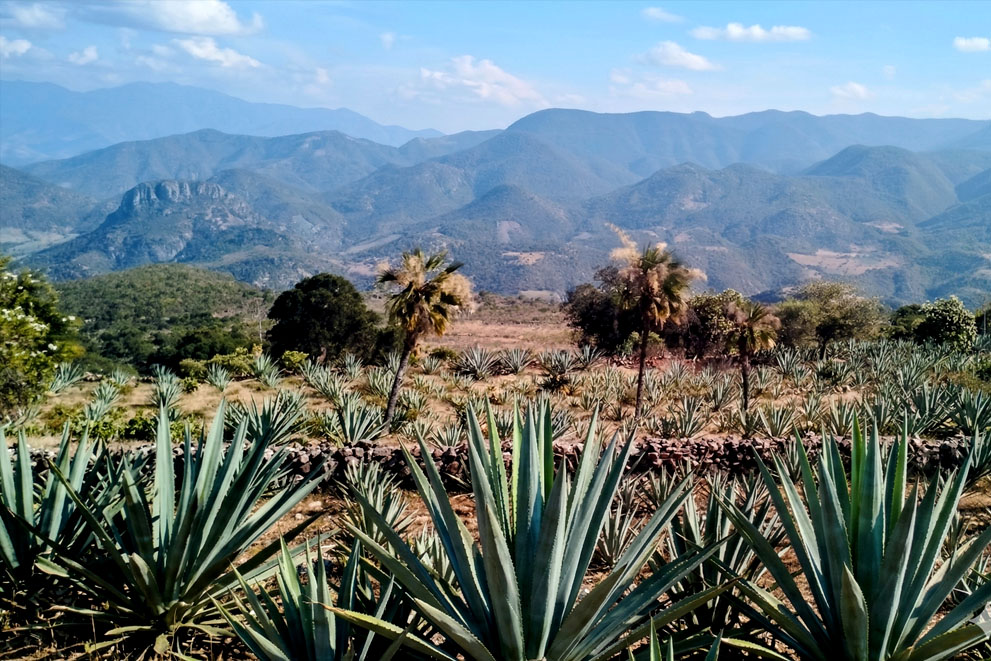
Along roads leading to communities like San Luis del Río—where celebrity-backed brands such as Dos Hombres, co-founded by Breaking Bad actors Bryan Cranston and Aaron Paul, are produced—vast agave plantations now cover hillsides that were forest just years ago.
Forests Cleared, Water Stressed
Research led by Rufino Sandoval-García, a forestry engineer and professor at the Technological University of the Central Valleys of Oaxaca, documents the scale of change. In two major mezcal-producing areas, more than 86 acres of tropical dry and pine-oak forests have disappeared over two decades to make room for agave cultivation—an area roughly the size of Monterrey. Agave plantations expanded by over 400 percent in three decades, with most new plantings devoted to espadín, a variety used in commercial mezcal.
The consequences extend beyond tree loss. Deforestation is accelerating soil erosion, reducing carbon capture by an estimated 4 million tons annually in the studied region, limiting groundwater recharge, and creating heat islands in heavily planted areas.
Mezcal production has always demanded significant resources. Producing one liter requires at least 10 liters of water for fermentation and distillation, according to industry estimates. The process also generates waste: bagasse (the pulpy residue) and vinazas (acidic wastewater) often end up untreated in rivers.
A 2025 report from Oaxaca’s Network of Interpreters and Cultural Promoters warned that the industry is extracting more than 50 million liters of water annually without adequate regulation, while over 70 million tons of vinazas are discharged into rivers. The organization identified transnational companies—including Britain’s Diageo, France’s Pernod Ricard, and Mexico’s Becle (formerly José Cuervo)—as linked to brands contributing to environmental damage.
The Shift From Milpa to Monoculture
Félix Monterrosa, a third-generation producer from Santiago Matatlán who owns the Oaxacan brand CUISH, describes how industrial mezcal displaced the traditional milpa system he learned from his ancestors—a method where corn, beans, and squash were cultivated alongside agave.
“Now everything is monoculture, and that is the real problem,” Monterrosa said.
The shift has left visible scars. In his town, decades of dumping mezcal waste into the river left the water so contaminated that residents nicknamed it “Nilo”—short for “ni lo huelas,” or “don’t even smell it”. Monterrosa now plants wild agaves alongside corn and trees to restore biodiversity, though he acknowledges that scaling this approach remains difficult.
Scientific research supports concerns about biodiversity loss. A genomic study published in October 2025 found that espadín—the dominant agave used in commercial mezcal—represents a clonal lineage selected by farmers for desirable production traits, resulting in considerable genetic differentiation from wild agave populations. This genetic uniformity increases vulnerability to pests and disease while reducing resilience to climate change.
Economic Lifeline or Environmental Toll?
For many in Oaxaca—where poverty rates remain among Mexico’s highest—the mezcal boom has brought unprecedented economic opportunity.
Luis Cruz Velasco, a producer from San Luis del Río who works with Mexican brands like Bruxo, said the industry’s growth has created jobs for nearly every family in his town of about 300 residents. “Before, people in this town lived in houses with thatched roofs. Then we were able to build with sheet metal, and now they are made of cement,” said Luis Cruz Ruiz, 62, reflecting on the changes. “We survived because of the maguey”.
Velasco acknowledges the environmental trade-offs. “There are many people who criticize us and ask what we do to reforest,” he said. “But we have to look for a livelihood and food”.
He points to a lack of public incentives as a core problem. “We know it has an impact,” Velasco said, adding that large brands have done more than the government to support marginalized areas, but farmers need support to adopt sustainable practices like planting native trees or maintaining traditional systems.
Efforts Toward Sustainability
In 2018, Garnica founded a women’s collective called Guardians of Mezcal. The group promotes mezcal production using sustainable practices: using only fallen trees for firewood, planting agave alongside other crops, and avoiding monoculture.
With support from Tierra de Agaves and local community officials from Santa María Zoquitlán, the collective secured protected status for 26,000 hectares of forest surrounding the municipality.
“If there is a funeral, a wedding, a party, mezcal is a drink you are going to share with others, and above all, many families depend on it,” Garnica said. “Mezcal is a way of life, like a form of work that our parents taught us, so it really means a lot”.
As the thirst for Mezcal arround the world continues to grow, so does pressure on ecosystems.