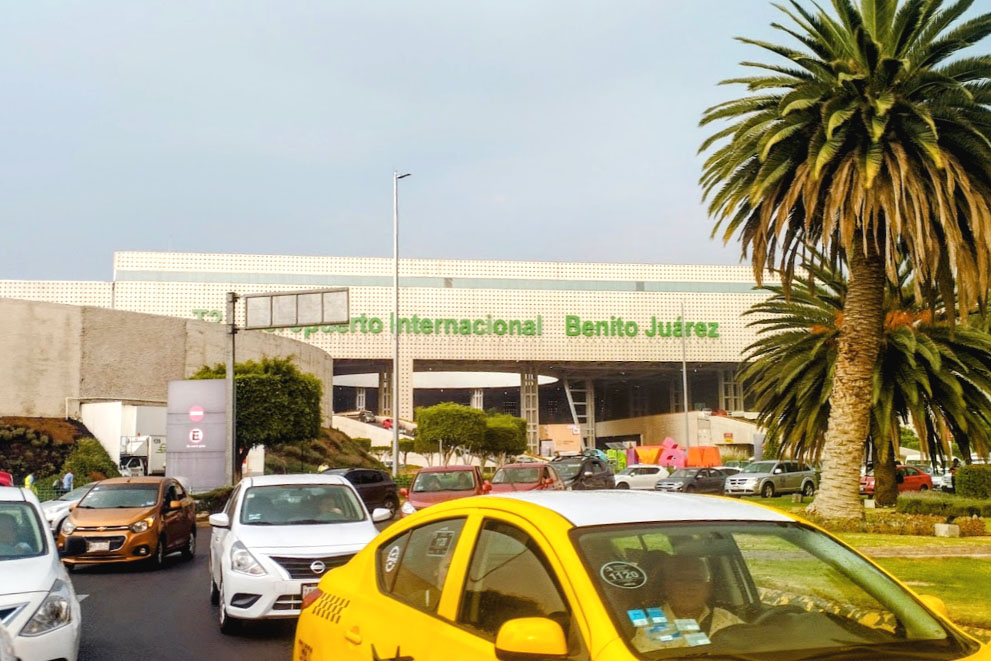
Hundreds of taxi drivers blocked access to Mexico City’s Benito Juárez International Airport this week, paralyzing circulation at both terminals in a dramatic protest against ride-hailing platforms they say are illegally stealing their livelihoods.
The March 11 protest, organized by the airport’s 11 authorized taxi unions, left passengers stranded on access roads, many of whom were forced to haul luggage long distances to catch flights. Police in riot gear eventually negotiated the reopening of some lanes while shuttle trucks transported stranded travelers.
At the heart of the conflict is a legal gray area that has festered for nearly a decade: federal law explicitly prohibits services like Uber, Didi, and inDrive from operating within airport grounds, yet they continue picking up passengers daily with little consequence.
A Web of Contradictory Rules
The legal framework seems clear on paper. According to the Ley de Aeropuertos and Ley de Caminos, Puentes y Autotransporte Federal, all ground transportation within airports falls under federal jurisdiction. To operate legally, vehicles need permits from the Secretaría de Infraestructura, Comunicaciones y Transportes, as well as authorization from the airport administration.
Authorized taxi operators must meet strict requirements: vehicles must be no more than five years old, meet specific technical specifications, have passenger insurance, be emissions-certified, and pay significant access fees to the airport. Some unions report paying up to six million pesos per month for the right to operate within the federal zone.
“We are simply demanding that the law be followed,” said Ignacio Rodríguez, secretary of the Movimiento Nacional Transportista.
But the situation grew murkier in October 2025 when a federal judge granted Uber a definitive suspension in an amparo case. The ruling, from the Juzgado Décimo Tercero en Materia Administrativa, ordered the Guardia Nacional to halt sanctions against Uber drivers at airports, requiring that any operations be conducted in accordance with existing transportation law.
Uber celebrated the decision, stating it protects its drivers and calling on Congress to modernize the legislation ahead of the 2026 World Cup.
The SICT quickly clarified that the ruling does not grant authorization to operate, arguing that the ruling is invalid and would be ignored.
Historical Tensions Boil Over
The conflict is hardly new. In May 2015, hundreds of Mexico City taxi drivers blocked major thoroughfares protesting Uber’s arrival.
A year later, tensions turned physical when cab drivers surrounded suspected Uber vehicles near the Monumento a la Independencia, rocking cars and pushing against them in snarled traffic.
Now, authorized taxi operators claim the economic damage has become unsustainable. Before ride-hailing platforms, their organizations averaged 6,000 monthly trips. Today, that figure has fallen to 2,000.
Carlos Lovera, advisor for Sitio Nueva Imagen, told reporters they are not opposed to competition, but demand equal rules.
“We demand an even playing field, the way things are running currently is simply not sustainable,” Lovers said.
Taxi drivers have also been active on social media, arguing that ride-sharing platforms are unsafe. However, most comments on platforms like Facebook and TikTok point out that taxi drivers are infamous for not following the rules themselves and are, in fact, less safe than drivers on platforms like Uber or Didi.
Violence and Tensions
Wednesday’s protest saw moments of physical confrontation. At Terminal 2, pushing matches erupted between protesters and police attempting to clear lanes. A 39-year-old man was detained for breaking a tow truck’s medallion, although he was released after agreeing to pay damages. Five others were released hours later.
Three vehicles obstructing traffic were sent to impound lots. For passengers caught in the chaos, the political battle translates into missed flights and frustrating delays.
An Uncertain Resolution
Following four hours of dialogue with the federal government and airport authorities, protesters agreed to lift the blockades. The government committed to initiating operations by the national guard beginning March 12 to “disincentivize” ride-hailing services in the federal zone, with permanent monitoring expected by the end.
But taxi representatives remain skeptical. “We have been promised the same thing over and over, but it never actually happens,” said taxi driver Manuel Olivera.
As the 2026 World Cup approaches, with more than 5.5 million additional visitors expected, pressure mounts for a permanent solution. Uber has urged Congress to establish clear regulations enabling coexistence between traditional and digital models.