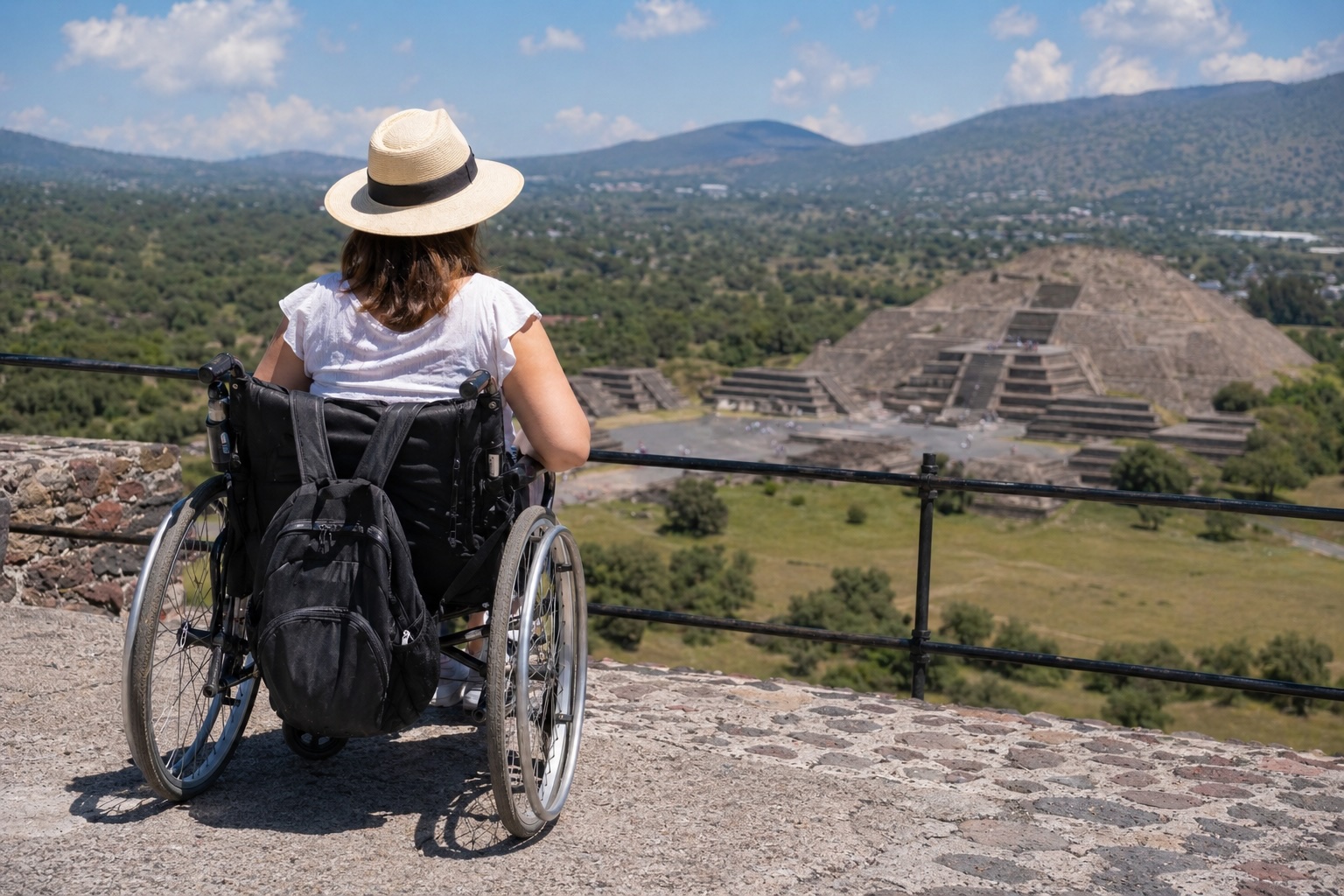
Mexico welcomes tens of millions of tourists a year. For the roughly 20.8 million Mexicans who live with some form of disability — about 16% of the population, according to the 2020 national census — the country has been considerably harder to navigate. That is starting to change, driven by a mix of private operators, municipal initiatives, and a push at the federal level that advocates say is long overdue.
The picture on the ground is uneven. Only 14 of Mexico’s 440 beaches have any accessibility features for travelers with disabilities, according to the Instituto Mexicano de Turismo y Accesibilidad (IMETAC), and only about 1 in 736 tourism businesses is equipped to serve travelers with disabilities. The gap between what exists and what’s needed is wide — but the momentum, at last, is building.
Legislative Push
In February 2026, lawmakers in the Chamber of Deputies introduced legislation that would create a public registry of accessible tourism providers under Mexico’s National Tourism Registry. The proposed rules — put forward by Morena legislator Magda Erika Salgado Ponce — would require certified providers to document their accessibility features by disability type, covering physical, visual, hearing, and cognitive conditions. The initiative also seeks to ensure that travelers with disabilities can access lodging, restaurants, transportation, and recreational areas under the same conditions as anyone else.
Mexico’s current Sectoral Tourism Program for 2025–2030 includes accessibility goals, and the country ratified the UN Convention on the Rights of Persons with Disabilities in 2007. But critics note that formal commitments have rarely translated into on-the-ground results.
Quintana Roo Leads on Beaches
The Caribbean coast has moved further than most regions. In Quintana Roo, Playa Delfines in Cancún has become a widely cited example of inclusive beach infrastructure, with adapted access, amphibious wheelchairs, and trained staff. Playa Fundadores in Playa del Carmen has added designated wheelchair spaces, signage, and shaded accessible zones. The beach towns of Mahahual and Cozumel have made similar investments.
A Cancún-based operator called Cancún Accesible has been working in the space for more than 15 years, offering wheelchair-accessible van transport from the airport, adapted tours to sites including Chichén Itzá and Tulum, and equipment rentals ranging from beach wheelchairs to oxygen systems. The company also runs a program called Tour Con Causa, through which local residents with disabilities can join a tourist’s excursion, at no cost to them, if the traveler consents.
Major resorts in the region, including Hotel Xcaret México and the Hyatt Ziva Cancún, have added adapted rooms, staff training, Braille menus, and digital assistance tools. The Museo Maya de Cancún has ramps, elevators, and some sign-language guided tours. Archaeological sites including Tulum and San Gervasio on Cozumel have introduced flatter pathways and adapted information modules, though terrain remains a practical challenge at many sites.
Mexico City and Beyond
In Mexico City, accessible tourism has progressed through a combination of museum upgrades, cultural routes with sign-language guides, and improvements on some Metro lines. The Museo Frida Kahlo in Coyoacán is wheelchair accessible, and Chapultepec Park, one of the largest urban green spaces in Latin America, has added ramps and paved paths. The Anthropology Museum — arguably the country’s most important — is accessible via Metrobús.
In San Luis Potosí, the municipal government released an accessible tourism guide in late 2025, the product of four years of work. Sites were evaluated using the international ISO 21902 standard for accessible tourism, with assessments conducted in collaboration with residents with disabilities and the local DIF (Mexico’s family welfare agency). City officials described it as a model they hope other Mexican municipalities will replicate.
In Ensenada, Baja California, the hotel industry association president announced in April 2026 the development of a Sensory Tourism Route — a circuit designed to integrate accessibility across the full travel chain, including nature experiences, gastronomy, and lodging. Andrés Martínez Bremer, president of Ensenada’s hotel association, noted that inaccessibility directly limits the competitiveness of tourist destinations and that the industry needs to move from symbolic gestures to verifiable, measurable standards.
Where Yucatán Fits
In Yucatán, the work is largely in the hands of individuals rather than institutions. Progreso became the first disability-inclusive beach in the state after installing adapted beach equipment and a boardwalk accessible to mobility device users. And in Mérida, Raúl Espejo Andrade has spent nine years building a small but specialized ecotourism operation called Aguas Sagradas Expeditions that takes travelers with a wide range of disabilities — including quadriplegia — into cenotes, caves, and jungle terrain south of the city.
Espejo, originally from Jonacatepec, Morelos, came to the work after noticing that the adaptive tourism options he was seeing internationally had no equivalent in Mexico. Working with his daughter Saknité, who is certified in technical rescue and diving, he designs each tour around the individual traveler’s needs, using professional-grade equipment and conducting a full assessment before every outing. Tours cover cenotes, archaeological zones, beaches, and nature reserves in the communities of Abalá, Telchaquillo, and Tecoh. Groups are private and family-based, allowing for the flexibility that one-size-fits-all tours can’t provide.
His answer to why such experiences are possible when most operators don’t offer them is the same one he gives to clients who assume the answer will be no: there are no limits.
At a Glance: Aguas Sagradas Expeditions
- Operator: Raúl Espejo Andrade and Saknité Espejo
- Address: Calle 57 #588-D x 78 y 76, Centro, Mérida
- Phone: (999) 290-6751
- Activities: Cenote tours, rappelling, snorkeling, cave exploration, jungle bike tours
- Specialties: Inclusive tours for travelers with motor and other disabilities; private and family tours
- Areas visited: Abalá, Telchaquillo, Tecoh, and surrounding communities south of Mérida
- Email: aguas.sagradas@yahoo.com.mx
With Information from Diario de Yucatán