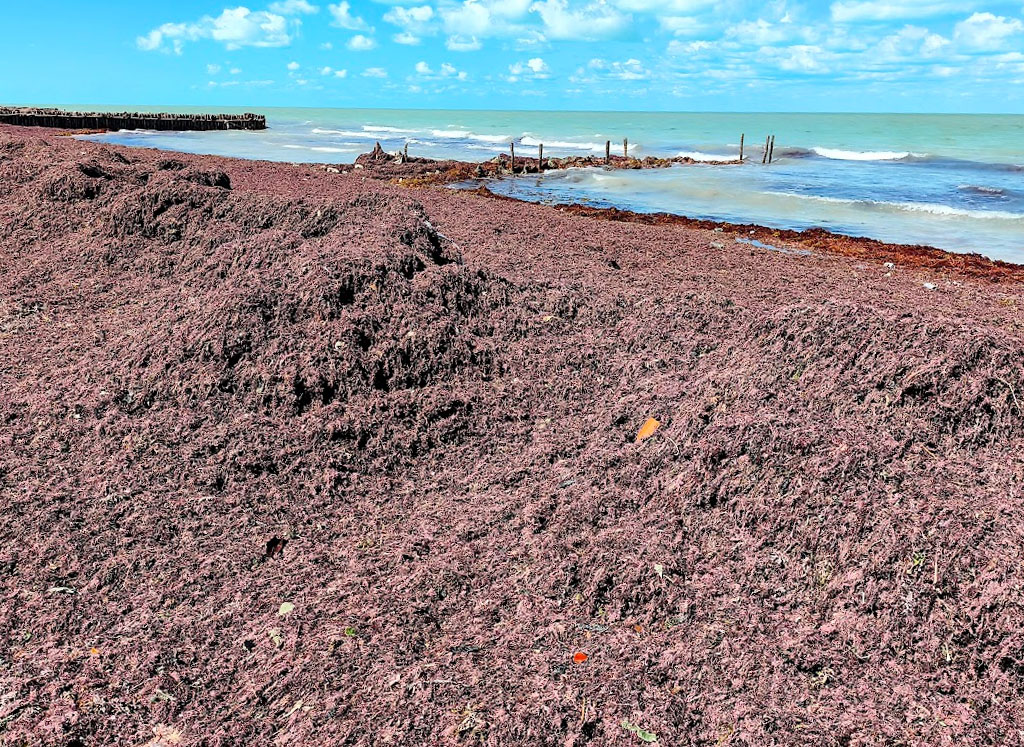
The beaches of Mexico’s Caribbean coast, famous for their white sand and turquoise water, face a recurring threat. Every year, massive amounts of brown seaweed known as sargassum wash ashore.
It rots in the sun, releasing a smell like rotten eggs, harming wildlife, and driving away tourists. In 2025, authorities in Quintana Roo collected over 80,000 tons of the stuff, and 2026 is projected to be even worse. However, researchers are turning this problem into a solution. Scientists in Mexico have developed methods to extract heavy metals from the seaweed and convert the remaining organic material into biofuel.
Getting Over the Heavy Metal Hurdle
To understand the solution, you first have to understand the problem: the seaweed is toxic. According to Dr. Raul Tapia-Tussell, a senior researcher at Mexico’s Secretariat of Science, Humanities, Technology and Innovation, “Heavy metals in sargassum pose serious risks to human health. As this seaweed decomposes on beaches, it can leach toxic substances like arsenic and cadmium into the environment”. These metals mean you cannot simply grind up the sargassum and use it as fertilizer or fuel. If you burned raw sargassum, you would release those toxins into the air.
This is where the new research comes in. Scientists are treating the sargassum like an ore that needs refining. The first step is a cleaning process to remove the heavy metals, particularly arsenic. Because the cell walls of Sargassum act like magnets for dissolved metals in the ocean, they hold onto these pollutants tightly. Researchers use pre-treatment methods—sometimes involving water washes or chemical baths—to pull the arsenic and cadmium out of the biomass. Once the dangerous metals are removed, the remaining material is largely cellulose and carbohydrates, which are perfect for energy production.
The cleaned seaweed is then processed in a device called an anaerobic digester. This is essentially a sealed tank without oxygen. Naturally occurring bacteria are added to the tank, which eat the seaweed. As the bacteria digest the carbohydrates, they produce a gas mixture primarily composed of methane. This gas, known as biogas, can be burned to generate electricity or further purified into renewable natural gas to power vehicles. The leftover solid material can even be used as a soil amendment, provided the heavy metals were successfully removed.
Other Uses for Sargassum
Beyond fuel, the seaweed has other uses. The Mexican government has officially declared sargassum a “fishery resource” to encourage its harvesting. Entrepreneurs are currently using it to make construction materials. Specifically, researchers have tested using sargassum ash as a substitute for cement in concrete, which reduces the carbon footprint of building. The algae can also be turned into biofertilizers for crops or processed into paper and colored pencils.
Despite these useful applications, the amount of seaweed keeps increasing every year. There are two main reasons for this. First, climate change is warming the ocean. Second, and more specifically, there is a natural cycle involving phosphorus. An international team led by the Max Planck Institute for Chemistry recently published findings in Nature Geoscience explaining the driver. Upwelling—a process where wind pushes surface water away and pulls deep, cold water up—brings phosphorus to the surface near the equator.
This phosphorus feeds tiny bacteria that live on the sargassum. These bacteria have a special ability: they can pull nitrogen from the air and turn it into fertilizer for the seaweed. The study notes that these cyanobacteria “capture atmospheric gaseous nitrogen and convert it into a form usable by the algae”. This symbiotic relationship gives sargassum a competitive advantage over other seaweeds, allowing it to reproduce rapidly and form the “Great Atlantic Sargassum Belt” that drifts toward the Caribbean.
Rosa Rodríguez Martínez, a coastal ecologist at the National Autonomous University of Mexico (UNAM), sums up the shift in perspective required to fix the issue. “Sargassum isn’t just a problem — it’s a resource,” she said. “But only if we learn how to manage it sustainably”. The race is now on to build the facilities needed to process the millions of tons arriving each year before they hit the shore, turning a smelly liability into a source of biofuel and building materials.

Impact on Tourism
But despite these innovations and new ways of thinking about sargassumm, the fact remains that it is, and likely will continue to be, a problem for Mexico’s vital tourism sector.
Once pristine beaches like Cancun are increasingly overrun with the foul-smelling seaweed, and partnerships between hotels and governments spend millions to clean up the mess, the best they can; but only achieve a modest measure of success.
To make things even more complicated, changing sea currents and rising temperatures threaten beaches that have historically not been hit by large amounts of sargassum, as is the case with Isla Mujeres.