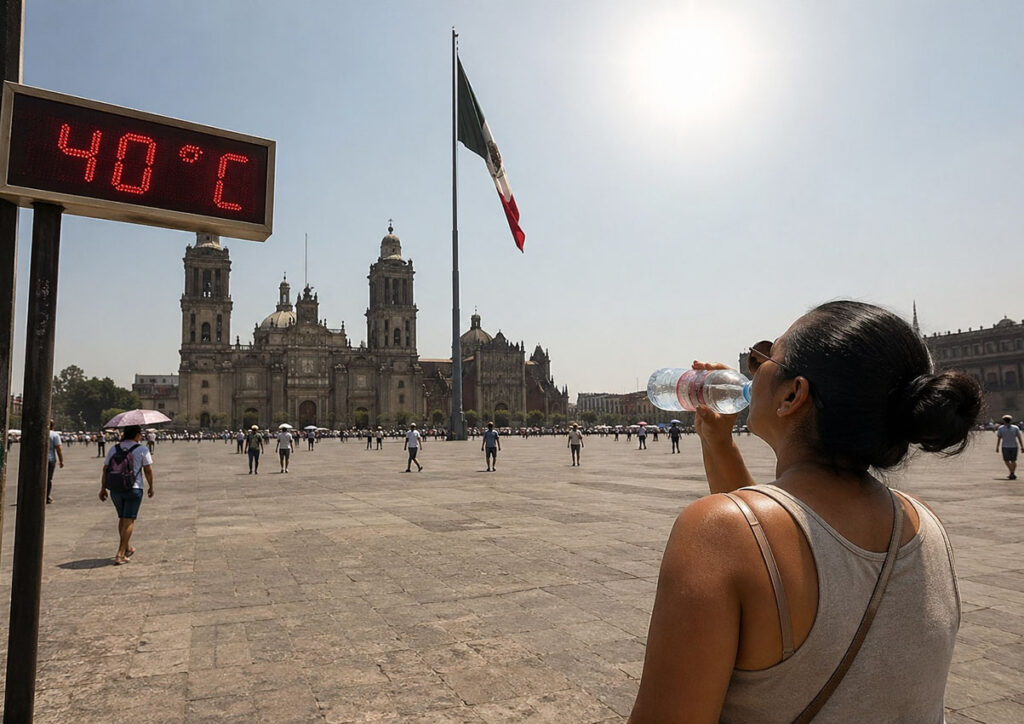
Spring in Mexico brings reliable sunshine, dry skies, and, increasingly, dangerous heat. This week, Mexico City’s civil protection agency issued a formal advisory warning residents of a heat wave running through Thursday — with daytime highs projected between 29 and 32 degrees Celsius (84 to 90 Fahrenheit) across the capital, along with strong wind gusts and elevated UV radiation levels.
Mexico City isn’t alone. The advisory noted heat affecting several other states, including Tlaxcala, the State of Mexico, Hidalgo, Veracruz, and Tabasco. On the Yucatán Peninsula, where spring heat is a fact of life, temperatures in April regularly climb to 33 to 36 degrees Celsius (91 to 97 Fahrenheit) across the region, with inland areas like Mérida often running hotter.
April and May are statistically the most heat-prone months in Mexico. According to the country’s National Meteorological Service (SMN), roughly 71% of Mexico’s annual heat waves occur during these two spring months. That pattern has been intensifying: in spring 2024, the country endured three consecutive heat waves, with temperatures exceeding 45 C (113 F) in parts of the north and records broken across multiple cities. Heat-related deaths that season surpassed 125, according to World Weather Attribution researchers, who linked the severity of that event directly to climate change.
For the Peninsula, where the dry season wraps up just as temperatures peak, the weeks before the rainy season begins in June represent an annual challenge. Mérida’s April highs regularly top 35 C (95 F), and inland areas can push well above 40 C (104 F) on the hottest days. Humidity, still relatively low in April, rises fast as summer approaches, making conditions feel more oppressive.
There’s something worth understanding about how this heat behaves. A high-pressure system trapping warm air close to the surface — a heat dome — is typically behind the worst spikes. That’s what drove the 2024 crisis and what forecasters watch for each spring. With ocean surface temperatures in the Gulf of Mexico and Caribbean running warmer than historical averages, the conditions that fuel these systems have become more common.
For residents and visitors across Mexico right now, civil protection authorities are recommending straightforward precautions. Yucatán Magazine has more on surviving the heat.
Staying Safe in the Heat
- Drink water consistently — don’t wait until you’re thirsty
- Wear lightweight, light-colored clothing and a hat
- Limit time outdoors between 11 a.m. and 4 p.m.
- Apply sunscreen and reapply throughout the day
- Avoid eating food that has been left out in the heat — spoilage accelerates rapidly
- Check on elderly neighbors, children, and pets
- Use air-conditioned spaces — malls, libraries, museums — during peak afternoon hours
Those visiting archaeological sites during April and May should plan to arrive by 8 a.m. and wrap up by mid-morning. By late morning, sites with limited shade become genuinely punishing. Carrying at least two liters of water per person is not an overcaution.
Temperatures on the Yucatán Peninsula typically ease once the rainy season begins, usually in June, when afternoon storms break the heat — though they also bring higher humidity and the beginning of hurricane season. For now, the Peninsula is in its hottest and driest stretch of the year.
Source: Secretaría de Gestión Integral de Riesgos y Protección Civil