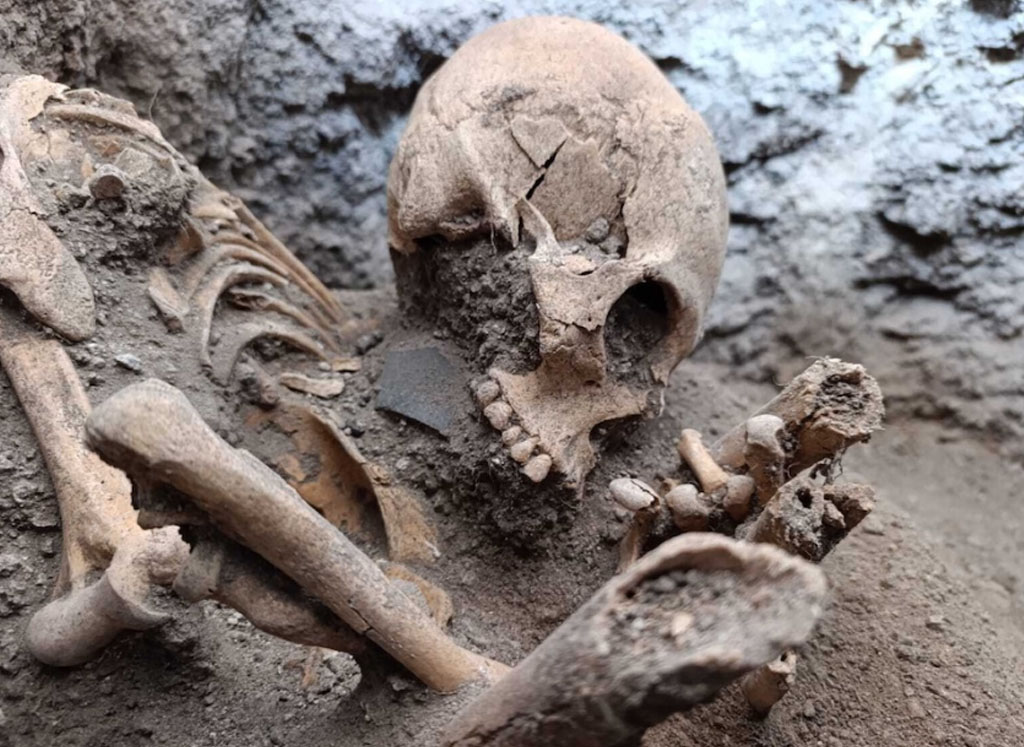
A residential neighborhood from the height of the Teotihuacán civilization, complete with a collection of intricate shaft tombs and human remains near Tula, has been uncovered during salvage work for a new railway line in central Mexico.
The find was made in the community of Ignacio Zaragoza, near the ancient Toltec capital of Tula in Hidalgo state, roughly 90 kilometers (50 miles) north of Mexico City. Since September, a team from the National Institute of Anthropology and History (INAH) has been systematically exploring a 2,400-square-meter area, about half the size of a football field, that lies directly in the path of the new Mexico City-Querétaro passenger train.
What they discovered was not a grand ceremonial center like that at Tula, but something arguably more intimate: a 1,800-year-old domestic compound, providing a rare window into the daily lives and death rituals of common people living in the shadow of a vast empire.
“Every burial, every offering, and every context recovered by the INAH provides information about the ways of life, beliefs, and social organization of those who inhabited this region over a thousand years ago,” said Claudia Curiel de Icaza, Mexico’s Secretary of Culture, as quoted by INAH. “It confirms that infrastructure development can go hand in hand with rigorous research and the care of our heritage.”
Led by field archaeologist Laura Magallón Sandoval, the team found the first clues in plain sight: fragments of pottery scattered on the surface. Test pits soon revealed the faint outlines of walls, leading to full-scale excavations augmented by drone flights and orthophotography for precise mapping.
What emerged was a pattern of small residential units clustered around central and side patios, with doorways aligned north-south and east-west. The main period of occupation dates back to between 225 and 550 C.E., during the Tlamimilolpan and Xolalpan phases—the very apogee of the great metropolis of Teotihuacan. The site also saw minor reoccupation much later, during the Postclassic period, as evidenced by Coyotlatelco and Mexica ceramics, as was also the case in Tula itself.
The ancient inhabitants of the area surrounding Tula took advantage of the area’s rocky terrain, digging their most sacred spaces deep into the soft volcanic stone known as tepetate. Among the most significant discoveries are five shaft tombs, named for the vertical entrance shafts that lead down to burial chambers. Inside one residence, archaeologists found two such tombs. The northern tomb contained a particularly striking scene: the skeletal remains of eight individuals, most of them adults, placed inside its chambers alongside 47 miniature vessels. Remarkably, six of the bodies were found in a seated position, with the ceramic offerings placed at their feet.
The tomb itself appears to have been a family crypt, used and reused over generations. “When they were going to deposit the last individual, they removed the funerary bundle of the previous one,” explained Juana Mitzi Serrano Rivero, an archaeologist on the team. This practice resulted in a complex mix of remains, including complete and incomplete skeletons from adults, juveniles, and at least one child between eight and 11 years old. Among the offerings found with the burials were a small shell, part of a pendant made of mother-of-pearl, and several engraved vessels.
The discoveries near Tula do not exist in isolation. Archaeologist Jonathan Velázquez Palacios noted that the area has been exploited since pre-Hispanic times as a source of lime, a crucial material for the plaster coatings of Teotihuacan’s monumental buildings, located 90 kilometers away.
The find adds to a growing list of Classic-period settlements in the region north of Tula, including the significant Teotihuacan center of Chingú, as well as sites like El Tesoro, Acoculco, El Llano, and La Malinche. For the researchers, the work is far from over. The funerary contexts will be key to unlocking the beliefs, social structure, and culture of a people who lived and died in the orbit of one of the ancient world’s most influential cities, their memories now unearthed by a modern train.