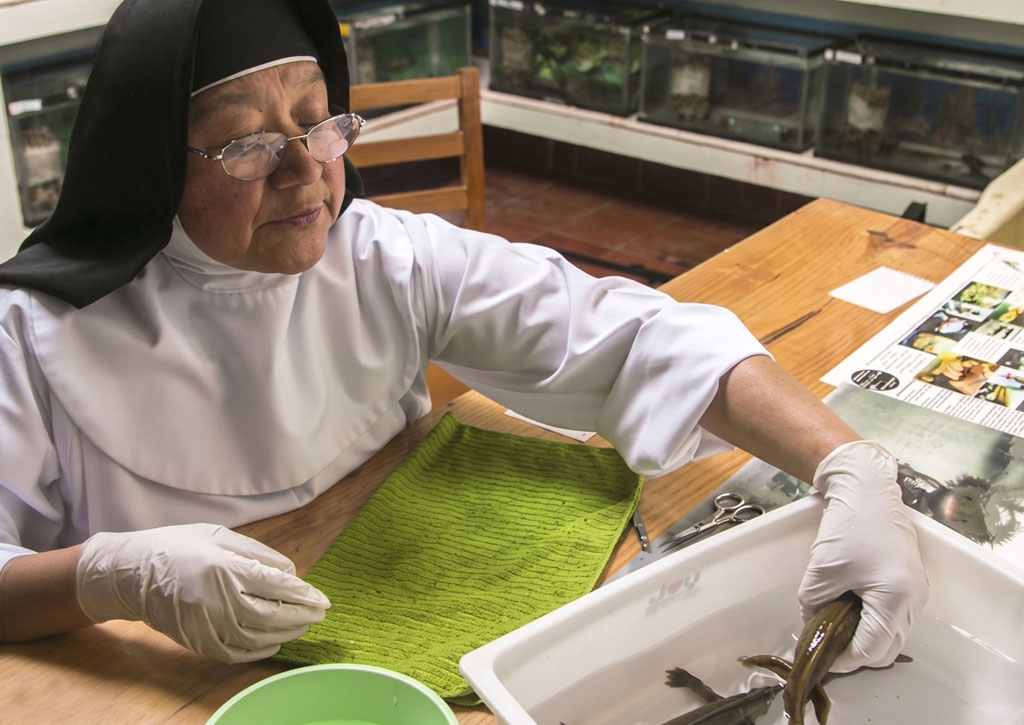
For more than two decades, a community of Dominican nuns in Pátzcuaro has quietly been leading one of Mexico’s most extraordinary conservation efforts.
Tucked behind the walls of their monastery, adjacent to a 16th-century basilica, the sisters care for and breed the critically endangered Lake Pátzcuaro salamander. This species, known locally as the achoque, exists nowhere else on Earth.
While the salamander’s wild population has collapsed due to pollution, invasive species, and habitat loss, the convent has become an unexpected ark.
Today, the largest known captive population of this amphibian is maintained not in a university laboratory or a government facility, but in rows of glass aquaria and white enamel bathtubs inside a religious order.
The story of how these sisters became the species’ primary guardians is a testament to the unexpected ways that faith, tradition, and science can converge in the service of conservation.
A Centuries-Old Remedy
The achoque, scientifically known as Ambystoma dumerilii, is a paedomorphic salamander.
This means it retains its larval features, including its feathery external gills, throughout its entire adult life. It is a close relative of the better-known axolotl, another Mexican amphibian that has captivated scientists worldwide for its remarkable ability to regenerate lost limbs and even portions of its brain and heart.
For centuries, long before the species was formally described by French herpetologist Alfredo Dugès in 1870, the Indigenous Purépecha people of the Lake Pátzcuaro region revered the achoque as both a food source and a vital ingredient in their traditional medicine.
The salamander even held spiritual significance, with some accounts linking it to pre-Columbian deities. This deep cultural connection to the lake and its creatures laid the groundwork for the salamander’s later role in the monastery.
The Dominican sisters at the Monastery of Our Lady of Health have used achoques to produce a traditional cough syrup, known as jarabe, for generations. Some sources indicate that this practice dates back 150 years.
The syrup, believed to treat respiratory ailments such as asthma, coughs, and even anemia, became the convent’s main source of income, selling for approximately 200 pesos per bottle. The nuns would traditionally collect salamanders from the lake to make their remedy. However, in the 1980s, the wild population of achoques in Lake Pátzcuaro crashed dramatically.
The lake, the species’ only natural home, was shrinking and becoming increasingly polluted by sewage, agricultural fertilizer runoff, deforestation in the surrounding watershed, and the introduction of invasive fish species such as Asian carp. In the 1980s, fishermen were still extracting as much as 20 tonnes of axolotls from the lake each year. Today, fewer than 150 adult achoques are thought to remain in the wild.
When the Lake Began to Die
Faced with the collapse of both the species and their own livelihood, the nuns took decisive action. With guidance from a friar who was also a trained biologist, they began breeding the salamanders in captivity, establishing the colony that now thrives within the monastery.
What started as a practical measure to preserve their syrup business evolved into something far more significant. Sister Ofelia Morales Francisco, who has cared for the achoques for nearly 20 years, and her fellow sisters mastered the amphibians’ complex reproductive biology through patient observation and hands-on experience.
They developed their skills through a combination of independent trial and error and consistent support from local universities and research centers. “Being part of a religious order is not an obstacle for scientific progress,” Sister Ofelia has said. For her and the other nuns, the work has taken on a deeper meaning beyond commerce. “It’s about protecting a species from nature,” she explained in an interview with the New York Times. “If we don’t work to take care of it, to protect it, it will disappear from creation.”
The transformation in their mission was gradual but profound. The sisters moved from being harvesters of a wild resource to being its most dedicated custodians. Their daily routine now includes meticulous monitoring of water quality, feeding schedules, and health checks for hundreds of individual salamanders.
Faith Meets Science
The nuns’ achievement has not gone unnoticed by the international scientific community. Biologists from the nearby University of San Nicolás de Hidalgo in Michoacán discovered that the sisters were expert breeders and began collaborating with them on a formal conservation program.
The United Kingdom’s Chester Zoo, which has a long history of amphibian conservation, also recognized the monastery’s thriving colony as an invaluable resource. Dr. Gerardo Garcia, a curator and expert on endangered species at the zoo, has described the nuns as “very vital” to the salamanders’ prospects in the wild.