
Author: MxTrib Staff

  • 2 Train Workers Lacked Valid Railroad Licenses in Fatal Crash

    2 Train Workers Lacked Valid Railroad Licenses in Fatal Crash

    The machinist and conductor operating a Tren Interoceánico locomotive that collided with a trailer truck on Dec. 7 did not have valid railroad operating licenses at the time of the accident, according to local media. The accident left 14 people dead and 98 injured.

    The Federal Railroad Transportation Agency (AFTF) confirmed that neither worker possessed the required certification to operate the train on the Interoceanic Railway route, where the fatal collision occurred at a highway crossing.

    The revelation adds scrutiny to Mexico’s interoceanic rail project, which has faced questions over safety protocols since passenger service was relaunched in recent years on the historic line connecting the Pacific and Gulf coasts.

    Safety Oversight Under Question

    Mexican law requires all train operators to hold valid licenses issued by the AFTF, which oversees railroad safety and certification nationwide. The licensing process includes technical training, medical evaluations, and demonstrated competency in railroad operations.

    While investigations continue into the circumstances of the crash, the lack of proper licensing raises questions about training standards and oversight for the railway project, which operates across the Isthmus of Tehuantepec.

    Historic Railway Line

    The Tren Interoceánico runs along a historic route connecting Coatzacoalcos, Veracruz, on the Gulf of Mexico, with Salina Cruz, Oaxaca, on the Pacific coast. The railway crosses the narrowest part of Mexico, offering an alternative to the Panama Canal for cargo movement.

    The Mexican government revitalized the line as part of infrastructure modernization efforts, adding both freight and passenger service to the corridor. The route spans approximately 186 miles (300 km) across the Isthmus of Tehuantepec.

    Critics have questioned whether safety measures have kept pace with the railway’s expanded operations. The project’s operator has defended its training programs and safety protocols.

    The December accident was not isolated. Several collisions with vehicles at grade crossings have occurred on Mexican rail lines, though most resulted in property damage rather than fatalities.

    Transportation experts note that grade crossing safety remains a critical challenge for railroad operations worldwide, particularly in areas where highways and rail lines intersect without protective barriers or advanced warning systems.

    Federal Investigation Ongoing

    Mexico’s Attorney General’s Office continues investigating the December crash to determine whether criminal negligence played a role. The licensing revelation could influence potential charges against railway operators or supervisors responsible for crew certification.

    The AFTF has not publicly commented on how the unlicensed operators were cleared to work or what disciplinary measures may follow. The railway operator has also declined to address the licensing issue.

    The incident highlights concerns about regulatory oversight as Mexico expands its rail infrastructure. The country’s freight rail network has operated for over a century, but passenger service expansions require renewed attention to safety standards and crew training.

    Sources: Diario de Yucatán, Mexican Federal Railroad Transportation Agency, Attorney General’s Office reports

  • Mexico’s Left-Wing Government Faces Growing Economic and Political Headwinds
    Mexico’s Left-Wing Government Faces Growing Economic and Political Headwinds

    Despite its popularity, the strongest left-wing party in the democratic world is facing major challenges.

    President Claudia Sheinbaum’s first year leading Mexico’s ruling MORENA party has been marked by mounting challenges that threaten to undermine the ambitious social agenda championed by her predecessor. Economic stagnation, fiscal constraints, and rising public frustration over security issues are testing the government’s ability to maintain its unprecedented electoral dominance.

    The numbers paint a sobering picture. Mexico’s economy grew just 0.3% in 2025, marking four consecutive years of slowdown. Analysts project GDP will expand only 0.5% this year, placing the country near the bottom of G20 growth rankings. The government inherited a budget deficit that reached a 36-year high of 5.7% of GDP in 2024, largely driven by election-year spending.

    Sheinbaum promised aggressive fiscal consolidation, targeting deficit reductions to 3.9% of GDP by 2025 and 3.2% in 2026. Those goals now appear out of reach. The Finance Ministry projects deficits of 4.4% this year and 4.1% next year, as spending commitments have become increasingly rigid. Nearly 44% of the budget goes to subsidies, pensions, and debt servicing—up from 33% when Andrés Manuel López Obrador took office in 2018.

    The state oil company PEMEX continues draining public resources, requiring $14 billion in 2026, nearly double the previous year’s allocations. Public investment remains significantly lower than in other Latin American economies, at just 2.5% of GDP compared to a regional average of 3.5%.

    These fiscal pressures come as Sheinbaum faces the high-stakes review of the United States-Mexico-Canada Agreement this year. President Donald Trump has called the trade deal “irrelevant,” and uncertainty over tariffs and cross-border commerce weighs heavily on business confidence. Investment levels fell from 24.8% of GDP in mid-2024 to 22% by late 2025.

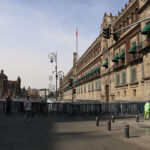
    Palacio Nacional
    The outside of Palacio Nacional, which houses the president of Mexico, is surrounded by metal walls in 2021. File photo

    Security concerns have also damaged the government’s standing. The Nov. 1 assassination of Uruapan Mayor Carlos Manzo sparked massive protests across Mexico. On Nov. 15, thousands took to the streets in Mexico City and other major cities, with some demonstrations turning violent. More than 100 police officers were injured in clashes at the capital’s Zócalo plaza.

    The protests, organized by groups calling themselves “Generation Z Mexico,” denounced violence, corruption, and what demonstrators called excessive power concentration in the federal executive. Sheinbaum, who maintains a 70% approval rating, accused opposition parties of infiltrating the movement and using social media bots to inflate attendance.

    Despite these challenges, MORENA has consolidated extraordinary political power. The party and its allies control 24 of Mexico’s 32 state governorships, hold supermajorities in both houses of Congress, and govern major metropolitan areas. In Yucatán, MORENA captured the governorship in 2024 elections, extending the party’s reach into what had been an opposition stronghold.

    That dominance has enabled controversial reforms. Congress pushed through judicial changes requiring judges to be elected through popular vote, a measure critics say threatens judicial independence. The government has dismantled several autonomous regulatory agencies, centralizing authority in the executive branch. U.S. Ambassador Ken Salazar warned last year that the judicial reforms pose a “risk” to Mexico’s democracy.

    The government has achieved significant social welfare gains. More than 13 million Mexicans were lifted out of poverty between 2018 and 2024, according to government figures, largely through cash transfer programs and minimum wage increases. The minimum wage rose 13% this year and nearly tripled during López Obrador’s six-year term.

    But whether these programs remain sustainable amid economic stagnation is increasingly questioned. Tony Payan, director of the Center for the United States and Mexico at Rice University’s Baker Institute, said the government is pursuing “aggressive” revenue collection because “they are running out of money.”

    The political opposition remains weak and fragmented. Traditional parties like the Institutional Revolutionary Party and National Action Party control just a handful of states. One-fifth of MORENA’s coalition legislators are former members of right-wing or center-right parties, diluting the movement’s progressive agenda and creating internal tensions over policy priorities.

    Mexico’s challenges reflect broader regional trends. The “pink tide” of left-wing governments that swept Latin America in the early 2020s has begun receding. Argentina, Bolivia, Chile, Honduras, and Panama have elected right-leaning governments, with analysts predicting conservative gains in upcoming Costa Rica, Peru, and Colombia elections.

    For Sheinbaum, 2026 will test her ability to balance nationalist rhetoric with pragmatic governance. The USMCA review negotiations require careful navigation between domestic policy priorities and international trade commitments. Security strategy must address organized crime without triggering violence spikes. And economic policy must deliver tangible results without the fiscal room that her predecessor enjoyed.

    Whether Mexico’s “Fourth Transformation” can weather these storms will determine not just the fate of MORENA’s political project, but the living standards of millions who have come to depend on the government’s social programs.

    Key Challenges Facing Mexico’s Government

    • Budget deficit reached 36-year high of 5.7% of GDP in 2024
    • Economic growth projected at just 0.5% in 2026, among lowest in G20
    • PEMEX requires $14 billion in 2026, double previous year’s funding
    • Investment declined from 24.8% to 22% of GDP between mid-2024 and late 2025
    • USMCA trade agreement review scheduled for 2026 amid Trump threats
    • Mass protests in November 2025 over security and corruption concerns
    • Judicial reforms requiring elected judges criticized by U.S. and legal experts
    • Public spending increasingly rigid with 44% going to subsidies, pensions, debt

    Sources: The Economist, Americas Quarterly, Rice University Baker Institute, Atlantic Council, Al Jazeera

  • New Single by Mandinga Refuses to Play Nice: Watch the Video Here… 

    New Single by Mandinga Refuses to Play Nice: Watch the Video Here… 

    All photos courtesy Mandinga

    Mandinga, the European band best-known for their unique blend of Latin rhythms and global pop sensibilities, has just released their latest single… and it’s a hot one.

    Marking a deliberate shift toward Latin urban territory, the track, Mala, is now available on all major streaming platforms and pairs Afrobeat-influenced production with unapologetic lyrics delivered by Romanian-born frontwoman, Barbara Isasi.  

    A Personal Statement Set to Heavy Bass

    For Isasi, Mala isn’t just a musical experiment. The singer, who has fronted Mandinga since the group’s formation, says the song allowed her to drop the polish that often comes with commercial Latin pop.

    “I wrote Mala for myself, but I know I’ll have behind me all the women who are sick of being ‘good,’” Isasi explains. “It’s about that moment when you stop filtering everything, stop being polite, stop smiling when you don’t feel like it.”

    The track opens with a hook built around the phrase “Cali mala, pura diabla,” a line that repeats throughout and anchors the song’s defiant tone. Production-wise, Mala leans into bass-heavy urban beats rather than the salsa and bachata arrangements that defined much of Mandinga’s earlier catalog.

    The Production Team Behind the Sound

    Chupi Tool, the group’s founding drummer and producer, recognized early that Mala would require a different approach than previous releases.

    “I knew from the first few seconds that Mala was different from anything we’d done,” he says. “We decided to open new lines in Latin urban to deliver each message the way it deserves: direct, without softening it.”

    The executive production credit goes to Dani Joo (born Dan Ioan Plohi), a 17-year-old bassist who has already built a reputation in Romanian music circles. Mala marks his first executive producer role on a project of this scale. Mixing and mastering duties fell to Dragomir Gabriel-Iulian, a veteran audio engineer whose work spans multiple genres across the Romanian and international music scenes.

    A Visual Companion That Matches the Message

    The official video, directed by Rimenescu, places Isasi at the center of every frame. Choreography by Ruxandra Timoasca features dancers Teodora DutcaMihai Ioana Mihaela, and Ioana Alexandra Gramada in sequences designed to reinforce the track’s central theme: Isasi leads, everyone else follows.

    The visual treatment avoids the bright, tropical aesthetics common in Latin pop videos. Instead, the production opts for darker tones and tighter shots that keep attention fixed on Isasi’s performance.

     “That doesn’t mean we’re not preparing new music for traditional Mandinga fans, salsa, bachata, everything that has defined us,” Chupi Tool clarifies. “But it does mean we’re no longer limiting ourselves. If the message calls for urban, we go urban.”

    The group has indicated that additional releases are planned throughout 2026, spanning both Latin urban and their more traditional catalog. For now, Mala serves as the opening statement for what the band promises will be a productive year.

    You can watch the full video here: Mala, by Mandinga.

  • Nearly 2 in 3 Mexicans Feel Unsafe in Their Cities, New Government Survey Shows

    Nearly 2 in 3 Mexicans Feel Unsafe in Their Cities, New Government Survey Shows

    More than 63% of Mexicans living in urban areas said they felt unsafe in their cities at the end of 2025, according to a quarterly government survey that tracks public perception across the country’s 91 largest metropolitan areas.=

    The National Urban Public Security Survey, released Jan. 23 by Mexico’s statistics agency INEGI, found women reported feeling significantly more insecure than men. Nearly 70% of women said living in their city felt unsafe, compared to 57% of men.

    The numbers mark a slight increase from September 2025, when 63% reported feeling unsafe, and represent a statistically significant jump from December 2024’s 61.7%.

    Five cities topped the list for perceived insecurity. Uruapan in Michoacán led with nearly 89% of residents feeling unsafe, followed closely by Culiacán Rosales in Sinaloa at 88%. Ciudad Obregón in Sonora, Ecatepec de Morelos in México state, and Irapuato in Guanajuato all reported insecurity levels at or above 87%.

    Both Uruapan and Culiacán have faced escalating cartel violence in recent months. Culiacán has been ground zero for an internal war within the Sinaloa Cartel since September 2024, with more than 1,000 people killed and thousands disappeared. In Uruapan, the November 2025 assassination of Mayor Carlos Manzo, who had launched an aggressive campaign against organized crime, sparked nationwide protests.

    At the other end of the spectrum, wealthy San Pedro Garza García in Nuevo León recorded the lowest insecurity perception at less than 9%, followed by Benito Juárez in Quintana Roo at 14.8% and Piedras Negras in Coahuila at 17.3%.

    The survey also measured where people feel most vulnerable. More than 72% said they felt unsafe using ATMs on public streets, while nearly 65% reported feeling insecure both on public streets and on public transportation. About 59% said highways felt dangerous.

    Looking ahead, residents showed mixed expectations. Nearly 34% of respondents said crime and insecurity would stay equally bad over the next year, while 25.6% predicted conditions would worsen. On a more optimistic note, 23% believed things would improve.

    The survey found alcohol consumption in the streets topped the list of observed criminal or antisocial behavior at nearly 60%, followed by robberies and assaults at 48%. Drug dealing or consumption came in third at 40%, with vandalism and frequent gunfire rounding out the top five concerns.

    During the final quarter of 2025, more than 36% of adult residents experienced some type of direct conflict with family members, neighbors, coworkers, business staff, or government authorities. Fear of crime prompted 42.5% of residents to stop carrying valuables like jewelry, cash, or credit cards, while 38% changed habits about letting children go outside unaccompanied.

    When it came to law enforcement, the Mexican military branches received the highest marks. Eighty-three percent rated the Navy as very or somewhat effective, followed by the Air Force at 81.4% and the Army at nearly 80%. In contrast, municipal police earned approval from just 46% of respondents.

    The survey, conducted quarterly since 2013, asks urban residents about their experiences with crime and perceptions of safety. While actual crime statistics have shown some recent declines in homicide rates under President Claudia Sheinbaum’s administration, the perception data suggests many residents haven’t yet felt those improvements in their daily lives.

    Regional variations remain stark. States like Yucatán continue ranking among Mexico’s safest, with homicide rates more than 10 times lower than the national average. The Yucatán state has held the top spot in the Mexico Peace Index for eight consecutive years, boasting a 2025 homicide rate of just 2.2 per 100,000 people compared to the national rate of nearly 25.

    KEY FINDINGS FROM THE ENSU SURVEY

    • 63.8% of urban residents felt unsafe in their cities in December 2025

    • Women reported 12 percentage points higher insecurity than men (69.4% vs. 57.1%)

    • Uruapan, Culiacán, and Ciudad Obregón topped insecurity perception above 88%

    • 72.3% felt unsafe at street ATMs, the most vulnerable location

    • 32.3% of households had at least one member victimized by robbery, extortion, or fraud during the second half of 2025

    • 45.4% of people who contacted security authorities reported experiencing at least one act of corruption

    • 86.4% identified potholes as their city’s biggest problem, ahead of water supply issues (63.9%) and traffic (61.2%)

    Sources: INEGI National Urban Public Security Survey (ENSU), Human Rights Watch, Institute for Economics and Peace Mexico Peace Index 2025, InSight Crime

  • Final Days: 200 Artful Nopales Take Over Mexico City’s Main Plaza

    Final Days: 200 Artful Nopales Take Over Mexico City’s Main Plaza

    Mexico City’s iconic Zócalo has become an unexpected garden where 200 cactus sculptures dominate the vast concrete square. The open-air exhibition, named “Nopalera en el corazón,” transforms the Plaza de la Constitución into a vibrant showcase where artists reimagine one of Mexico’s most recognizable symbols.

    Time is running short to see this ambitious project. The exhibition closes February 8, giving visitors just days to experience what Mexico City Mayor Clara Brugada calls “a garden of resistance, memory and contemplation.”

    Each sculpture stands roughly six feet (two meters) tall, shaped like a nopal and customized by artists and collectives from across the capital. The designs range widely. Some reference prehispanic deities and the Mexica founding myth. Others incorporate modern elements like the Metro system, comic strips and social proclamations. Several feature abstract patterns or showcase flora and fauna like hummingbirds.

    Artful Nopales Take Over Mexico City’s Main Plaza

    The techniques vary just as much. Artists applied everything from screen printing and engraving to spray paint and sculptural additions. Walking through the exhibition feels less like viewing artwork than navigating a colorful forest that somehow sprouted overnight.

    The project began modestly last June during the Feria del Nopal 2025 with 50 pieces at the Monument to the Revolution. From July through September, it appeared on Paseo de la Reforma, where it drew crowds before moving to the Zócalo in expanded form. The current version quadruples the original size.

    According to the Mexico City Department of Culture, 113 sculptures were created by male artists, 67 by women, and 23 by collectives or duos. The expansion coincided with celebrations marking 700 years since the founding of Mexico-Tenochtitlan in 1325, when Mexica people settled in the Valley of Mexico after recognizing a divine sign: an eagle perched on a nopal cactus, devouring a serpent. That image appears on Mexico’s flag and remains central to national identity.

    “This exposition is an artistic and political expression,” Brugada said at the January 9 opening. “This emblematic symbol of our country and our city speaks to our history, our resistance and how we see ourselves as a people.”

    The Zócalo location carries particular weight. The vast square sits atop what was once the ceremonial center of Tenochtitlan. By placing the exhibition here, organizers connect contemporary artistic expression with ancient symbolism in the exact spot where the Mexica capital began.

    Ana Francis López Bayghen Patiño, secretary of culture for Mexico City, emphasized the project’s community aspect. Artists worked in public spaces, particularly in the Guerrero neighborhood, where residents watched the creative process unfold. “Taking artistic practice out of the museum and bringing it to the street has a clear meaning,” she said.

    After February 8, the sculptures won’t disappear. Officials plan to distribute them across the city at various landmarks before the 2026 World Cup, allowing neighborhoods beyond downtown to host pieces from the collection.

    The exhibition includes programming beyond the static display. Free guided tours run regularly, including special nighttime walks called “Time and the Stars.” Cultural performances feature music, theater and presentations by nopal producers from Milpa Alta.

    Getting there is straightforward. Metro Line 2 stops at Zócalo/Tenochtitlan station, which opens directly onto the plaza. Metrobús Line 4 has nearby stops. The location in the Centro Histórico means visitors can easily combine the exhibition with other downtown attractions.

    At the opening, Brugada issued a challenge to artists: create a similar exhibition featuring ajolotes before Easter. She envisions the endangered salamander as another symbol of national identity and regeneration.

    For now, the nopal sculptures remain, turning Mexico City’s largest public space into an unexpected celebration of identity, creativity and the cactus that defined a civilization’s destiny.

    VISITING DETAILS

    • On view through February 8, 2026
    • Location: Zócalo (Plaza de la Constitución), Centro Histórico
    • Hours: Open 24/7 (outdoor exhibition)
    • Admission: Free
    • Metro: Zócalo/Tenochtitlan (Line 2)
    • Activities: Free guided tours, cultural performances, artisan markets