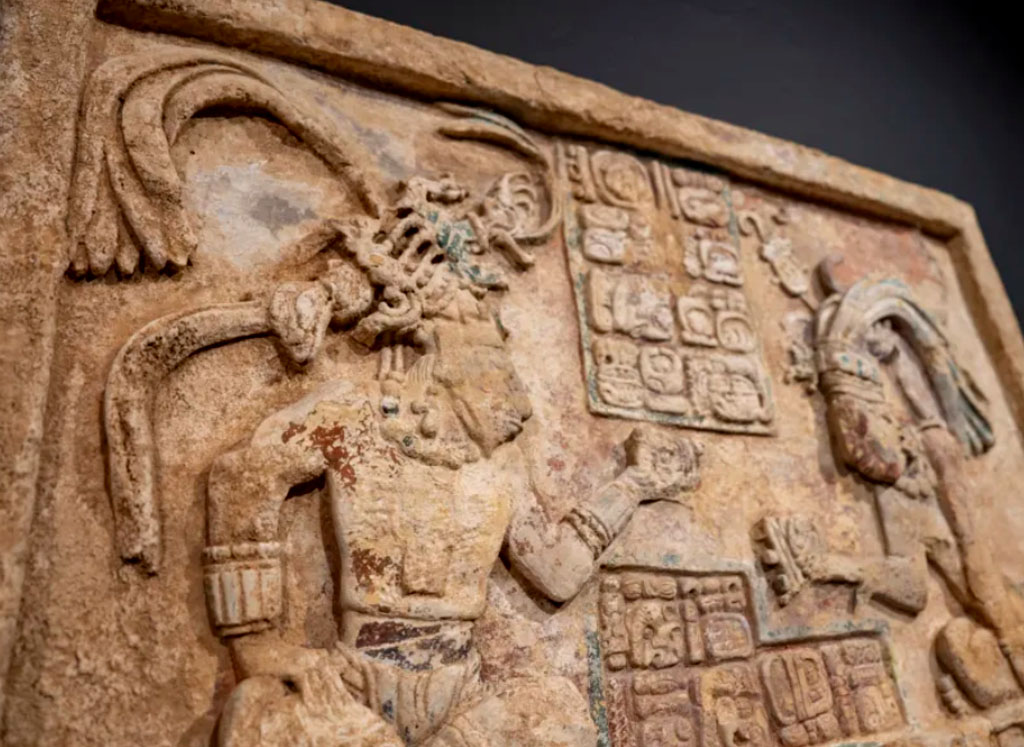
A Maya limestone lintel dating to the Mesoamerican Classic period (600-900 A.D.) will be returned to Mexico after an anonymous businessman voluntarily surrendered the piece to the Mexican Consulate in New York. The artifact, weighing approximately one ton, was presented to the public for the first time on April 16, 2026, during a ceremony at the consulate’s Octavio Paz Auditorium.
What Is a Maya Lintel
In Maya architecture, a lintel is the horizontal beam that spans the opening above a doorway, set between two upright supports. At major Maya centers like Yaxchilán in Chiapas, rulers commissioned elaborately carved limestone lintels to document dynastic history, ritual events, and military conquests. These lintels were placed above doorways so that anyone entering the room would see the commemorative text and image.
Maya lintels are considered among the finest examples of pre-Hispanic art. The carvings combine hieroglyphic texts with detailed figural scenes, providing scholars with invaluable records of royal lineages, political alliances, and religious practices. Their value lies not only in their artistic quality but in the historical information they preserve about Maya rulers and their ceremonies. Fewer than a dozen such carved wooden lintels are known to exist from the Classic period, making each discovery a significant archaeological event.
Identity of the Ruler Depicted
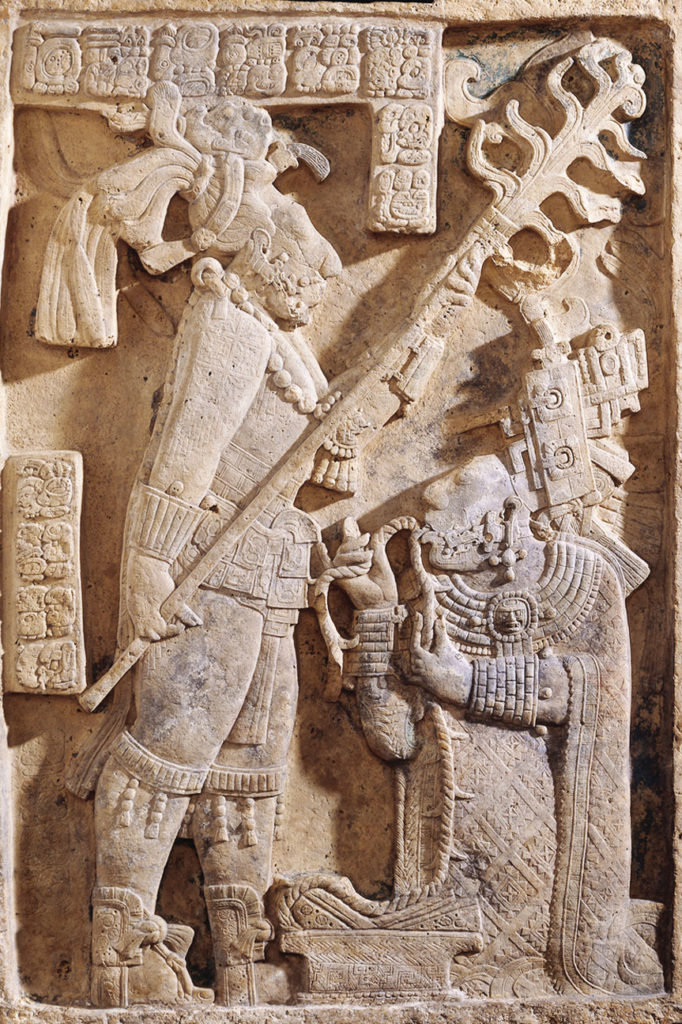
Diego Sandoval, the consulate’s legal director, explained that iconographic analysis identified the main figure on the lintel as Cheleew Chan K’inich, also known as Jaguar Acorazado IV, the ninth ruler of Yaxchilán. He reigned from approximately 769 to 800 A.D. and is shown receiving tribute from a subordinate ruler.
The scene includes symbolic elements such as atlantean figures holding a representation of the sky and the presence of the god Itzam, associated with mountains and universal balance. At the center of the carving appears the signature of the artisan, “Mayú.” Sandoval noted that the figures together represent a quincunx, a symbol of cosmic order and the renewal of time.
How the Artifact Left Mexico
Mexican authorities have not disclosed how the lintel was removed from Mexican territory. The artifact originated in the Yaxchilán region of Chiapas, a major Maya center located along the Usumacinta River that flourished during the Late Classic period. The consulate stated that the piece was taken from Mexico, passed through Europe, and eventually arrived in the United States, but specific details about its removal remain unknown.
Erroneous Reports About the British Museum
Following news of the repatriation, some media reports incorrectly suggested that the lintel had previously been housed at the British Museum in London. This is not accurate. While the British Museum does hold notable Maya lintels from Yaxchilán, those pieces are different artifacts. Lintels 24 and 25 from Yaxchilán Structure 23 are on permanent display in the British Museum’s Mexican Gallery. Those lintels were removed from Yaxchilán by Alfred Maudslay in 1882 and 1883 and shipped to Great Britain. The lintel being returned to Mexico from New York is a separate piece that has no connection to the British Museum’s collection.
Dispute Over the Lintel’s True Origin
While Mexican authorities have claimed the lintel as part of their national heritage, some experts argue that the artifact may actually originate from Guatemala and should therefore be repatriated there. Scholarly research on similar looted Maya lintels has documented the case of a sculptor named Mayuy, whose signature appears on at least four masterwork lintels that have been traced to northern Guatemala.
According to academic studies published by the Getty Research Institute, the lintels in question were discovered in 1950 by explorer Dana Lamb, who stumbled upon a Maya ruin in the tropical forests of northern Guatemala. Lamb called the site Laxtunich but failed to record its precise location, turning his find into a longstanding mystery. The lintels he discovered there, long since looted, are considered among the masterworks of Maya sculpture from the Classic period. Using fieldwork, physical evidence, and Lamb’s expedition notes, researchers have identified a small area with archaeological sites where the carvings were likely produced.
The scholar Stephen Houston and his colleagues have argued that these works can be assigned to a carver named Mayuy, who sculpted his name on two of them. The research points to their repatriation and, as an ultimate aim, repatriation to Guatemala. One analysis specifically examines how Mayuy grafted celestial, seasonal, and divine identities onto a local magnate and his overlord from the kingdom of Yaxchilan, Mexico, suggesting a complex political relationship between sites on both sides of the modern border.
Transport and Final Destination
A Mexican Air Force plane will transport the lintel to Mexico, where it will be received by Foreign Secretary Roberto Velasco. The piece will then be taken to the National Museum of Anthropology in Mexico City as part of the government’s ongoing policy of cultural patrimony restitution.
According to Consul Bucio, this piece is among approximately 14,000 archaeological pieces recovered by Mexico in the last five years during the administrations of Andrés Manuel López Obrador and Claudia Sheinbaum. Of that total, more than 2,300 pieces were in New York and were recovered with support from the Manhattan District Attorney’s Office.
The exact date of the lintel’s return to Mexico has not been announced. It remains unclear whether Guatemala will make a formal claim for the artifact, and how Mexican authorities would respond to such a request.