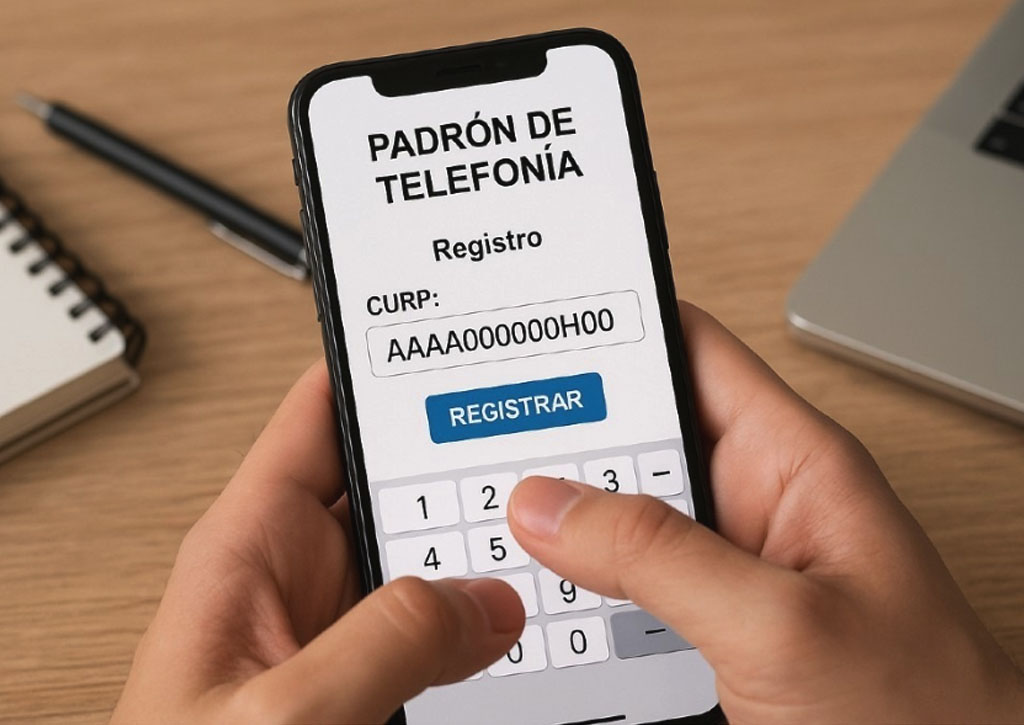
With a handful of weeks to go before Mexico’s mandatory cell phone registration deadline on June 30, 2026, registrations are finally starting to tick upward.
But a significant portion of the population is refusing to comply, citing fears over data privacy and a profound distrust of the government.
The Registro Nacional de Usuarios de Telefonía Móvil (Renaut) requires every mobile phone user to link their SIM card to their CURP (Unique Population Registry Code) and a valid ID – or risk losing service entirely.
As the cut-off approaches, registrations have gradually increased, but the numbers remain troublingly low. As of late May, only about 49.5 million of the country’s estimated 158 million active lines had been registered, a compliance rate of just 31%.
Other reports put the figure even lower, reporting that only 28.3 million of 161.7 million lines had been processed – barely 17.5 percent of users.
How to Register
For those wishing to register their line, the Mexican government has set up a step-by-step tutorial (in Spanish). The process is simple and requires an INE voters’ card or, for foreigners, a valid passport.
Because of the rush to register, the websites of several companies, including Telcel and AT&T, have been experiencing technical problems, so getting it done may not work on the first try.
However, after three attempts, if the registration is not completed properly, the system will stop working, forcing a phone reset, the use of another device, or a visit to the mobile carrier’s offices.
Privacy Fears and a Troubled History
The government claims the registry is a crucial tool to combat extortion and phone fraud, but many Mexicans remain unconvinced. This is not the country’s first attempt at such a measure. A similar database, Renaut, was scrapped in 2011 after it was discovered that user information was being sold in open-air markets. In 2022, the Supreme Court declared a similar biometric registry unconstitutional, citing privacy violations.
Civil liberties groups, such as the Network for Digital Rights (R3D), warn that the new system is still deeply flawed, as security authorities can request data from telecoms without a court order – a dangerous loophole in a nation plagued by corruption and cyberattacks. These fears are not hypothetical. Recent years have seen a series of catastrophic breaches, including a 2022 hack of the Secretariat of National Defense (Sedena) that exposed seven terabytes of classified documents and a 2024 attack on the Presidency’s Legal Counsel that leaked 206 GB of sensitive data.
“There are reports that similar databases have been hacked or sold. So, it is not unreasonable for people to worry that their name, CURP, and cell number could end up in the hands of criminals,” an analyst stated, summarizing the public’s predominant anxiety.
“Time to Revise”: Carlos Slim Weighs In
Adding a powerful voice to the criticism, Mexican billionaire Carlos Slim – whose company América Móvil owns the country’s largest carrier, Telcel – has publicly called for the government to reconsider its strategy. Slim described the registration process as “very complicated” and argued that the deadline is too short, particularly for the prepaid market, which accounts for roughly 80% of all lines.
“I think they should give it a ‘re-study’ to make it more efficient,” Slim said, suggesting the current timeline is unrealistic for millions of users.
Skepticism Regarding Actual Suspensions
The most widespread belief among the unregistered is that the promised service suspension is a bluff. A huge number of Mexicans do not believe that phone companies will follow through on disconnecting their service.
Many are convinced that a last-minute amnesty will be granted or that the Supreme Court, which has already struck down similar mandates, will step in at the eleventh hour to block the cut-off.
As of May 2026, authorities maintained that no extension would be granted, but with the deadline looming, many are betting on last-minute political or judicial intervention. The coming weeks will determine whether the government’s security gamble pays off, or if millions of cell phones go silent.