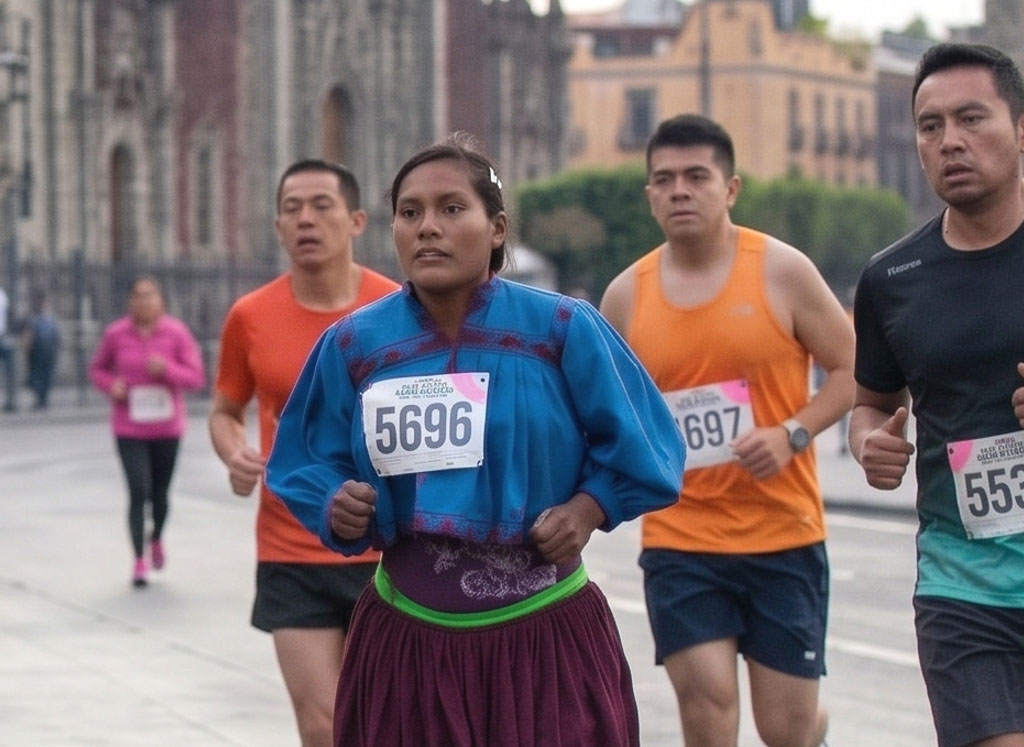
Five Indigenous Mexican runners have returned home as heroes after a stunning performance at the 23rd Great Wall Marathon in China, sweeping the podium in multiple categories and shattering a long-standing record.
The team, made up of three Rarámuri athletes—Sabina, Mario, and Antonio—alongside Mixtec runners Miriam and Balbina, secured two gold medals, two silver medals, and one bronze across the 21K and 42K events. Twenty-year-old Miriam delivered the most remarkable performance of the day, setting a new women’s half-marathon record in 1:38:49, nearly six minutes faster than the previous mark.
The athletes are part of México Imparable (Unstoppable Mexico), a government-backed program launched in August 2025 to elevate Indigenous talent onto the global stage. Photos of the five women and men, standing proudly before the ancient fortress in their traditional attire, have since gone viral, sparking widespread celebration across Mexico as a powerful symbol of Indigenous identity and national pride.
The Rarámuri: The ‘running people’ of the Copper Canyons
The Rarámuri, often historically referred to as Tarahumara, are a Uto-Aztecan people who inhabit the remote, rugged terrain of the Sierra Madre Occidental in Chihuahua, Mexico. The name Rarámuri translates to “those who run fast” or “foot-runners,” and it is a title earned through centuries of necessity.
When Spanish colonizers arrived in the 16th century, the Rarámuri retreated into the labyrinthine canyons of the Copper Canyon, a natural fortress where they largely avoided subjugation. Historically, they were never fully conquered by the Spanish conquistadors or the Jesuits, preserving much of their ancestral culture. In this isolated environment, running was not a sport but a key survival tool for hunting, inter-village communication, and transportation across dispersed settlements.
Scientific theories: Why are they so unstoppable?
Researchers have long been fascinated by the Rarámuri’s seemingly superhuman endurance—often comparing them to “modern Spartans”—and have offered several explanations for their legendary stamina.
First and foremost is lifestyle. While modern athletes dedicate hours to regimented training, the Rarámuri are simply living their lives. Their day-to-day existence in the high-altitude canyons, often above 2,000 meters (6,500 feet), involves constant, low-intensity activity, from herding cattle to transporting goods. This has imbued them with a remarkable cardiovascular efficiency.
Furthermore, the Rarámuri’s diet of corn, beans, and pinole (a powdered maize drink) offers a steady release of complex carbohydrates without processed fats or sugars. National Geographic studies have noted that Rarámuri communities experience virtually zero rates of diabetes, heart disease, or cancer, a testament to this organic, high-resilience fuel.
Their minimalist footwear, huaraches made from recycled tire rubber, forces a natural mid-foot strike that avoids the heavy heel impact common in modern running shoes, potentially reducing the risk of long-term injuries. Combined with a cultural ethos where running holds deep spiritual and ceremonial importance (such as the ancient ball-kicking game rarajipari), the Rarámuri have effectively trained their bodies for ultra-marathons for centuries.