The recent death of Noelia Castillo in Spain has reignited a global conversation about medical aid in dying. After an 18-month legal battle that reached the European Court of Human Rights, the 25-year-old Spaniard finally accessed euthanasia—a case her father and conservative groups had fought to block. For activists in Mexico, Castillo’s ordeal was both a warning and a catalyst: a reminder that determined opposition can prolong suffering, and proof that the right to die can be legally protected.
The Face of the Right to Die in Mexico
At the heart of Mexico’s movement is 30-year-old Samara Martínez. Diagnosed with lupus and chronic kidney failure, the journalist from Chihuahua has transformed her own terminal condition into a national campaign. In August 2025, she launched the “Ley Trasciende” (Transcend Law), a citizen initiative to reform Mexico’s General Health Law and Federal Penal Code. Current law classifies euthanasia as “homicide by mercy”—punishable by 4 to 12 years in prison—and assisted suicide as a crime carrying 1 to 5 years. The proposed legislation would allow terminally ill adults to request medical assistance in dying, shifting the framework from criminal prohibition to regulated access.
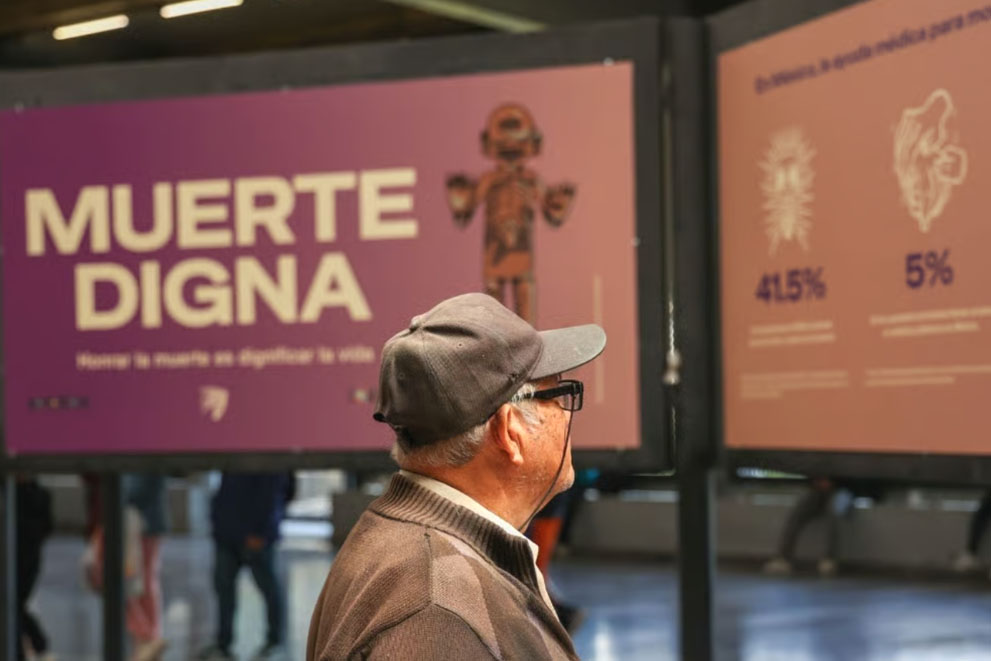
Martínez has taken this conversation to unconventional spaces. In March 2026, she inaugurated “Muerte Digna ¡Ya!” (Dignified Death Now!), an art installation in Mexico City’s Metro system. The exhibition, featuring informational panels and personal testimonies, aims to reach the thousands of commuters who daily face chronic illness and suffering in silence.
Political traction has followed. Martínez has gathered over 130,000 signatures, presented the initiative to Congress, and filled auditoriums at the Senate and UNAM. Legislators from both the ruling Morena party and the opposition have expressed support, with a potential vote expected in late 2026. Public opinion appears favorable, with surveys showing 70% of Mexicans backing active euthanasia.
Political, Cultural, and Religious Challenges
Yet significant hurdles remain. Mexico remains deeply Catholic, and the Church hierarchy has historically mobilized against progressive legislation. More nuanced resistance comes from within medicine itself. A 2025 study of palliative care clinicians at Mexico’s National Cancer Institute revealed a “paradox”: doctors who witness daily suffering often position themselves against euthanasia, viewing their role as managing suffering through palliative care rather than ending it.
Mexico lags behind countries like the Netherlands and Canada, where assisted dying has been legal for years. The Netherlands permits euthanasia for psychological suffering and patients as young as 12; Canada’s MAID framework has steadily expanded since 2016. In Latin America, only Colombia and Ecuador have legalized the practice. Mexico would become the third if the Ley Trasciende passes.
The Castillo case underscored a critical vulnerability: even in countries with euthanasia laws, family objections can delay access. Castillo’s father challenged her request for 18 months, requiring European Court intervention. Mexican activists see this as a cautionary tale about the need for clear, unimpeachable legal frameworks.
For Martínez, whose own health continues to decline, the fight is personal. She speaks of wanting to die surrounded by family, without pain—a choice currently denied to terminally ill Mexicans. “Since the disease took away our opportunity to choose how to live,” she said recently, “at least let us have the choice of how to leave.”