
Mexico City’s Museo Nacional de la Estampa — one of the country’s premier destinations for graphic arts — is getting a significant makeover as it marks its 40th anniversary. The National Institute of Fine Arts and Literature, known as Inbal, has launched a MX$3 million (roughly US$150,000) renovation that is expected to wrap up by May 30.
The work covers a wide range of improvements. New lighting will be installed in all exhibition halls, the facade will be repainted, and gallery floors will be replaced. Workers will also clean Vitral para el Munae, a stained-glass artwork by the late visual artist Salvador Piñoncelly, who spent more than five decades creating glass works for public buildings across Mexico. The renovation also includes carpentry and metalwork on the building’s windows, new awnings, restroom upgrades, and a redesigned ticketing area.
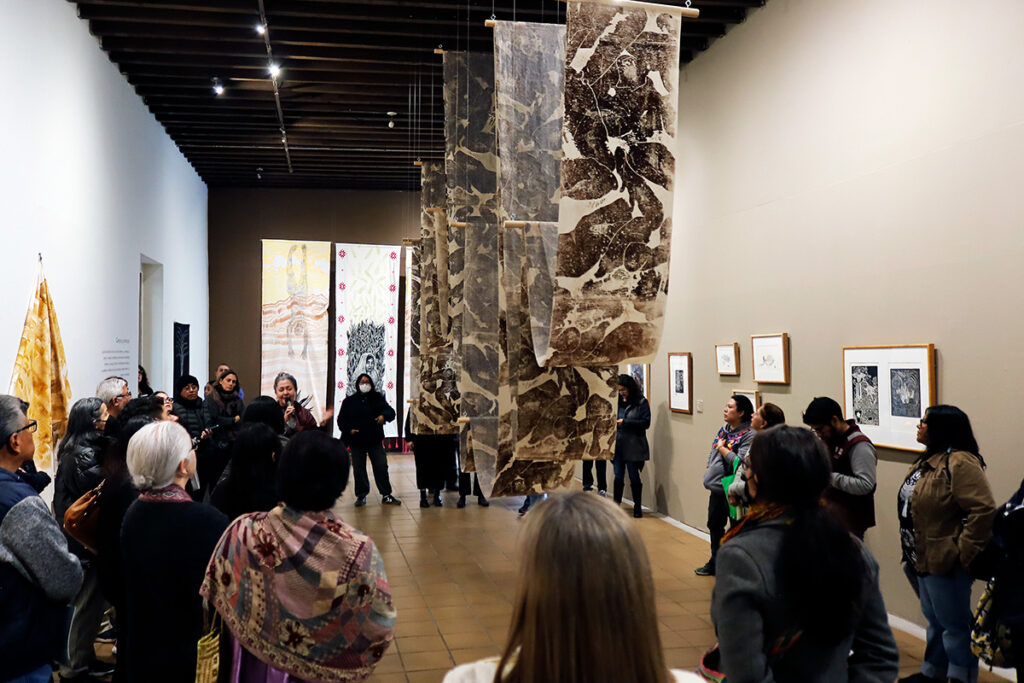
According to Inbal, the projects are being supervised by the Dirección de Arquitectura, the Dirección de Recursos Materiales, and Cencropam — the national center responsible for the conservation of Mexico’s movable artistic heritage.
Munae opened Dec. 17, 1986, by presidential decree, with the stated mission of collecting, preserving, and promoting the graphic work of Mexican and foreign artists. It sits on Av. Hidalgo 39, on the Plaza de la Santa Veracruz in the capital’s historic center — a colonial-era square that also includes the Franz Mayer Museum and the Church of Santa Veracruz. The 19th-century Neoclassical building that houses the museum was remodeled at its founding to accommodate galleries while preserving its original character.
Over nearly four decades, Munae has assembled a collection of more than 12,500 works, spanning Prehispanic clay seals, colonial-era woodcuts, lithographs from the Academy of San Carlos period, and contemporary prints. The museum has organized some 350 temporary and traveling exhibitions, making it a steady anchor in Mexico City’s cultural calendar. Among its curiosities is an 1800 Washington printing press, one of the oldest engraving machines still on display anywhere.
Printmaking has deep roots in Mexican artistic identity. Long before the muralist movement of the 20th century, graphic art served as a vehicle for social commentary and popular culture — most famously in the work of José Guadalupe Posada, whose skeletal caricatures helped define a national visual language. The medium later shaped artists like José Clemente Orozco and David Alfaro Siqueiros, whose graphic works are held in related collections at the nearby Museo Nacional de Arte.
Mexico City is second only to London in total number of museums, and Munae occupies a distinctive niche in that crowded field. It’s compact by the standards of the megalopolis — a focused collection rather than an encyclopedic one — and it regularly draws visitors who want to try their hand at printmaking in its public workshop. Those interactive sessions, where visitors can carve or press their own linocut, have made it a favorite stop for travelers looking for something beyond the usual tourist circuit. For more on the capital’s museum scene, Yucatán Magazine has covered Mexico City’s National Museum of Anthropology, widely regarded as one of the world’s finest.
The museum will remain closed during the renovation. Inbal has not announced a formal reopening event, though the May 30 target would position Munae for a summer reopening. More details are available through Inbal’s official site.
Museo Nacional de la Estampa — At a Glance
- Address: Av. Hidalgo 39, Plaza de la Santa Veracruz, Centro Histórico, Mexico City
- Founded: Dec. 17, 1986, by presidential decree
- Collection: More than 12,500 works from Prehispanic seals to contemporary prints
- Renovation budget: MX$3 million (approx. US$150,000)
- Projected reopening: May 30, 2026
- Supervising agencies: Dirección de Arquitectura, Dirección de Recursos Materiales, Cencropam
Source: Excélsior