
In the ruins of Huitzo, Oaxaca, Mexico, archaeologists have uncovered a secret that had been locked in stone for over thirteen centuries. The discovery christened Tomb 10 of Huitzo is not just another ancient burial. Leading experts from Mexico’s National Institute of Anthropology and History (INAH) are calling it the most important archaeological discovery in the country in the past decade.
The find forces historians to rewrite the timeline of what they thought they knew about one of Mexico’s foundational cultures: the Zapotecs.
To understand the shock of this discovery, we must first understand the people who built it. The Zapotec civilisation, often called (Loosely translated as the Cloud People), flourished in the Valley of Oaxaca for more than two thousand years. Around 500 B.C.E, they accomplished something remarkable. They built one of the first major cities in all of the Americas: Monte Albán.
This great city was constructed on top of a mountain, leveled by hand. The Zapotecs were master architects, creating grand plazas, ball courts, and intricate tombs. They developed one of the earliest writing systems in the Americas, recording their history and rituals on stone.
The Archaeological Site of Huitzo
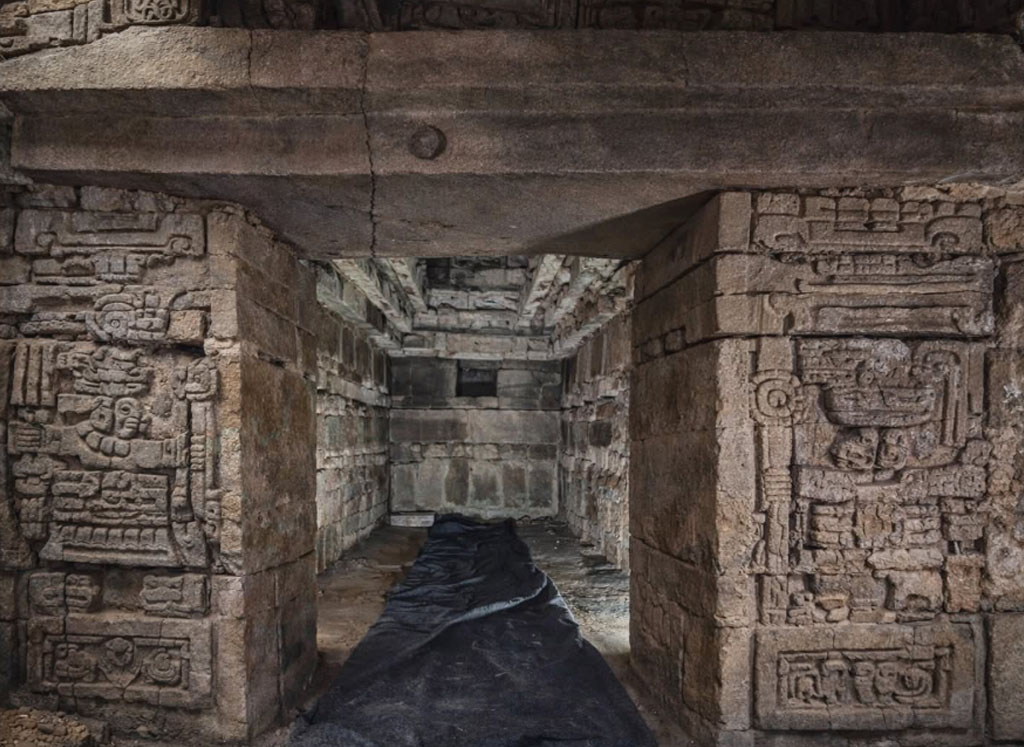
Huitzo, known in ancient times as Etlatongo, was one of these important towns in the northern part of the valley. It was a significant center in its own right. Tomb 10 was found deep within the main pyramid at the core of Huitzo. The tomb itself is a chamber carved directly into the bedrock, the solid layer of rock beneath the soil. Its entrance was sealed with a heavy, rectangular stone slab. This seal was intact, a crucial fact. It meant that for all those centuries, the tomb had remained untouched by looters. Everything inside was exactly as the Zapotec people had left it during a royal funeral ceremony around 700 C.E.
The Treasures Found Within Tomb 10 of Huitzo
When archaeologists carefully opened the tomb at Huitzo, they found the burial of a single adult male. His position and the treasures surrounding him left no doubt: this was a person of great authority. He was likely a cocijo, a king, or a supreme priest of Huitzo. But it was the objects buried with him that caused such a stir among researchers.
The contents of Huitzo’s Tomb 10 are extraordinary for their material and their craft. The most stunning find is a large pectoral, a kind of chest ornament, shaped like a crescent moon. It is made of solid gold. The craftsmanship is exquisite, with fine details that show a highly skilled artisan made it. This alone was a surprise. Before this tomb, experts believed the Zapotecs of this period worked primarily with jade, obsidian, and ceramic. Gold was associated with later cultures, like the Mixtecs, or with peoples far to the south. Finding this much gold in a Zapotec tomb from this early date completely changes the story.
The golden pectoral was not alone. The royal body was adorned with numerous other gold ornaments, including beads and pendants. There were also beautiful pieces made of jade, a green stone the Zapotecs valued above all for its symbolic link to life and water. He wore ear spools and necklaces of this precious material. There were also sharp blades made from obsidian, a volcanic glass used in ceremonies.
Along the walls of the tomb, the archaeologists found several large ceramic urns. These are not simple pots. They are elaborate sculptures, often depicting important figures in formal poses. These are believed to represent ancestors or gods, placed there to guard and accompany the ruler into the afterlife. The combination of gold, jade, and these sacred urns created a burial scene of unmatched richness for this period in Zapotec history.
The elaborate tomb at Huitzo shares features such as refined stucco work and owl imagery with other remarkable tombs, like those at Lambityeco and Zaachila, but is of scientific importance comparable perhaps only to Tomb 7 of Monte Albán.
So, why is this single tomb considered the discovery of the decade? First, it challenges the timeline of technological and trade developments. The gold proves that the Zapotecs, at least by 700 C.E., had mastered complex metalworking or had strong trade networks that brought finished gold objects from other regions. This shows they were far more connected to the wider Mesoamerican world than previously proven.
Second, it reveals a shift in political power. The tomb dates to a time when the great capital of Monte Albán was beginning to lose its tight control over the valley. The incredible wealth buried in a secondary center like Huitzo suggests that local rulers were growing very powerful. They had the resources to command such treasures and the authority to take them to the grave. It paints a picture of a valley with multiple strong kingdoms, not just one dominant capital.
Because the tomb had never looted or even opened until its discovery, its context remained untouched, a real rarity. Every artifact was in its original place, telling a clear and truthful story about the burial rituals and the social status of the individual.