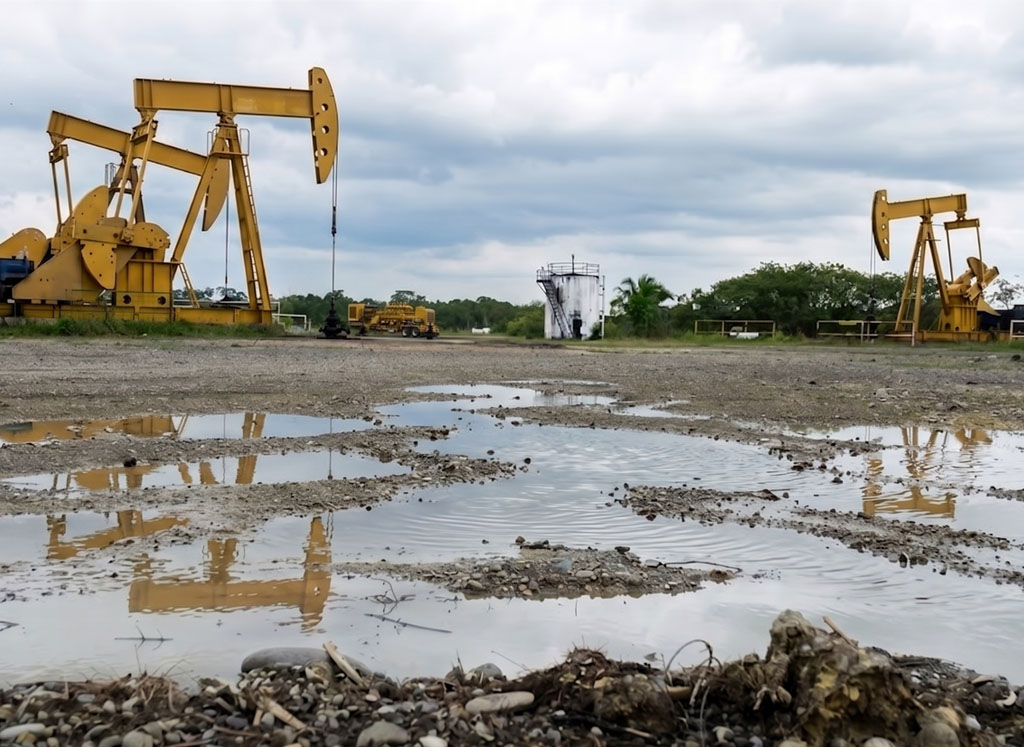
President Claudia Sheinbaum has signaled a major policy shift by opening the door to new natural gas extraction technologies, a decision that environmental groups and energy experts warn could be a dangerous leap into an environmental “dead end.”
During her daily press conference this week, Sheinbaum defended the exploration of non-conventional gas extraction techniques, arguing they are essential to “fortify” the nation’s energy sovereignty. This marks a significant reversal from her previous staunch opposition to hydraulic fracturing, the controversial process more commonly known as fracking.
While the President insists she is rejecting “traditional fracking” due to its severe environmental impacts, she has proposed a scientific committee, including experts from UNAM and the IPN, to evaluate newer, purportedly “low-impact” methods. However, more than 80 civil society organizations, including the Mexican Alliance Against Fracking, immediately condemned the proposal.
“The idea of a ‘sustainable’ version of fracking may sound promising in a speech, but in reality, it does not exist,” the coalition said in a blistering statement, accusing the administration of a “political U-turn” that breaks campaign promises.
What is Fracking and Why is it a Problem?
Hydraulic fracturing, or fracking, is the process of injecting a high-pressure mixture of water, sand, and toxic chemicals deep into underground rock formations to crack them open and release trapped oil or gas.
While the industry has hailed it as a bridge to energy independence, the technique is deeply controversial due to a catastrophic list of side effects documented over the last 15 years across more than 2,300 scientific studies.
In the United States, the cradle of the fracking boom, the consequences have been dire. The disposal of fracking wastewater—so chemically laden it cannot be returned to the water cycle—has been directly linked to a dramatic surge in earthquakes in states like Oklahoma and Texas.
Furthermore, the industry is currently facing a wastewater crisis. In the Permian Basin, for every barrel of oil extracted, up to five to six barrels of toxic brine are produced. Disposal wells are overloading, leading to leaks, ground deformation, and the potential contamination of freshwater reserves. These “new technologies” touted by the government—such as using treated wastewater or seawater—have been tested in the US but have not become standard practice due to prohibitive costs, ranging from $5 to $10 million per installation.
The Pemex Factor: Corruption and Catastrophe
Even if the technical hurdles of fracking could be overcome, experts argue that Mexico is uniquely ill-equipped to manage the risks, primarily due to the state of Petróleos Mexicanos (Pemex). The state-owned giant has a notoriously poor environmental and safety record, raising profound questions about its ability to regulate a process as volatile as fracking.
The skepticism is not unfounded. Just this week, Pemex admitted that one of its undersea pipelines caused a massive oil spill in the Gulf of Mexico, which has already soiled beaches and threatens biosphere reserves like Los Tuxtlas. This incident is merely the latest in a long history of disasters.
Furthermore, a 2024 fatal incident at the Pemex Deer Park Refinery in Texas, which released over 27,000 pounds of hydrogen sulfide gas, killing two workers, highlighted the company’s ongoing struggles with maintenance and safety protocols.
Critics argue that entrusting Pemex with the high-stakes, precision-dependent task of fracking is reckless. Analysts point to the soaring costs and operational failures of the Dos Bocas refinery as evidence that Pemex cannot handle complex projects.
“The President, blinded by ideology, starts from an error,” one political analysis noted. “The enormous limitations of Pemex are not being considered. The overcosts and operational problems of the Dos Bocas refinery should be enough not to entrust a single project more to them”.
The Numbers Don’t Add Up
Beyond the environmental and institutional risks, the coalition of NGOs argues that the economic rationale for fracking in Mexico is fundamentally flawed. Currently, Mexico imports 75% of its natural gas, creating a dependency Sheinbaum wishes to break.
However, the math does not support the plan. According to Pemex’s own Strategic Plan, by 2035, Mexico would only produce 4.988 billion cubic feet per day (MMpcd) of gas. This falls drastically short of the current national demand of 9,000 MMpcd.
“Energy sovereignty will not be achieved by extracting Mexico’s dwindling gas reserves,” the NGOs argued. “Even if we could extract all the gas in our subsoil, it would be insufficient to supply the growing demand for fossil gas”.