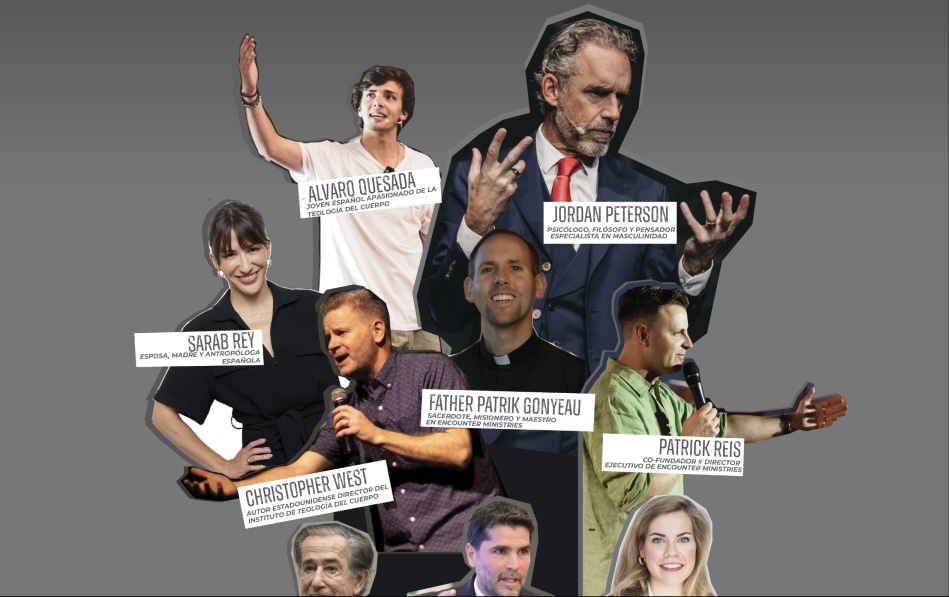
A masculinity conference billed as the largest of its kind in Latin America is coming to Guadalajara this month — and it has sparked a broader debate about how Mexican society thinks about men, manhood, and the weight of tradition.
Fearless Congress 2026 runs April 17–19 at the Santuario de los Mártires in Tlaquepaque, a suburb of Guadalajara, Jalisco. Organizers expect more than 10,000 attendees. Tickets range from MX$1,450 to MX$7,490 (about US$82–US$422).
The speaker lineup includes Canadian psychologist Jordan Peterson, retired Spanish footballer Carles Puyol, Spanish psychologist Isabel Rojas Estapé, Catholic speaker Christopher West, and Mexican actor and activist Eduardo Verástegui, who has publicly supported U.S. President Donald Trump.
The event is promoted as addressing a male identity crisis. “We are living through a silent crisis,” reads the Fearless website: “men confused, empty and disconnected from their purpose.” Andrés Villaseñor, the organizer, says men have “lost their way” and face depression, addiction, and lack of purpose — and must “return to the original plan” to become “defenders, protectors and providers.”
The event drew controversy before it opened. Government logos from Jalisco, Guadalajara, and Zapopan appeared on the Fearless website, suggesting official backing, though they were removed by April 7. The nature of any institutional support has not been publicly confirmed. The sponsoring governments all belong to Citizens’ Movement (MC), a party nominally classified as center-left and social-democratic, but Jalisco has long been a socially conservative state with deep Catholic roots, and critics questioned whether public platforms should be used to promote an event with such a specific ideological and religious focus.
Critics have also linked the conference to the broader “manosphere” — a network of online communities that, according to the United Nations, promotes masculinity while trivializing gender-based violence and reinforcing discriminatory stereotypes. The UN has labeled the manosphere a serious threat to gender equality.
Machismo and Its Discontents
The timing puts a spotlight on something Mexico has been wrestling with for decades. Machismo — a cultural code built around dominance, stoicism, and male authority — remains one of the more persistent forces in Mexican social life. Its roots trace back to the Spanish conquest, when colonial structures combined with Catholic doctrine to lock in rigid expectations for men and women alike.
At its most benign, the code encourages men to work hard, protect their families, and carry their burdens without complaint. At its most destructive, it has been linked to elevated rates of domestic violence, femicide, mental health struggles among men, and the systematic exclusion of women from economic and political life. Mexico records roughly 10 femicides per day, according to government data — a figure that advocates tie directly to entrenched gender norms.
Those norms are shifting, if slowly. Feminist marches across Mexico have brought sustained public pressure, and President Claudia Sheinbaum’s election in 2024 as the country’s first female head of state was widely seen as a cultural turning point. Women now hold roughly half the seats in Mexico’s Senate and nearly half in the Chamber of Deputies.
Yet legislative progress and cultural change don’t always move together. Groups like Gendes A.C. in Mexico City have worked for years to reach men directly — running Alcoholics Anonymous-style meetings to help men understand and confront how gender-based violence operates. Their director has put it plainly: “A macho in rehabilitation is a man in deconstruction.”
2 Visions of Manhood
What makes Fearless interesting — and contested — is that it enters this debate from the opposite direction. Rather than interrogating machismo, it frames traditional masculinity as something worth recovering. Critics say that framing glosses over the harm those traditional roles have caused, particularly to women. Others argue that addressing male alienation and mental health shouldn’t be dismissed simply because it comes wrapped in conservative theology. Men in Mexico — and across Latin America — do face real crises: higher rates of suicide than women, lower rates of therapy use, and persistent pressure to perform a version of strength that leaves little room for vulnerability.
What’s clear is that the conversation isn’t going away. Whether the forum is a feminist rally on the Paseo de Montejo, a therapy circle in Roma, or a weekend conference in Jalisco, more and more Mexicans are asking the same question from different angles: What should it actually mean to be a man here?
That debate, for better or worse, just got a very large stage.
At a Glance: Fearless Congress 2026
- Dates: April 17–19, 2026
- Venue: Santuario de los Mártires, Tlaquepaque, Jalisco
- Expected attendance: 10,000+
- Ticket prices: MX$1,450–MX$7,490 (approximately US$82–US$422)
- Speakers include Jordan Peterson, Carles Puyol, Isabel Rojas Estapé, Christopher West, Eduardo Verástegui
- More information: fearlessmasculinity.com
Sources: El Occidental, Mexico News Daily