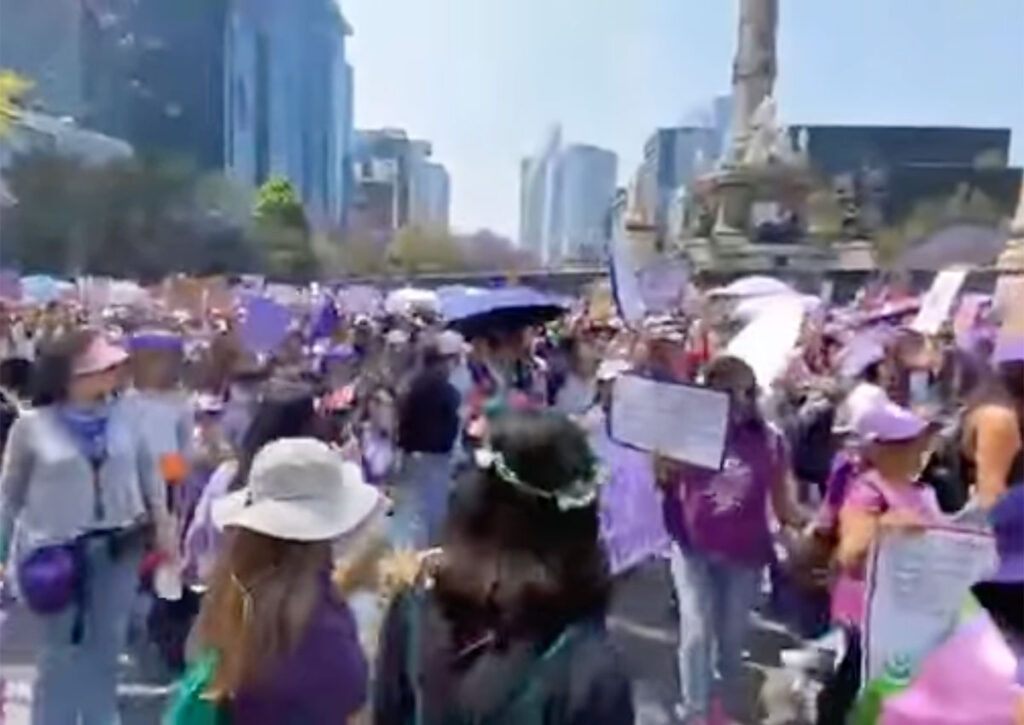
One of Mexico’s largest annual protests unfolded Sunday in Mexico City, with more than 120,000 women flooding the streets to mark International Women’s Day and demand an end to gender-based violence. The demonstration, widely known as 8M, drew participants from across the capital, who converged on Paseo de la Reforma before marching toward the Zócalo, the city’s historic central plaza.
Mexico City Mayor Clara Brugada praised the event as a testament to the capital’s political character. “This city has demonstrated, once again, that it is a capital of rights and freedoms, where any expression and demonstration is fully respected and guaranteed,” she posted on social media. “More than 120,000 women took to the streets of our city peacefully, in a day that concluded without major incidents.”
An All-Female Police Deployment
Security arrangements reflected the march’s scale. The Secretaría de Seguridad Ciudadana (Mexico City Public Safety Secretariat) deployed 400 female officers from the Ateneas unit — a specialized all-women police corps — who accompanied the march equipped only with helmets, shields, and some fire extinguishers. No arrests of protesters were made.
The march began gathering from around 10 a.m. at the Glorieta de Amajac and other staging points, with the final contingents clearing the route by 8:30 p.m. Medical crews from the emergency response unit ERUM (Escuadrón de Rescate y Urgencias Médicas, or Rescue and Medical Emergency Squadron) attended to 90 people during the day — mostly minor issues — including 14 police officers.
Brugada singled out the participating officers for recognition. “When women raise their voices, society advances, and when their rights are guaranteed, justice is strengthened,” she said.
Minor Incidents at the Margins
Not everything was entirely without incident. Police identified a masked group, unconnected to the march itself, attempting to damage a building on Avenida Juárez. Officers encircled the group near Calle 5 de Mayo and confiscated several tools, including hammers and a pickaxe. Around 20 men — described by authorities as outsiders to the demonstration — broke windows at a Mexico City government building. Eight were detained; five were referred to the attorney general’s office, and three were sent before a civic court judge.
Damage to nearby businesses was limited to broken glass at four commercial properties. Marchers themselves intervened to push the disruptive group away from the main procession.
A Movement Rooted in Urgency
The 8M march has become Mexico’s most significant annual political demonstration. The driving force is a femicide crisis that has persisted for years. An average of 10 women are killed per day in Mexico, according to the Washington Office on Latin America and other advocacy organizations. Only one in 10 cases involving femicide results in a conviction. In the weeks before this year’s march, two women who attended the Autonomous University of the State of Morelos were reported missing and later found dead, adding fresh urgency to a movement that has been building for years.
721 femicides were registered in Mexico in 2025 alone — and the real figure is likely far higher. In 2024, 3,601 women were reported missing in the country, a number that has been rising steadily.
The marches have grown steadily in size and intensity over the past decade. In 2024, over 180,000 people rallied in Mexico City, denouncing rampant gender violence. Participation this year, at 120,000, reflected a somewhat smaller but still massive turnout in the capital, with parallel demonstrations held in cities across the country.
Beyond Mexico City
Protests took place nationally, from Guadalajara to Cancún to Mérida. Last year’s 8M marches across Mexico brought together thousands of women in Yucatán alone, with participants carrying signs reading “No means No” and “We want to stay alive.”
The issue has reached the highest levels of government. President Claudia Sheinbaum, who took office in 2024 as Mexico’s first female president, acknowledged Sunday that more work remains. Her administration has pointed to a decline in femicide numbers and updates to investigation protocols, though advocates say impunity remains the central obstacle.
For the women who marched Sunday, the message was the same as it has been for years: they want to be safe, they want justice, and they are not going away.
Read more on gender violence in Mexico from CBC News.
Quick Facts
- The March 8 march in Mexico City drew an estimated 120,000 participants, according to city authorities
- 400 female officers from the Ateneas police unit provided security, armed only with helmets and shields
- Eight men, described as outsiders to the march, were detained for property damage
- 90 people received medical attention during the event; all cases were minor
- An average of 10 women per day are killed in Mexico due to gender-based violence
- 721 femicides were officially recorded in Mexico in 2025, with the true figure believed to be higher
- Only about 1 in 10 femicide cases in Mexico results in a criminal conviction
Source: Excélsior