
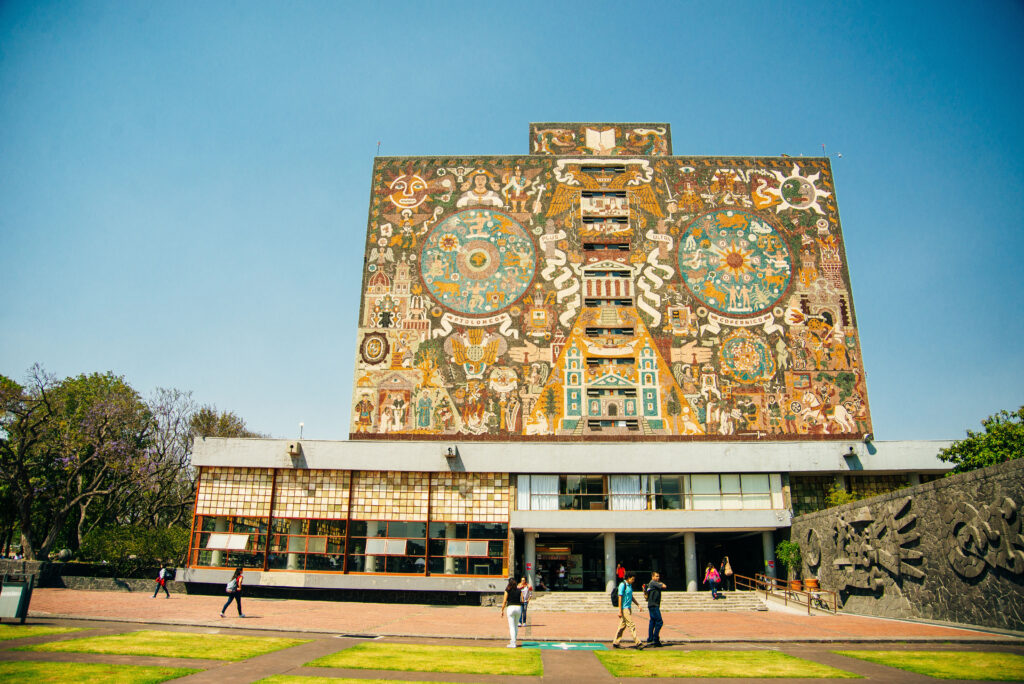
Each exterior wall of UNAM’s Biblioteca Central in Mexico City tells of different eras. The north wall of the Central Library faces the pre-Hispanic past. It shows the duality of life and death. On one side are the gods of life and creation. Quetzalcoatl appears as a feathered serpent. Tlaloc carries a mat on his back. On the other side are the gods of darkness and death. Tezcatlipoca stands with a skull. Mictlantecuhtli rules the underworld. At the bottom is the founding of Mexico-Tenochtitlan.
The south wall faces the colonial past. Here, the grand structure’s architect, Juan O’Gorman, shows a clash of two worlds. Two large circles represent the opposing ideas of Ptolemy and Copernicus. One shows the Earth at the center of the universe. The other shows the sun at the center. This symbolizes the revolutionary shift in thought that accompanied the conquest.
The library, which opened on April 5, 1956, after years of planning by O’Gorman, who was also a painter, and fellow architects Gustavo Saavedra and Juan Martínez de Velasco. Carlos Lazo managed the larger project to build the entire university campus.
The library was not originally meant to be just a university library. The plan was to house the National Library and the National Newspaper Archive. That changed during construction. When it opened, it became the university’s Central Library. It started with about 80,000 volumes.
The building has 10 floors. It is built on a platform raised three meters above the ground. The lower part is made of dark volcanic stone carved by hand. This stone came from the rocky ground of El Pedregal de San Ángel, where the university was built. The reading room has thin slabs of tecali stone that softly filter the light. The upper 10 floors have no windows. They are completely closed to protect the books from sunlight and to control temperature and humidity.
O’Gorman covered the four blind facades of the tower with a mosaic of colored stones. He called it Historical Representation of Culture. It covers 4,000 square meters and is one of the largest murals in the world made of natural stone tiles. O’Gorman traveled across Mexico to find stones in the right colors. He collected 12 different shades. For the blue tones, he could not find a stone that satisfied him. He used pieces of colored glass instead.
The idea came from his work with Diego Rivera on the Anahuacalli Museum. Rivera was building a museum for his collection of pre-Hispanic art. O’Gorman learned there how to work with volcanic rock and how to make mosaics that would last outdoors.
The east wall faces the modern world. It shows the Mexican Revolution and the struggle for social justice. Emiliano Zapata appears on this wall. A red star represents socialist ideas. The atom floats at the top as a symbol of science and the new age.
The west wall faces the university and modern Mexico. O’Gorman dedicated this side to the UNAM itself. It shows the university seal and its motto. This wall represents the university’s role in advancing Mexican culture.
There is another layer to the design. The whole building is shaped like the face of Tlaloc, the rain god. The two large circles on the north wall are his eyes. The central lower part is his nose. The entrance doors are his mouth. This was not an accident. O’Gorman was a deep admirer of pre-Hispanic culture. He hid this figure in plain sight.
In July 2007, UNESCO declared the Central Library and the whole central campus of University City a World Heritage Site. They called it a unique example of 20th-century modernism that integrates urbanism, architecture, engineering, landscape design, and fine arts.
The library has grown far beyond its original collection. Today, it holds about 1.5 million volumes. More than 500,000 theses are kept there. There is a rare book collection with works printed in the 15th through 18th centuries. One treasure is an incunable of Las Siete Partidas by Alfonso the Wise, printed before 1501.
The library is one of the most photographed buildings in Mexico City. It appears in movies, music videos, and television shows. Students use it as a meeting point. Visitors come from all over the world to stand before its walls. It is on postcards, t-shirts, and souvenirs. When people think of UNAM, they see this building. When they think of Mexican modern art, they see these walls. It has become a symbol not only of the university but of the country itself.
If you go
The UNAM campus, where the library is located, is easily accessible through Mexico City’s Line 3 subway station. Taking a taxi or ride-sharing service is also an option, but traffic in the area can be quite heavy. The campus is very large, so make sure to wear comfortable shoes. Since you will already be in the area, consider visiting the ruins of Cuicuilco, which are just to the south of the UNAM campus. This archaeological site is the oldest in Central Mexico, as it was built in the 8th century B.C.E. The site also serves as a natural reserve of sorts, which is great for birding, and has an impressive museum.