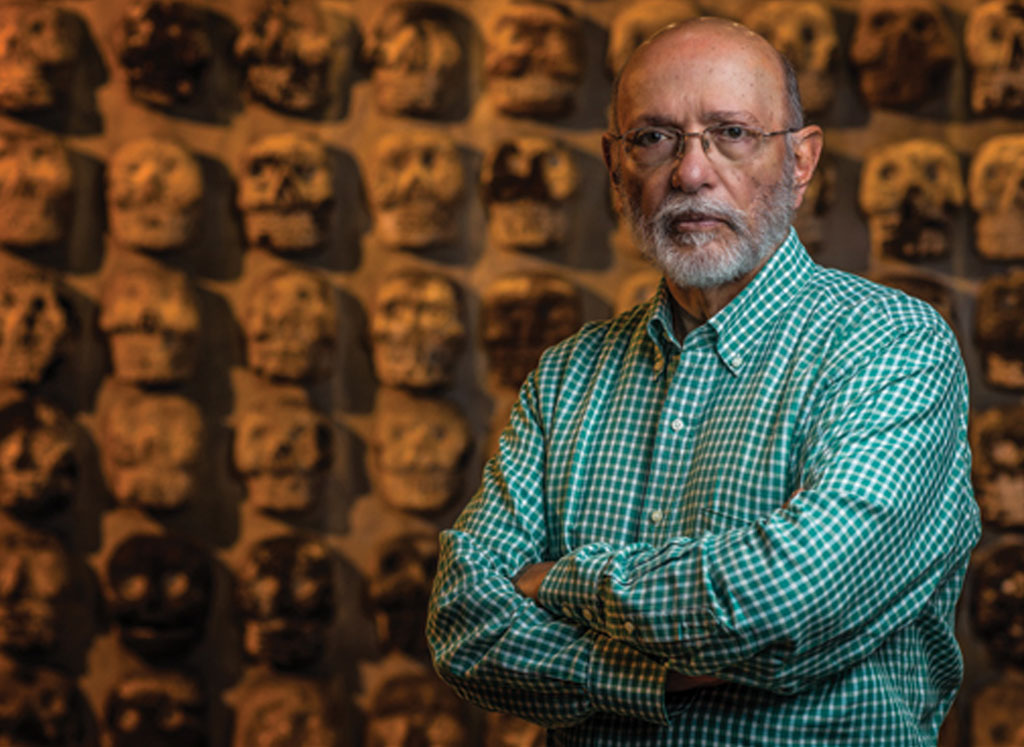
Eduardo Matos Moctezuma, the 86-year-old emeritus professor of the National Institute of Anthropology and History (INAH) and the legendary director of the Templo Mayor Project, has broken a long silence to issue a devastating critique of the institution to which he dedicated his life.
In a series of statements, he warns that INAH is undergoing cumulative deterioration, hindered by chronic budget shortages, bureaucratic paralysis, and political pressures that threaten to erode its ability to protect the country’s ancient heritage.
The Conscience of a Master
In a recent article titled “These Times We Live In,” published in the magazine Arqueología Mexicana, Matos Moctezuma pulls no punches. He describes as “desolate” the relocation of archaeological facades and elements to so-called “Memory Parks” as part of the Mayan Train megaproject. Beyond this specific project, he expressed a deep-seated “disenchantment” at seeing museums and archaeological sites lack the necessary resources for maintenance, while young graduates of the National School of Anthropology and History (ENAH) cannot get hired because the Ministry of Finance refuses to open permanent positions.
His criticism also takes aim at what he sees as attempts to rewrite history for political ends.
“I stopped hearing my voice when they tried to change the founding date of Tenochtitlán,” he states, referring to official attempts to place the event in 1325 to align with a presidential term. Similarly, he recently condemned the sanitization of pre-Hispanic history, specifically the denial of the well-documented practice of human sacrifice among the Mexica.
An Accumulated Crisis
For Matos, these are symptoms of a deep, systemic illness. During a recent forum titled “These Times We Live In,” held at the INAH’s own Directorate of Historical Studies, he explained that the institution’s problems are not merely circumstantial.
“I have seen different administrations come and go, with differences between them,” he reflected, “but today we face problems reflected in the lack of renewal of positions, in increasing administrative obstacles, and in conditions that make academic work difficult.”
He added, “After 66 years in the INAH and having seen about 10 directors pass, some better, others worse or in between, of course, I have a disenchantment, because I see that support for everything concerning our institution is waning.”
A Rebellion of Archaeologists
Matos Moctezuma’s lament echoes a broader insurrection brewing within the ranks of INAH professionals. A collective of researchers has issued a sharp public letter denouncing the agency’s current state. Their grievances paint a picture of an institution brought to a near-standstill by its own weight.
They denounce an “absurd” internal bureaucracy, stating that research has become “an extremely difficult task” due to excessive and unnecessary administrative red tape. The collective also demands the resignation of the president and members of the Council of Archaeology, whom they accuse of exceeding their authority as a mere consultative body, covering up the destruction of archaeological heritage, and making authoritarian decisions that “denigrate archaeological work”.
More than a year ago, in November 2025, the group requested meetings with the general director of the INAH, Joel Omar Vázquez Herrera, to address these issues. After six months without a response, they have gone public. “After six months without receiving a concrete response, we publicly denounce that our authorities, in addition to being deaf, are insensitive and incompetent,” the letter states.
A Pact of Silence and a Question of Survival
The frustration is palpable. An anonymous letter from academic staff, presented at the forum by ethnologist Rosa María Garza Marcué, denounced that colleagues not only face contracts that violate labor laws but are sometimes expected to work for months without pay and to pay for supplies out of their own pockets. This precariousness, critics say, drives away new talent, leaving INAH an aging institution that is failing to renew itself.
In his article, Matos Moctezuma wrote that profound sadness is his main feeling upon observing the reality of INAH. “Deep down, it is not only a matter of resources,” he said. “It is a matter of will… of understanding that what is at stake is the memory of a country.” His words constitute a final, desperate call to reverse what he sees as a slow sinking. The question now, resounding through the halls of Mexican archaeology, is whether anyone in a position of power is still listening.