
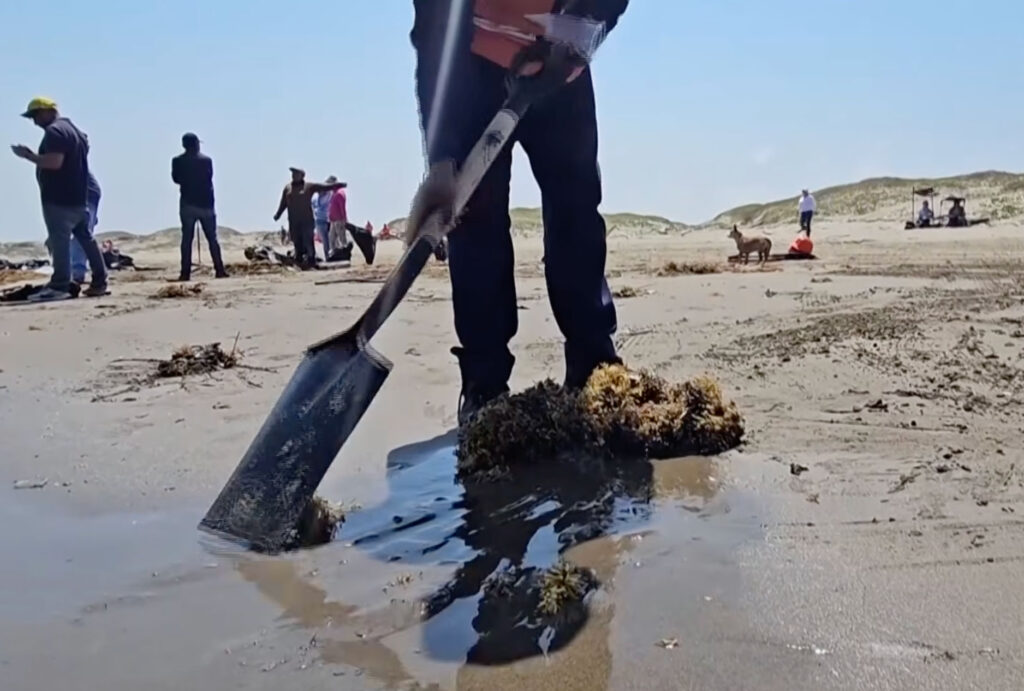
Nearly three weeks after crude oil began washing up on Mexico’s Gulf Coast, the federal government still cannot say where it came from — and a major ocean conservation group says that silence is making a bad situation worse.
Oceana, the international ocean protection organization, called on President Claudia Sheinbaum to establish transparent, binding interagency coordination mechanisms and take structural steps to ensure the Gulf of Mexico never again faces a crisis without clear responsibility, information, or accountability.
The oil first appeared on March 2, when fishermen near the Veracruz municipality of Pajapan reported tar in the sea and on beaches. What followed was a slow-moving environmental and political emergency. More than a dozen individual spill sites have since been identified, affecting 39 communities across Veracruz and Tabasco and contaminating roughly 230 kilometers (143 miles) of shoreline.
The oil spill in the Gulf of Mexico has so far spared Yucatán’s coast, but the ecological and political fallout is being felt across the Peninsula.
The timing could hardly be worse for coastal communities. The Lent season is typically the most important period of the year for local fishermen, who now face contaminated nets and suspended fishing operations. Fishing cooperative leaders in Alvarado say many nets have been so saturated with tar as to be completely unusable in just a matter of days.
Renata Terrazas, Oceana’s executive director, said the lack of government transparency is compounding the damage. “The opacity surrounding this spill generates impunity,” she said. “Without clarity about who is responsible, the causes of the accident, and the scope of the damage, it is impossible for authorities to be held accountable, design effective response strategies, or guarantee reparations to affected communities.”
The organization went further, framing the crisis in terms that go well beyond a single incident. Oceana characterized the spill as not only a socio-environmental emergency but also a crisis of transparency and government accountability that violates the right of coastal communities to a healthy environment.
On the question of responsibility, official accounts have shifted repeatedly. Veracruz Gov. Rocío Nahle initially suggested a natural oil seep might be to blame, then said the source was a private tanker conducting exploration activities off the Tabasco coast — a claim she later had to walk back after the navy told her that investigation findings were inconclusive. President Sheinbaum has said that Pemex, Mexico’s state oil company, is not responsible and that a criminal investigation is underway.
Federal cleanup operations are now roughly 85% complete, authorities say, with more than 90 tonnes of contaminated waste removed from beaches in the Coatzacoalcos area alone. But with Holy Week approaching and coastal towns expecting a surge of visitors, officials have put cleanup efforts into high gear.
The ecological damage documented so far is significant. Communities associated with the Reef Corridor Network report the deaths of sea turtles, a manatee, and multiple fish species, as well as damage to 17 coral reefs in the Southwest Gulf reef corridor and contamination of the Laguna del Ostión, a vital ecosystem for nine fishing communities.
Oceana’s warning comes with a longer-lens argument about what unchecked spills mean over time. The organization cited its own research indicating that the effects of hydrocarbon spills can persist for years or even decades, with contaminants accumulating in marine organisms and coastal sediments and eroding biodiversity, fishing productivity, and food security. Mexico News Daily has been tracking the response.
Terrazas called on the government to fundamentally rethink how development in the Gulf is managed. “The Gulf of Mexico and its coastal communities cannot continue to be treated as a sacrifice zone — a territory where hydrocarbon spills happen without consequences, while thousands of fishing and indigenous families pay with their health, livelihoods, and cultural heritage for a wealth that does not belong to them,” she said.
Gulf of Mexico Oil Spill: Key Facts
- First reports of oil on beaches: March 2, 2026
- States affected: Veracruz and Tabasco
- Coastline contaminated: approximately 230 km (143 miles)
- Communities affected: 39
- Cleanup status: approximately 85% complete as of mid-March
- Source: Still under criminal investigation; a private tanker is suspected
- Yucatán coast: No contamination reported as of late March
With reporting from Diario de Yucatán