
Category: Travel

  • Go, Canada! Canadians Beat Out USA for Most Air Routes to Mexico

    Go, Canada! Canadians Beat Out USA for Most Air Routes to Mexico

    Photo: Kylie Anderson / Unsplash

    For the first time on record, Canadian cities hold more top-ten positions than America in the ranking of busiest international air routes into Mexico. According to data released by Mexico’s Federal Civil Aviation Agency (AFAC), five of the ten busiest international corridors now connect Canadian airports with Mexican destinations, with the Torontoto Cancún route topping the list as the single busiest international flight into the country.

    The Toronto to Cancún route grew 26.1% in 2025 to surpass 1.3 million passengers, while the Montreal connection climbed 24%, carrying more than 737,000 travelers. Those are the largest year-over-year increases since records began. Meanwhile, six of the ten busiest U.S. routes to Cancún lost passengers: Chicago dropped 11.7%, Dallas fell 4.5%, New York slipped roughly 4%, and Atlanta declined 2%.

    Overall, Mexico welcomed just over 2.8 million Canadian visitors in 2025, an 11% increase over the previous year, according to Mexico’s Ministry of Tourism. Of that total, 1.6 million arrived through Quintana Roo, accounting for 13.6% of all international arrivals to the state. The United States remains the overall leader by volume, with 13.7 million passengers (5.29 million to Cancún alone), followed by Canada, the United KingdomColombia, and Argentina.

    More Air Routes to Mexico Result of Boycotts of USA

    The shift didn’t happen by accident. A boycott of U.S. travel that began in early 2025, triggered by President Donald Trump’s repeated suggestions that Canada should become the 51st U.S. state, has shown no signs of slowing down. An Abacus Data poll in March 2025 found that 62% of Canadians planned to avoid traveling to the U.S. for the following year. By late 2025, Flight Centre Canada reported that bookings to U.S. destinations were down 40% year over year, with general manager Anita Emilio telling CTV News the decline was expected to continue through 2026.

    Airlines wasted no time redirecting capacity. According to aviation data from PAX News, Canada’s four largest carriers, Air CanadaWestJetPorter Airlines, and Air Transat, collectively boosted capacity to Latin America by approximately 36% for the 2025-2026 winter season while trimming more than 1,500 flights to the United States. WestJet and Air Canada together now control roughly 70% of the Canada-Mexico market. New seasonal routes, including WestJet’s direct Calgary to Cozumel service and a Winnipeg to Cancún connection, launched in late 2025, with Porter introducing its first-ever Caribbean flights from Toronto, Hamilton, and Ottawa.

    Francisco Madrid, director of STARC (a Mexican tourism research body), put the shift in perspective: for the first time in history, the busiest international air routes into Mexico are not those connecting U.S. cities, but those linking Canadian ones.

    Betting on Canada

    Tourism officials in the region are treating this as an opportunity that demands a deliberate response. Andrés Martínez Reynoso, director of the Quintana Roo Tourism Promotion Council (CPTQ), confirmed plans to double promotional spending in Canada for 2026. The council is also working to increase flight frequency from the 19 Canadian cities already connected to Cancún, at a time when 17 new air routes into Cancún International Airport are being added, including five from Canada and the first ever non-stop from Dublin via Aer Lingus.

    But the boom comes with a caveat. Seven out of every ten international tourists arriving in Mexico still come from North America. The decline of South American and European markets in the 2025 rankings, with countries like Brazil and Peru both losing ground, underlines the risk of relying too heavily on a single region. The CPTQ says diversification toward those markets is now part of its strategy, alongside the Canadian push.

    For expats living along the Riviera Maya and in Cancún, the influx is already visible. More Canadian voices at airport arrivals, more WestJet and Air Canada liveries on the tarmac at CUN, and a growing snowbird population choosing Mexico over Florida and Arizona

    Whether the trend holds will depend in part on the political temperature between Ottawa and Washington, but for now, Canada has quite literally taken the top spot on the departure board.

  • The UNAM Biblioteca Central: Juan O’Gorman’s Stone Mosaic Masterpiece
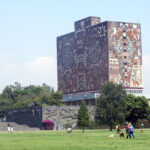
    The UNAM Biblioteca Central: Juan O’Gorman’s Stone Mosaic Masterpiece

    Each exterior wall of UNAM’s Biblioteca Central in Mexico City tells of different eras. The north wall of the Central Library faces the pre-Hispanic past. It shows the duality of life and death. On one side are the gods of life and creation. Quetzalcoatl appears as a feathered serpent. Tlaloc carries a mat on his back. On the other side are the gods of darkness and death. Tezcatlipoca stands with a skull. Mictlantecuhtli rules the underworld. At the bottom is the founding of Mexico-Tenochtitlan.

    The south wall faces the colonial past. Here, the grand structure’s architect, Juan O’Gorman, shows a clash of two worlds. Two large circles represent the opposing ideas of Ptolemy and Copernicus. One shows the Earth at the center of the universe. The other shows the sun at the center. This symbolizes the revolutionary shift in thought that accompanied the conquest.

    The library, which opened on April 5, 1956, after years of planning by O’Gorman, who was also a painter, and fellow architects Gustavo Saavedra and Juan Martínez de Velasco. Carlos Lazo managed the larger project to build the entire university campus.

    The library was not originally meant to be just a university library. The plan was to house the National Library and the National Newspaper Archive. That changed during construction. When it opened, it became the university’s Central Library. It started with about 80,000 volumes.

    The building has 10 floors. It is built on a platform raised three meters above the ground. The lower part is made of dark volcanic stone carved by hand. This stone came from the rocky ground of El Pedregal de San Ángel, where the university was built. The reading room has thin slabs of tecali stone that softly filter the light. The upper 10 floors have no windows. They are completely closed to protect the books from sunlight and to control temperature and humidity.

    O’Gorman covered the four blind facades of the tower with a mosaic of colored stones. He called it Historical Representation of Culture. It covers 4,000 square meters and is one of the largest murals in the world made of natural stone tiles. O’Gorman traveled across Mexico to find stones in the right colors. He collected 12  different shades. For the blue tones, he could not find a stone that satisfied him. He used pieces of colored glass instead.

    UNAM Library
    Themes of pre-Hispanic cosmology and religion are common motifs in murals on city streets, as well as in government buildings and throughout the city. 

    The idea came from his work with Diego Rivera on the Anahuacalli Museum. Rivera was building a museum for his collection of pre-Hispanic art. O’Gorman learned there how to work with volcanic rock and how to make mosaics that would last outdoors.

    The east wall faces the modern world. It shows the Mexican Revolution and the struggle for social justice. Emiliano Zapata appears on this wall. A red star represents socialist ideas. The atom floats at the top as a symbol of science and the new age.

    The west wall faces the university and modern Mexico. O’Gorman dedicated this side to the UNAM itself. It shows the university seal and its motto. This wall represents the university’s role in advancing Mexican culture.

    There is another layer to the design. The whole building is shaped like the face of Tlaloc, the rain god. The two large circles on the north wall are his eyes. The central lower part is his nose. The entrance doors are his mouth. This was not an accident. O’Gorman was a deep admirer of pre-Hispanic culture. He hid this figure in plain sight.

    In July 2007, UNESCO declared the Central Library and the whole central campus of University City a World Heritage Site. They called it a unique example of 20th-century modernism that integrates urbanism, architecture, engineering, landscape design, and fine arts.

    The library has grown far beyond its original collection. Today, it holds about 1.5 million volumes. More than 500,000 theses are kept there. There is a rare book collection with works printed in the 15th through 18th centuries. One treasure is an incunable of Las Siete Partidas by Alfonso the Wise, printed before 1501.

    The library is one of the most photographed buildings in Mexico City. It appears in movies, music videos, and television shows. Students use it as a meeting point. Visitors come from all over the world to stand before its walls. It is on postcards, t-shirts, and souvenirs. When people think of UNAM, they see this building. When they think of Mexican modern art, they see these walls. It has become a symbol not only of the university but of the country itself.

    UNAM Library
    The north wall of the UNAM Central Library faces the pre-Hispanic past. Photo: Irina Brester / File

    If you go

    The UNAM campus, where the library is located, is easily accessible through Mexico City’s Line 3 subway station. Taking a taxi or ride-sharing service is also an option, but traffic in the area can be quite heavy. The campus is very large, so make sure to wear comfortable shoes. Since you will already be in the area, consider visiting the ruins of Cuicuilco, which are just to the south of the UNAM campus. This archaeological site is the oldest in Central Mexico, as it was built in the 8th century B.C.E. The site also serves as a natural reserve of sorts, which is great for birding, and has an impressive museum.

  • Tequila Jalisco Was Abandoned by Tourists. Now it Hopes to Win Them Back
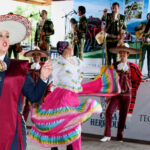
    Tequila Jalisco Was Abandoned by Tourists. Now it Hopes to Win Them Back

    Tequila, the world-famous spirit that gives its name to the town of Tequila, Jalisco, with this name being nearly synonymous with Mexico.

    The town of Tequila in Jalisco, Mexico, was once a major tourist destination. People came from all over the world to see the agave fields and learn how the famous libation is made. They would come by train on the famous Tequila Express or by busloads from nearby cities like Guadalajara. 

    But in recent years, the number of tourists dropped sharply. Residents say organized crime has been a problem for a long time. The criminals moved through the town openly, and the nearby mountains made it easy for them to operate. 

    The agave field and tequila distilleries that tourists once came to see were targeted by organized crime and abuses of power by government officials. The Jose Cuervo company, one of the largest tequila producers, filed a lawsuit over what they called extortion money dressed up as property taxes that were 20 times higher than the legal rate. They also faced a fine of more than 5 million dollars. 

    In early February 2026, federal authorities arrested the mayor of Tequila, Diego Rivera. They also arrested the town’s security director and the heads of public works and land registry. Officials say these leaders worked with the Jalisco New Generation Cartel to extort money from tequila and beer producers. The government says the group also stole public money.

    Following the arrest, the state government quickly put plans in place to bring tourism back. Governor Pablo Lemus visited the main plaza and announced a large investment of 500 million pesos for the year 2026.

    A major part of the plan is security. The governor promised that extortion in Tequila must stop. He said that 200 state police officers, along with the Mexican Army and the National Guard, will stay in the town permanently. He asked tequila companies, hotel owners, and agave farmers to invest again, promising them that their money would be safe.

    The government is also spending money on buildings and roads. Plans are also underway to remodel the main streets and the historic center. Another major project is the National Tequila Museum. It had been closed because the previous mayor tried to turn it into a private residence. The state government promised to reopen it with a new exhibition before the 2026 FIFA World Cup.

    The town will also get more promotion to attract visitors from Mexico and other countries. The governor said the previous administration stopped cultural events. Now, the state plans to hold concerts and activities to bring life back to the town.

    The interim mayor, Lorena Marisol Rodríguez Rivera, is working with the state government. Officials held meetings with teachers, shop owners, religious leaders, and farmers to make sure the plans help everyone. The governor stated his goal clearly: to help Tequila recover its beauty and its visitors.

    All About Tequila

    Long before the Spanish arrived, the native peoples of Mexico, such as the Mexica, made a drink from the agave plant. They fermented the sweet sap of the agave to make a beverage called pulque. They used this drink in religious ceremonies. This practice dates back to around 1000 B.C.

    Everything changed in the 1500s when Spanish conquistadors came to Mexico. They ran out of their own brandy. To make a new alcoholic drink, they used European distillation methods on the local agave plant. This was the birth of mezcal, the first distilled spirit from the Americas. The town of Tequila, located in the state of Jalisco, became a central hub for this new spirit. By the early 1600s, the Marquis of Altamira built the first large-scale distillery there. In 1758, the Cuervo family started making tequila, followed by the Sauza family in 1873. 

    Tequila
    A jimador is a laborer specialized in harvesting agave for tequila or mezcal production, using a long wooden pole with a sharp disc at the end known as a coa de jima.

    Today, the rules for tequila are very strict. It has a Denomination of Origin, just like Champagne. This means tequila can only be legally produced in five specific states of Mexico: Jalisco, Guanajuato, Michoacán, Nayarit, and Tamaulipas. The vast majority comes from Jalisco. To be called tequila, the spirit must be made from at least 51% blue Weber agave. The best tequilas are labeled “100% de agave,” meaning they use only that plant and no added sugars. If it is made from this same agave plant but outside of these five Mexican states, it cannot be called tequila. It is usually just labeled as an agave spirit or mezcal.

    For tequila, the agave hearts, called piñas, are steamed or baked in large ovens above ground. For mezcal, the piñas are roasted in underground pits that are lined with hot rocks. This underground roasting gives mezcal its strong, signature smoky flavor. Tequila generally has a cleaner, earthier taste with notes of citrus and cooked agave.

  • El Insurgente; CDMX – Toluca Train Is a Game Changer for Commuters

    El Insurgente; CDMX – Toluca Train Is a Game Changer for Commuters

    For years, the daily commute between Mexico City and Toluca has been long and exhausting. The roads, especially the highway, are often congested. The distance of  60 kilometers (37 miles) can take hours. 

    This problem affects tens of thousands of people every day—students, workers, and families. Now, after a very long wait, a new solution has arrived. 

    The Mexico-Toluca Interurban Train, called ‘El Insurgente,’ is finally fully open. This project took 12 years and three presidential terms to be completed. On February 2, President Claudia Sheinbaum inaugurated the last 8.4 kilometers. This final section links the Santa Fe to the Observatorio Metro station in Mexico City.

    El Insurgente’s goal is simple but important: to connect the Toluca Metropolitan Area with the western part of Mexico City. This connection aims to improve regional mobility at scale. 

    Most impressively, El Insurgente can transport 140,000 passengers per day, operating with 20 trains, each with a capacity of 719 passengers (326 seated).

    Why El Insurgente is a Big Deal

    El Insurgente provides a reliable, predictable, and safe alternative to cars and buses stuck in traffic. The train covers a total distance of 58 kilometers. It is not just a link between two major cities. It also connects to the Observatorio station, which is a major transportation hub for Mexico City’s Metro and bus networks. This makes it easy for people to continue their journey.

    On El Insurgente, the full route takes roughly 50 minutes as the train’s dedicated tracks mean it is not affected by road traffic. This saves people hours every day, and the need to leave home for work or school as early as 4 a.m. to guarantee arriving on time. 

    How the Train Works

    The train has seven stations along its route: Zinacantepec, Toluca Centro, Metepec, Lerma, Santa Fe, Vasco de Quiroga, and Observatorio. Trains run often, about every 10 to 15 minutes. This means people don’t have to wait long for the next one. The service hours are long to help early birds and night owls. From Monday to Friday, it runs from 5 in the morning until midnight. On Saturdays, it starts at 6 a.m., and on Sundays at 7 a.m., both running until midnight. The last train leaves Zinacantepec at 11 p.m., and the last one leaves Observatorio at midnight.

    El Insurjente’s Fair Fare System

    The cost of tickets on El Insurgente depends on the number of stations travelled, with short trips within the State of Mexico or within Mexico City costing 15 pesos, and the full trip from terminal to terminal, Zinacantepec to Observatorio or back, costs 100 pesos. When we consider the cost of gas, tolls, car maintenance, and the value of time saved, this fare is an outright bargain for most commuters.

    “Honestly, I would be happy to pay twice as much. Travel via bus is a nightmare and incredibly unsafe. And taking the car is out of the question,” said Toluca resident Manuel Escovedo.

    How to Ride

    To use El Insurgente, commuters need a Tarjeta de Movilidad Integrada (Integrated Mobility Card), or TUMI. This card is personal and cannot be shared. You can buy it and add money at the stations. You tap the card when you enter and tap again when you leave the station. This system automatically calculates the correct fare based on where you started and ended your trip. Riders are responsible for their own card and its balance. The train authority notes that if the card is lost or stolen, it cannot be replaced free of charge.

    Part of a Larger Trend

    El Insurgente joins other new public transit programs designed to make life in Mexico City’s metro area more livable. Other examples include CDMX’s Cablébus expansion, the ever-growing Metrobus network, light rail, and one of the world’s largest Metro systems

  • Park Hyatt Mexico City Set to Become Polanco’s Defining Luxury Address

    Park Hyatt Mexico City Set to Become Polanco’s Defining Luxury Address

    Photo courtesy Park Hyatt Mexico City

    Mexico City‘s hotel scene is about to gain a serious contender for the top spot in the luxury market. When Park Hyatt Mexico City opens its doors on Campos Elíseos in the summer of 2026, it will mark the brand’s first property in the Mexican capital, bringing 155 rooms, 23 private residences, and a rooftop pool to one of Polanco’s quietest and most desirable stretches of real estate.

    The property is positioned along the southern edge of the neighborhood, directly overlooking Bosque de Chapultepec, the 1,700-acre (688-hectare) urban park that has served as a retreat for everyone from Aztec rulers to Mexican presidents. 

    That proximity to green space, combined with a location in a district better known for private apartments and diplomatic compounds than tourist hotels, gives the Park Hyatt an unusual advantage: a sense of calm that most Mexico City hotels can only dream of.

    A Third-Generation Architectural Vision

    The project is being developed by SOMA Group, with architecture by Sordo Madaleno Arquitectos, a Mexico City-based studio founded in 1937 that now operates from both the capital and London, England. The building comprises two towers rising to approximately 472 feet (144 meters), with a metallic facade whose window openings and recessed terraces respond to the building’s interior program.

    Javier Sordo Madaleno, vice president of SOMA and a third-generation architect within the family firm, has described the design as drawing from Mexican architectural styles of the 1970s while remaining firmly contemporary. Vertical circulation cores are grouped along the south side of the building, freeing up uninterrupted sightlines toward Polanco and Chapultepec from the north-facing rooms.

    The hotel will occupy floors six through 18, while the 23 branded residences will run from the 19th to the 30th floor. Individual residences range from roughly 5,295 to 5,715 square feet (492 to 531 square meters), with terraces of up to 970 square feet (90 square meters). A signature penthouse tops out at over 11,260 square feet (1,046 square meters) with its own private entrance, concierge service, and 24-hour security.

    The development is also pursuing LEED Gold certification, aiming for efficient energy consumption and minimal emissions across the property.

    Rooms with Park Views and Private Terraces

    Each of the 155 guest rooms and suites will include a separate bathtub and rain shower, a lounge area with sofa, and views of either Chapultepec or the Polanco skyline. Guests booking Club Access rooms receive additional amenities, a formula that has worked well at other Park Hyatt properties around the world.

    Private terraces will offer the kind of outdoor space rarely found in urban luxury hotels. According to travel network Virtuoso, which has listed the property as a Preview Property, guests can also expect access to tennis and pickleball courts, a feature that sets the Park Hyatt apart from the city’s existing five-star offerings.

    The hotel will include at least two restaurants, an espresso bar, a show kitchen, and an outdoor veranda lounge. One dining concept will focus on sustainably sourced Japanese cuisine, while a second draws from South American culinary traditions. A rooftop bar rounds out the food and beverage program, with agave-focused cocktails and a curated wine and spirits list.

    The wellness offering includes a hydrotherapy spa with personalized treatments, a fitness center with floor-to-ceiling windows and city views, and the rooftop pool that will likely become the property’s most photographed feature. Canine companions are also welcome, with food and water bowls, a plush dog bed, and treats provided at check-in.

    Filling a Gap in the Market

    Sure, Mexico City has no shortage of luxury hotels. The Four Seasons Hotel Mexico City, the St. Regis Mexico City on Paseo de la Reforma, and the Ritz-Carlton all serve the high end of the market. But none of these belong to a hotel loyalty program with the reach of World of Hyatt, and the Park Hyatt brand’s emphasis on smaller, more intimate properties sets it apart from the city’s larger towers.

    The new hotel also arrives as part of a broader Park Hyatt push into Mexico. The brand’s Park Hyatt Los Cabos at the Cabo del Sol resort community on the Baja California Sur coast opened in 2025, while Park Hyatt Cancún is also slated for 2026. 

    The Park Hyatt Mexico City will sit directly alongside the existing Hyatt Regency Mexico City, a 755-room convention-oriented tower that has operated on Campos Elíseos since 1987. The two properties will share a street address but serve very different guests, with the Park Hyatt targeting leisure and luxury travelers and the Regency continuing to focus on its established business and group clientele.