Author: Carlos Rosado van der Gracht

  • The Ultimate Guide to All-Inclusive Resorts in Cancún, Riviera Maya and Nearby Islands

    The Ultimate Guide to All-Inclusive Resorts in Cancún, Riviera Maya and Nearby Islands

    Finding the perfect all-inclusive resort can feel like a big task, there are like what feel like endless options and many considerations. Beautiful beaches, delicious food, a comfortable room, and a sense of having gotten your money’s worth immediately come to mind. But, a few places really stand out in Cancún, the Riviera Maya, and the nearby islands of Cozumel and Isla Mujeres.

    Traveling With Children

    If you are looking for a resort that is great for the whole family, you will often see Hyatt Ziva Cancún at or near the top of several lists. People love it because it feels like a paradise for kids, with big playgrounds and a fun kids’ club, but it is also stylish and comfortable for adults. The rooms are modern, and many have stunning ocean views. Another family favorite that comes up often is the Fiesta Americana Condesa Cancún. It is known for being reliable and for offering safe, fun, thematically designed pools for children with slides, which is always a win for keeping the little ones happy.

    Another standout for traveling with children is the Nickelodeon Hotel, which offers comfortable themed rooms and a host of water slides and attractions featuring cartoon characters like SpongeBob SquarePants and the Rugrats. 

    Island Romantic Getaways

    For couples or anyone wanting a quieter, more grown-up atmosphere, the options get even more luxurious. The Le Blanc Spa Resort in Cancún is frequently ranked among the very best. It is an adults-only resort that focuses on top-tier service and relaxation. Just up the coast in the Playa Mujeres area, which is near Isla Mujeres, you will find two gems: Beloved Playa Mujeres and Excellence Playa Mujeres. Both are adults-only and consistently receive high marks for their beautiful rooms, excellent food, and amazing value for the level of luxury they offer. In fact, guests have rated Excellence Playa Mujeres incredibly highly for its value. The service is wonderful, making you feel truly pampered and cared for.

    Speaking of Isla Mujeres, if you want something truly special, there is the brand new Almare, a Luxury Collection Resort. It opened recently as an adults-only, all-inclusive island escape and has already made a big splash on “best of” lists for its stunning setting.

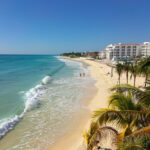
    When it comes to the beach itself, which is often the main event, you have to think about the seaweed, or sargassum. Some areas are naturally better than others. The west side of Cozumel, for example, is often a safe bet. The Melia Cozumel is a great example. It sits on a long, shallow beach with soft, white sand that is perfect for swimming, and it is much less affected by the seaweed that can sometimes pile up on the mainland coast.

    In the Riviera Maya, the Catalonia Riviera Maya in Puerto Aventuras has also been praised by guests for its beach. They have built breakwaters that do a good job of stopping the seaweed from coming ashore, so the swimming area stays clean and clear. 

    Another huge complex in the Riviera Maya is the Barceló Maya Grand Resort. It is made up of five different hotels in one, so there is something for everyone. It sits on a huge stretch of private beach, giving you plenty of room to find your own quiet spot. With 22 restaurants across the property, the dining options are endless, and the rooms, especially in the Caribe section, can be incredibly luxurious with their own private pools.

    For a fantastic blend of value and fun, the Riu Dunamar, located in the Costa Mujeres area near Isla Mujeres, is a great choice. Recent guests have described their family vacations there as “flawless,” praising the friendly service and the wide variety of food at the buffet. The resort has five pools and a fun water park with slides, which is perfect for keeping everyone entertained. The beach there is also described as beautiful, with plenty of sunbeds. It shows that you don’t always have to pay the highest price to have a wonderful and memorable holiday.

    Celebrating a Truly Special Occasion?

    If you are dreaming of a truly special splurge, there is a new and exclusive option in the Riviera Maya called The Reserve at Paraiso de la Bonita. It is a “resort-within-a-resort” with only ten suites, each with its own private infinity pool and butler service. It is the ultimate in privacy and luxury, with special dining and private areas on the beach. 

    Though its beaches have been hit quite hard by sargassum over the past couple of years, the Hotel Riu Palace Riviera Maya really stands out. The quality of the food is in a league of its own. As august as this adult-only resort, one is also able to make use of the amenities of all the other hotels, including pools and restaurants operated by Riu Hotels nearby. 

    Another standout is the Dreams Riviera Maya, as rooms without an ocean view are clustered into what the hotel describes as little haciendas with a canal-like pool that encircles each “hacienda,” giving guests access to a pool directly from their room. The gastronomic offerings are also top-notch, especially the seafood. 

    The Best Time of Year To Find A Great Deal

    The most budget-friendly months for booking are usually May, June, September (except during the long weekend of September 15 for Mexican Independence Day), and October. These months fall just after the busy winter and spring periods and before the holiday season picks up again.

    With so much competition, all-inclusive resorts in Cancún and the Riviera Maya tend to be very good, and even browsing recent reviews on travel sites like TripAdvisor or Expedia can give you a fairly good idea of what to expect.

  • Mexico Says No to Trump’s Peace Board, Citing Lack of Palestinian Role

    Mexico Says No to Trump’s Peace Board, Citing Lack of Palestinian Role

    Mexico has turned down a formal invitation from former US President Donald Trump to join his new initiative, the “Board of Peace.” This group is designed to oversee the reconstruction of the Gaza Strip and serve as an alternative to the United Nations in managing the conflict. On Tuesday, Mexican President Claudia Sheinbaum held a press conference to explain her government’s decision. While Mexico will not become a full member, it plans to send an observer to the board’s first meeting in Washington this Thursday.

    Sheinbaum said that declining full membership is a matter of principle regarding international recognition. 

    “In the statement, it says we recognize the search for peace in any space that opens up,” Sheinbaum explained. “But in this case, when it comes particularly to peace in the Middle East, given that we recognize Palestine as a state, it is important that both states participate, right? Both Israel and Palestine. And that is not how the meeting is set up.”

    This commitment to a two-state solution is a cornerstone of Mexico’s current foreign policy. Shortly after taking office, Sheinbaum’s administration made a significant diplomatic move by formally receiving the credentials of a Palestinian ambassador, a step she has highlighted as full recognition of the Palestinian state. This position was echoed earlier when the formal invitation arrived; Sheinbaum remarked that it was “very important” for the Board to have representation directly from Gaza, a sentiment also shared by Brazilian President Luiz Inácio Lula da Silva.

    The Board of Peace, an idea pushed by Trump, has received mixed reactions globally. According to Trump, about 35 countries have decided to join the group. However, it has notably failed to secure a seat for Palestine at the table. The inaugural meeting this Thursday in Washington will include some of Trump’s key international allies, particularly from the right wing, such as Argentina’s Javier Milei and Hungary’s Viktor Orbán. 

    While Argentina is on the list of Latin American participants, alongside Paraguay have been hesitant. Several European countries, including France, Norway, and Spain, have also opted out. Canada and New Zealand have already stated they have no intention of joining. Morocco stands out as the first African and one of the first Arab nations to join the assembly. A key detail of the board’s structure is the significant financial barrier to entry: Trump has required that countries pay $1 billion for a permanent seat, with the former president retaining final approval over all members and decisions.

    A Wider Context of US-Mexico Tensions

    Mexico’s refusal to join the Board of Peace is not an isolated decision. It adds another layer of complexity to an already strained relationship with the United States. Several major issues are currently testing the bilateral ties.

    One of the most immediate points of conflict is the fight against drug trafficking. The Trump administration has ramped up its rhetoric and actions against cartels, which has caused friction. There have been reports of the US military conducting operations in the Caribbean against drug vessels and a constant push for more aggressive action from Mexico. While President Sheinbaum has cooperated by extraditing cartel figures and deploying the National Guard to the northern border, she has firmly rejected any foreign intervention on Mexican soil, stating, “Under no circumstance will we accept interventions, interference, or any other act from abroad that is detrimental to the integrity, independence, and sovereignty of the country”.

    Another major point of contention is Cuba. The Trump administration has declared a national emergency regarding the island nation and imposed strict measures, including the threat of tariffs against any country that provides oil to Cuba. This puts Mexico, historically a supporter of Cuba and a member of the left-wing Morena party with ties to the island, in a difficult position. Despite US pressure, Sheinbaum has defended Mexico’s right to provide humanitarian aid. “We are going to continue sending humanitarian aid, food, and some other requests that the Cuban government has made that its people need,” she stated. 

    These issues are compounded by Trump’s constant threats to impose sweeping tariffs on Mexican goods, a favorite negotiating tactic of his. So far, Sheinbaum has navigated these challenges with a strategy described by some former diplomats as “squish and muddle through”—treading carefully to avoid direct conflict while subtly pushing back on key principles like national sovereignty and humanitarian support for allies. The Board of Peace’s decision fits this pattern: a polite but firm “no” based on a clear principle, while maintaining communication by sending an observer.

  • Is Mexico’s Proposed Electoral Reform a Threat to Democracy or a Necessary Change?
    Is Mexico’s Proposed Electoral Reform a Threat to Democracy or a Necessary Change?

    Mexico’s government, led by President Claudia Sheinbaum, is pushing forward with a major electoral reform that could change how the country’s political system works. While the formal proposal hasn’t reached Congress yet, the main ideas have already sparked intense debate about the future of Mexican democracy.

    The government says its goals are simple: make the electoral system cheaper and give ordinary citizens more direct participation. But critics have raised serious red flags about what this could mean for Mexico’s democratic institutions.

    Why The Opposition Calls This Reform Dangerous

    Opposition leaders have used stark language to describe their concerns. Senators from the PAN and PRI parties have labeled the proposed reform the “Ley Maduro,” drawing direct comparisons to authoritarian changes implemented in Venezuela. “This is not an electoral reform, it’s the ‘Maduro Law’ that the government wants to establish in Mexico,” warned the PAN’s coordinator in the Senate. Manuel Añorve of the PRI added that if this reform passes as proposed, “democracy in Mexico has its days numbered.”

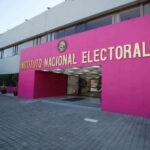
    At the heart of these warnings is a fear that the ruling party wants to take control of the institutions that are supposed to be impartial referees of elections. The National Electoral Institute, or INE, is generally seen as relatively impartial because of its independence and technical expertise. However, it would be an exaggeration to say that average citizens highly trust it. Nevertheless, weakening its autonomy and cutting its budget could make it harder for the institute to organize fair elections.

    Another danger critics highlight involves money and crime. Emilio Suárez Licona, a PRI lawmaker, warned that slashing public financing for political parties doesn’t eliminate the need for campaign funds; it just pushes candidates to look elsewhere. “If you reduce public funding for political parties, it opens the door for candidates to seek alternative financing mechanisms, and drug traffickers will be first in line,” he cautioned.

    The Main Changes

    One of the biggest proposed changes involves the legislators known as “plurinominal” deputies. Right now, party leaders select these lawmakers through closed lists to ensure minority parties are represented. The government wants voters to elect them directly instead. The parties that usually support the government oppose this change because they’d lose control over those positions. Opposition parties see it as an attempt to eliminate a system that guarantees diverse voices in Congress.

    The INE itself would get smaller under the proposal. The number of top officials would drop from eleven to nine, and some departments, including civic education, could disappear entirely. Local election offices would also change. Currently, the national INE helps choose who runs these local offices. The reform would end that connection. The government says this eliminates duplicate work, but opponents see it as a power grab that leaves local elections more vulnerable to manipulation.

    Where Things Stand Now

    The politics behind this reform are complicated. President Sheinbaum’s party, Morena, doesn’t have enough voteson its own to pass constitutional changes. They need their usual allies, the Green Party and the Labor Party, to go along. But those parties are pushing back hard, especially on the issue of plurinominal deputies and budget cuts that would directly affect their political influence. They see the current system as guaranteeing them seats, and they’re not eager to give it up.

    Negotiations have dragged on for over a month with no real breakthrough. If the government pushes too hard, it might lose its allies completely and see the reform fail, marking the fourth time this administration has tried and failed to change electoral laws. If they compromise too much, they end up with a weak reform that fails to deliver on their promises to voters.

    Civil society groups and business organizations have raised alarms. The business chamber Coparmex is concerned that the weakening of democratic institutions could scare away investment. Democracy watchdogs fear Mexico might backslide toward a system where those in power set the rules for elections.

  • Why Air Pollution in Mexico City Has Been So Bad This Year
    Why Air Pollution in Mexico City Has Been So Bad This Year

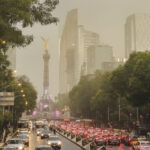
    Mexico City has faced repeated air quality emergencies during the first two months of 2026, with multiple environmental contingencies activated due to high ozone and particle pollution. But why is this happening, and what are the authorities doing to combat this perennial problem? 

    Back-to-Back Pollution Emergencies

    The year started badly. On January 1, authorities declared the first environmental contingency of 2026. According to authorities, this was mainly caused by fireworks used during New Year celebrations and emissions from high volumes of traffic, which released large amounts of pollutants into the air.

    Just one week later, on January 8, a second contingency was activated. This time, it was due to high ozone concentrations. A monitoring station in Cuajimalpa recorded 160 parts per billion (ppb) of ozone at 4:00 p.m., well above the 90 ppb standard that triggers emergency measures.

    By mid-February, the pollution problem had not gone away. On February 13 and 14, another Phase I contingency remained in effect, with ozone reaching 156 ppb in Atizapán. As of February 16, the air quality index remained rated “MALO” (bad) in several parts of the city, with PM2.5 particles as the primary concern.

    Pollution and Weather 

    The primary reason for this bad air is not that people are polluting more than usual. Rather, weather conditions have trapped pollution close to the ground.

    A high-pressure system has been sitting over central Mexico. This creates atmospheric stability, which means weak winds and poor ventilation. Normally, wind helps scatter pollutants. Without it, emissions just build up.

    Additionally, temperatures have been unusually warm for winter. On January 8, it reached 25 degrees Celsius. Sunlight triggers chemical reactions that form ozone from vehicle exhaust and industrial emissions. More sun means more ozone.

    The dry season makes everything worse. Without rain to wash pollutants out of the air, they just keep accumulating day after day.

    Geography Traps Pollution in the Valley

    Mexico City’s location is a fundamental part of the problem. The city sits in a basin at more than 2,200 meters above sea level, surrounded by mountains and volcanoes. This geography acts like a bowl. Pollutants get released into the air but cannot easily escape because the surrounding walls block wind from flowing through.

    During winter and early spring, temperature inversions make this even worse. Normally, the air gets cooler as you go higher. But during an inversion, a layer of warm air sits on top of cooler air near the ground. This warm layer acts like a lid, trapping pollutants underneath. These inversions can last for days, causing pollution levels to climb steadily.

    The ‘Hoy No Circula’ Program

    When a Phase I environmental contingency is declared, the main tool the government uses is the ‘Doble Hoy No Circula’ program. This restricts vehicle use to reduce emissions.

    On a normal day, Mexico City implements a ‘Hoy No Circula’ program that bans the use of vehicles based on their license plate numbers and verification stickers. However, during a contingency, the restrictions tighten, effectively doubling the number of vehicles forced off the road. 

    For example, on February 16, the restrictions applied to:

    All vehicles with verification hologram 2

    Vehicles with hologram 1 whose last digit is 1, 3, 5, 6, 7, or 9

    Vehicles with hologram 0 or 00 that have yellow stickers and plates ending in 5 or 6 

    The restrictions run from 5:00 a.m. to 10:00 p.m. Some vehicles are exempt, including electric and hybrid vehicles, vehicles with ecological plates, and emergency vehicles.

    When contingencies fall on weekends, the restrictions follow a set rotation of sticker colors so that over time, all vehicle types share the burden equally.

    Does the Program Work?

    Experts who study this issue say the ‘Hoy No Circula’ program has limits. It was created 37 years ago when Mexico City had roughly 1.5 million vehicles on the road. Currently, the metropolitan area has approximately 6.5 million vehicles, plus more than 700,000 motorcycles that are not covered by the program.

    In 2025, the worst year on record for environmental contingencies since tracking began in 1993. There were 12 days when Phase I was activated due to ozone. The first two months of 2026 suggest this year could be similar.

    Researchers at the UNAM Atmospheric Sciences Institute note that although vehicle emissions have become cleaner over the decades, the number of vehicles continues to increase. Additionally, many public transport operators are not effectively regulated.

  • The UNAM Biblioteca Central: Juan O’Gorman’s Stone Mosaic Masterpiece
    The UNAM Biblioteca Central: Juan O’Gorman’s Stone Mosaic Masterpiece

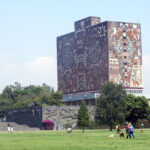
    Each exterior wall of UNAM’s Biblioteca Central in Mexico City tells of different eras. The north wall of the Central Library faces the pre-Hispanic past. It shows the duality of life and death. On one side are the gods of life and creation. Quetzalcoatl appears as a feathered serpent. Tlaloc carries a mat on his back. On the other side are the gods of darkness and death. Tezcatlipoca stands with a skull. Mictlantecuhtli rules the underworld. At the bottom is the founding of Mexico-Tenochtitlan.

    The south wall faces the colonial past. Here, the grand structure’s architect, Juan O’Gorman, shows a clash of two worlds. Two large circles represent the opposing ideas of Ptolemy and Copernicus. One shows the Earth at the center of the universe. The other shows the sun at the center. This symbolizes the revolutionary shift in thought that accompanied the conquest.

    The library, which opened on April 5, 1956, after years of planning by O’Gorman, who was also a painter, and fellow architects Gustavo Saavedra and Juan Martínez de Velasco. Carlos Lazo managed the larger project to build the entire university campus.

    The library was not originally meant to be just a university library. The plan was to house the National Library and the National Newspaper Archive. That changed during construction. When it opened, it became the university’s Central Library. It started with about 80,000 volumes.

    The building has 10 floors. It is built on a platform raised three meters above the ground. The lower part is made of dark volcanic stone carved by hand. This stone came from the rocky ground of El Pedregal de San Ángel, where the university was built. The reading room has thin slabs of tecali stone that softly filter the light. The upper 10 floors have no windows. They are completely closed to protect the books from sunlight and to control temperature and humidity.

    O’Gorman covered the four blind facades of the tower with a mosaic of colored stones. He called it Historical Representation of Culture. It covers 4,000 square meters and is one of the largest murals in the world made of natural stone tiles. O’Gorman traveled across Mexico to find stones in the right colors. He collected 12  different shades. For the blue tones, he could not find a stone that satisfied him. He used pieces of colored glass instead.

    UNAM Library
    Themes of pre-Hispanic cosmology and religion are common motifs in murals on city streets, as well as in government buildings and throughout the city. 

    The idea came from his work with Diego Rivera on the Anahuacalli Museum. Rivera was building a museum for his collection of pre-Hispanic art. O’Gorman learned there how to work with volcanic rock and how to make mosaics that would last outdoors.

    The east wall faces the modern world. It shows the Mexican Revolution and the struggle for social justice. Emiliano Zapata appears on this wall. A red star represents socialist ideas. The atom floats at the top as a symbol of science and the new age.

    The west wall faces the university and modern Mexico. O’Gorman dedicated this side to the UNAM itself. It shows the university seal and its motto. This wall represents the university’s role in advancing Mexican culture.

    There is another layer to the design. The whole building is shaped like the face of Tlaloc, the rain god. The two large circles on the north wall are his eyes. The central lower part is his nose. The entrance doors are his mouth. This was not an accident. O’Gorman was a deep admirer of pre-Hispanic culture. He hid this figure in plain sight.

    In July 2007, UNESCO declared the Central Library and the whole central campus of University City a World Heritage Site. They called it a unique example of 20th-century modernism that integrates urbanism, architecture, engineering, landscape design, and fine arts.

    The library has grown far beyond its original collection. Today, it holds about 1.5 million volumes. More than 500,000 theses are kept there. There is a rare book collection with works printed in the 15th through 18th centuries. One treasure is an incunable of Las Siete Partidas by Alfonso the Wise, printed before 1501.

    The library is one of the most photographed buildings in Mexico City. It appears in movies, music videos, and television shows. Students use it as a meeting point. Visitors come from all over the world to stand before its walls. It is on postcards, t-shirts, and souvenirs. When people think of UNAM, they see this building. When they think of Mexican modern art, they see these walls. It has become a symbol not only of the university but of the country itself.

    UNAM Library
    The north wall of the UNAM Central Library faces the pre-Hispanic past. Photo: Irina Brester / File

    If you go

    The UNAM campus, where the library is located, is easily accessible through Mexico City’s Line 3 subway station. Taking a taxi or ride-sharing service is also an option, but traffic in the area can be quite heavy. The campus is very large, so make sure to wear comfortable shoes. Since you will already be in the area, consider visiting the ruins of Cuicuilco, which are just to the south of the UNAM campus. This archaeological site is the oldest in Central Mexico, as it was built in the 8th century B.C.E. The site also serves as a natural reserve of sorts, which is great for birding, and has an impressive museum.