Author: Carlos Rosado van der Gracht

  • New Rules for Electric Bikes and Scooters in Mexico

    New Rules for Electric Bikes and Scooters in Mexico

    Micromobility
    Mexico’s micromobility revolution is being driven by rising fuel costs and urban congestion, turning e-bikes and scooters into affordable, everyday heroes for commuters and delivery drivers alike, but regulations are yet to catch up.

    Electric bikes and scooters have become a common sight in Mexican cities. They are cheap, practical, and perfect for short trips. But for years, they operated in a legal “gray area” with few rules. That is now changing. Authorities across the country are creating new regulations to improve safety and organize urban mobility, though the approach varies significantly from one city to another.

    Mexico City: Closing the Legal Loophole

    For a long time, these vehicles in the capital did not need a license, plates, or insurance. However, in August 2025, the local Congress approved reforms, giving the government a 360-day deadline to change the traffic regulations. The new rules will be officially presented on Tuesday, May 20, 2026. The goal is to end the legal vacuum that has allowed many electric vehicles to circulate without clear restrictions, a situation that has persisted even months after the laws were passed, with riders still not using helmets and circulating on sidewalks.

    The core of the new regulation is a formal classification system. The government has created a new category called Vehiculos Motorizados Eléwctricos Personales (VEMEPES), or Personal Electric Motorized Vehicles. This splits vehicles into two distinct types based on their technical specifications. 

    Type A VEMEPES include lighter e-bikes with pedal assistance, a motor under 250 watts, a maximum speed of 25 km/h, and a weight under 35 kilograms. These will be treated like regular bicycles and do not need plates. Type B covers faster and heavier vehicles, with motors between 250 watts and 1 kilowatt, that exceed 25 km/h or weigh more than 35 kilograms.

    Type B VEMEPES vehicles have much stricter rules as they are now legally considered more like motorcycles. Their drivers must have a valid driver’s license, and the vehicle must display license plates and have a registration card. These faster vehicles are banned from bike lanes and sidewalks and must stay in the main vehicle lanes. 

    For all riders, the new regulations will mandate the use of helmets, lights, and reflective elements. It will also be illegal to carry passengers on scooters or electric bikes, to use headphones or cell phones while driving, or to ride on sidewalks. Police will also apply alcohol and drug controls to drivers of these vehicles, just as they do for car drivers.

    While the laws have been passed, the final rules on how to register and obtain plates are still being prepared, with authorities currently finalizing the plate design and the registration process. The government has until August 2026 to make these adjustments, so riders have not yet faced any immediate changes. However, the rules are expected to be fully implemented after that period.

    Elsewhere in Mexico

    Other cities, like Guadalajara, León, and Puebla, are developing their own guidelines for e-bikes and scooters, but are not as far along as Mexico City. Cities like Mérida and Cancún currently have no specific regulations for electric scooters or bikes. For instance, Yucatán’s Ley de Tránsito y Vialidad still classifies scooters, electric bikes, and skates as “human-propulsion vehicles” in its regulations, which were last updated in May 2025.

    Mexico’s  Mico-mobility Revolution

    The increasing use of electric bikes and scooters in Mexico is not just a trend but a significant shift in how people move through the country’s largest cities. This growth is driven by a combination of economic factors, environmental awareness, and the practical need to navigate congested urban areas. The numbers from recent market research paint a clear picture of this rapid expansion.

    The overall market for micro-mobility, which includes electric kick scooters, skateboards, and bicycles, generated revenue of USD 912.1 million in 2024 and is expected to reach USD 1,725.5 million by 2030, growing at an annual rate of 11.2%. 

    This growth is part of a larger trend in the electric two-wheeler sector, which includes scooters and motorcycles. In 2025, this market was valued at approximately USD 689 million and is projected to nearly triple to USD 1.69 billion by 2034. Other analysts forecast it could reach USD 1.74 billion by 2033, showing strong agreement on the market’s upward trajectory.

  • Román Piña Chan: The Legacy of One of Mexico’s Greatest Archaeologists

    Román Piña Chan: The Legacy of One of Mexico’s Greatest Archaeologists

    February 29 marked what would have been the 106th birthday of Román Piña Chan, one of Mexico’s greatest archaeologists. Though Piña Chan passed away in 2001, tributes to his life prove that he is still very much remembered, admired, and even loved. 

    Piña Chan spent more than 50 years exploring ancient sites, teaching students, and writing books about pre-Hispanic cultures. His work, perhaps more than that of any other single individual, helped shape what we know today about Mesoamerica.

    Piña Chan
    Piña Chan spent more than 50 years exploring ancient sites, teaching students, and writing books about pre-Hispanic cultures.

    Piña Chan was born in Campeche. His family did not have much money. As a teenager, he worked teaching people to read and write. In 1942, when he was 22, he saw a poster at the National School of Anthropology and History in Mexico City about scholarships. He decided to try anthropology.

    He started in physical anthropology, but soon realized he preferred studying the things ancient people made and switched to archaeology. His first field work was in Tzintzuntzan, Michoacán. He then worked at Uxmal and Jaina in the Yucatán Peninsula.

    As a Campechan, he is remembered with particular appreciation in his home state. “Piña Chan was one of those once-in-a-generation geniuses. His love for his work and commitment to Mexico’s heritage, combined with his great intellect, made him a real powerhouse. But aside from straightforward admiration, he is also remembered with great affection by those who knew him and had the opportunity to work with him,” said Dr. Iván Urdapilleta Caamal of Campeche’s State University. 

    A Career of Discovery

    Piña Chan worked at more than 70 archaeological sites across Mexico, a staggering accomplishment that remains a record to this day. 

    Between 1945 and 1960, he worked at Chalcatzingo and Atlihuayán in Morelos, at Tlapacoya in the State of Mexico, and at Comalcalco and along the Grijalva River in Tabasco. In the 1960s, he explored Mulchic and the Cenote at Chichén Itzá, La Ventilla at Teotihuacan, and Cuicuilco near Mexico City.

    One of his most important early projects was Tlatilco, a site in the State of Mexico where he excavated hundreds of burials. This work became his 1951 thesis, and he received his degree in archaeology that same year. Later, he earned a doctorate from the National Autonomous University of Mexico.

    “Working with Piña Chan at Edzná was one of the highlights of my career,” said American Archaeologist Linda Lindholm during an interview with Yucatán Magazine. “He was a very interesting man, but also tremendously devoted to his work, a real role model for all of us youngsters at the time”, continued Lindonholm. 

    Piña Chan’s Most Important Contributions

    Piña Chan did not just dig up objects. He tried to understand what they meant. He combined what he found in the ground with what he read in old historical documents.

    He is known for his work on the Preclassic period—the time before 200 BCE, when early civilizations were forming. His studies of sites in the Valley of Mexico and the Gulf Coast helped define this era.

    Piña Chan also studied Quetzalcóatl, the Feathered Serpent god. In his 1977 book, he argued that this god began as a water deity. He believed the cult of Quetzalcóatl originated at Xochicalco and was later  carried to other places, including the great city of Tula.

    Teaching and Writing

    Piña Chan began teaching at the National School of Anthropology and History in 1953. He taught there for the rest of his life. He also taught at universities in Mexico and abroad, including Southern Illinois University Carbondale. At many of these schools, he helped start new courses and degree programs.

    He wrote more than 20 books and hundreds of articles. His most important works include Tlatilco (1958), Culturas y ciudades de los mayas (1959), Quetzalcóatl, Serpiente Emplumada (1977), and El lenguaje de las piedras glíficas olmecas y zapotecas (1993).

    Recognition and Awards

    Piña Chan received several awards. In 1985, the National Institute of Anthropology and History (INAH) named him Researcher Emeritus and gave him its Gold Medal for Academic Services. In 1994, he won the Premio Nacional de Ciencias y Artes in the History, Social Sciences, and Philosophy category — one of Mexico’s highest honors.

    Later Years and Legacy

    In September 1984, Piña Chan suffered a serious accident at the Becán site in Campeche. He fell from a building and broke a vertebra in his back. He spent nearly a year in bed. But even while recovering, he continued his research.

    Román Piña Chan died on April 10, 2001, in Mexico City from a stroke. He was 81 years old. He predeceased his wife, archaeologist Beatriz Barba, who died 20 years later.

    His legacy continues in several ways. Since 1996, the Simposio Román Piña Chan has been held each year in Mexico City. Scholars gather to discuss new research on pre-Hispanic cultures.

    His personal archive, the “Acervo Román Piña Chán,” contains his manuscripts, drawings, and photographs from 1945 to 2001. The collection shows how Latin American archaeology developed during the second half of the 20th century.

  • New Exhibition Takes Flight With the Mighty Hummingbird 

    New Exhibition Takes Flight With the Mighty Hummingbird 

    hummingbirds
    A new exhibit in Mexico City highlights the majesty of the hummingbird.

    At the Museum of Natural History in Mexico City, visitors are taking a deep dive into the world of hummingbirds

    Colibríes, arte y biodiversidad urbana (Hummingbirds, Art, and Urban Biodiversity), aims to educate the public about these remarkable birds while showcasing detailed clay sculptures by artist Davit Nava.

    Hummingbirds possess extraordinary physical abilities. They can hover in midair, fly backward, and change direction instantly—feats that have long fascinated scientists and bird enthusiasts alike. The exhibition highlights these traits while emphasizing the bird’s significance in Mexico’s ecosystem.

    Museum Director Mercedes Jiménez del Arco explained that the institution — part of the Mexico City Environment Secretariat — focuses on communicating important environmental topics to the public. Hummingbirds, she noted, are a key subject because of their unique biodiversity value.

    The Americas are the only places in the world where hummingbirds exist naturally, making the region particularly privileged. According to the National Commission for the Knowledge and Use of Biodiversity (CONABIO), more than 300 species of hummingbirds have been discovered globally. Mexico is home to approximately 59 of those species, and remarkably, nearly half can be found within Mexico City itself.

    “A city that we apparently see with many cars and many buildings still has such great biodiversity,” Jiménez del Arco said. “It’s really spectacular.”

    The 23 clay sculptures are each a life-sized representation of a hummingbird species rendered with scientific precision. Nava, a sculptor deeply committed to environmental issues, produced pieces that allow visitors to appreciate the birds’ intricate details up close.

    Beyond the scientific facts and artwork, the exhibition also provides an opportunity to reflect on the cultural significance hummingbirds have held throughout Mesoamerican history. Ancient civilizations, including the Aztecs and Maya, regarded these tiny creatures as sacred beings with deep spiritual meaning.

    The Maya people told a creation story in which the gods, after making all other animals, realized they had no messenger to carry their thoughts between worlds. With no remaining materials to fashion a new creature, they carved a small jade stone into the shape of an arrow and breathed life into it, creating the first hummingbird. According to Maya belief, these birds were so light and delicate that they could approach the most fragile flowers without disturbing a single petal. Their purpose was to travel between the human realm and the divine, carrying thoughts, prayers, and messages.

    Some traditional beliefs persist in parts of Mexico today—that a hummingbird appearing nearby brings a message of love from someone who is thinking of the observer. The Maya also maintained that hummingbirds should never be captured or caged, as their role as divine messengers required them to remain free.

    For the Aztecs, hummingbirds held equally powerful symbolism. Their primary deity, Huitzilopochtli—whose name translates to “Hummingbird of the Left” or “Hummingbird from the South”—was the god of war and the sun. Aztec tradition held that warriors who died in battle would be reincarnated as hummingbirds, returning to life to flit among flowers and drink nectar. The birds thus represented the spirits of fallen warriors, embodying strength, energy, and good fortune. Aztecs viewed the hummingbird’s long, sharp beak as a weapon, and believed that wearing hummingbird talismans conferred energy and power.

    Another Aztec legend described the hummingbird as the sun in disguise, taking the form of the tiny bird to court the moon, his true love, secretly.

    The Museum of Natural History and Cultural Environment is located in the Bosque de Chapultepec, Mexico City’s large urban park, on Avenida de los Compositores in the second section. The exhibition is included with regular museum admission, which costs 38 pesos for the general public. Students and teachers with valid identification pay 18 pesos, while senior citizens and people with disabilities enter free upon presentation of credentials.

    The museum operates Tuesday through Sunday from 10 a.m. to 5 p.m., with ticket sales ending at 4:30 p.m. Colibríes, arte y biodiversidad urbana will remain on display through April 12.

  • Cozumel Tourism Booms with Record Cruise and Air Travel Numbers
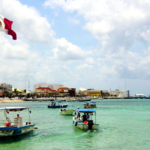
    Cozumel Tourism Booms with Record Cruise and Air Travel Numbers

    Cozumel
    Caption: With more cruises and flights than ever, Cozumel expects more than 9 million visitors in 2026.

    The island of Cozumel, off Mexico’s Caribbean coast, is expecting to welcome more than 9 million visitors during 2026. According to Mayor José Luis Chacón, a combination of improved air connections, a busy schedule of sporting events, and strong cruise ship traffic is driving the growth.

    Recent years have seen steady increases in tourism. In 2024, the island set a record with 4.6 million cruise passengers, finally surpassing pre-pandemic levels. The numbers continued to climb in 2025, with 4.72 million cruise visitors. Air travel also reached an all-time high, with over 700,000 passengers flying into the Cozumel airport. Ferry service between Playa del Carmen and Cozumel carried more than 3.6 million passengers, bringing the island close to the 9 million mark.

    The first two months of 2026 have started positively. Hotel occupancy was strong throughout January and February, and during the Carnival celebrations, hotels were full. The mayor also highlighted that some cruise ships will now extend their stays in port until 10 p.m., giving visitors more time to spend money in local shops, restaurants, and bars.

    Why Cozumel Is Increasingly Popular

    Cozumel’s appeal rests on several factors that bring visitors back year after year.

    World-Class Diving
    The island sits next to the Mesoamerican Barrier Reef, the second-largest reef system in the world. This makes Cozumel one of the top diving destinations globally. Divers and snorkelers come to see coral formations, sea turtles, rays, and hundreds of tropical fish species in clear, calm water.

    Beaches for Everyone


    The island offers different beach experiences. On the west coast, facing the mainland, the water is calm and protected, ideal for swimming. Public beaches like Playa Palancar and Playa Corona have beach clubs with loungers, food service, and snorkeling gear rentals. On the east coast, beaches like Playa Chumul face the open Caribbean Sea with stronger waves and a wilder feel.

    Cozumel
    Despite having so much going for it, Cozumel is ofcourse known for its beaches, which range from overcrowded to secluded and unspoiled.

    There is also the fact that Cozumel’s Isla Pasion was recently voted the world’s best beach in a TripAdvisor poll. 

    Maya History


    Cozumel was an important pilgrimage site for the ancient Maya, who traveled here to worship Ixchel, the goddess of fertility. At San Gervasio, the only Maya archaeological site open to the public, visitors can walk through the remains of temples and plazas built about a thousand years ago. The Cozumel Museum in San Miguel tells the story of the island from Maya times to the present.

    Dining and Shopping


    The food scene has grown beyond basic tourist fare. Small restaurants serve fresh seafood and authentic Mexican dishes. Craft breweries have opened, including Cerveceria Punta Sur, the island’s first microbrewery. Shopping ranges from silver jewelry stores to artisan markets where local artists sell handmade crafts. Renting a Jeep or scooter is a popular way to explore the island independently.

    Major Events


    Cozumel has become a destination for sports tourism. The island will host major triathlons in 2026, including the IRONMAN 70.3 in September and the Full IRONMAN in November. These events attract athletes and their families from around the world. The February Carnival celebration is another major draw, filling hotels and boosting business for local merchants.

    Cruise Industry Strength


    Cozumel remains one of the busiest cruise ports in the Caribbean, receiving 1,300 ships in 2025. Eleven new cruise ships made their first visits during the year. Royal Caribbean plans to open its Royal Beach Club Cozumel in 2026, providing another attraction for cruise passengers.

    Visitors Are Staying Longer


    Recent media coverage, including a “36 Hours” feature in the New York Times, has highlighted that, beyond the cruise-ship crowds, Cozumel offers a peaceful experience for overnight visitors. Hotel options range from beachfront properties on the east coast to sleek boutique hotels and comfortable waterfront options in town. Local tourism officials have been working to attract more overnight guests, spreading economic benefits to more businesses.

  • The Fall of Mexico’s Media Duopoly: Televisa and TV Azteca in Crisis

    The Fall of Mexico’s Media Duopoly: Televisa and TV Azteca in Crisis

    For decades, two companies controlled nearly everything Mexicans watched on television. Televisa, founded in the 1950s, grew into a media powerhouse with a virtual monopoly on broadcast television for over three decades. 

    Televisa programming, from telenovelas to news, reached into virtually every home, and its relationship with the government, particularly the long-ruling Institutional Revolutionary Party (PRI), was well-documented and mutually beneficial. The company’s power was such that its logo, an eye on a screen, was often seen as a symbol of its immense influence over public perception and political discourse.

    That comfortable arrangement was disrupted in 1993. The government privatized the Imevisión television network, and a businessman named Ricardo Salinas Pliego won the bid, creating TV Azteca. For the first time, Televisa had a real competitor. This broke the monopoly and, for a while, sparked a genuine rivalry. In the 1990s, both networks fought hard for viewers with new telenovelas, sports broadcasts, and news programs. 

    At the time, it was assumed that competition would result in a degree of political and social openness, as both channels sought to cover a changing Mexico. However, over time, the fierce competition settled into a more comfortable pattern. Instead of truly differentiating themselves, Televisa and TV Azteca began to resemble each other, both in the type of entertainment they produced and in their approach to political power. They formed a duopoly, working in tandem to protect their shared interests rather than fiercely competing for audience and market share.

    Their influence on Mexican society and politics cannot be overstated. For generations, these two networks were the primary sources of news and entertainment for most Mexicans. This gave them enormous power to shape public opinion. Critics have long accused them of biased news coverage that favored those in power. A famous example occurred during the 2012 presidential election, when Televisa was accused of running a de facto propaganda campaign for PRI candidate Enrique Peña Nieto, giving him favorable coverage while suppressing criticism, in exchange for lucrative government advertising contracts. This symbiotic relationship with the state was a cornerstone of their business model. They provided positive coverage and access to the masses, and in return, they received a steady flow of revenue from government advertising and benefited from regulations that protected their dominance. This arrangement made them incredibly wealthy and politically untouchable for a long time.

    Today, both networks are in serious trouble, and the old rules no longer apply. They are losing viewers and money, and their grip on Mexican society is slipping. There are three main reasons for this decline. The first is a massive shift in how people watch television. 

    The rise of streaming services like Netflix, YouTube, and social media has shattered the old broadcast model . Viewers, especially younger ones, are cutting the cord and choosing what to watch on their own time. This has led to a steep drop in audiences for traditional TV. Televisa, for example, has been bleeding subscribers from its satellite TV service, Sky, losing over 330,000 in just the first quarter of 2025 and seeing a 13.2% revenue drop in that unit. Its overall revenue has fallen for years.

    The second factor is the collapse of their traditional advertising revenue. For decades, the government was its biggest advertiser. Under President Andrés Manuel López Obrador, who took office in 2018, that spigot was nearly turned off. His administration slashed federal advertising spending by over 70% compared to his predecessors. During Enrique Peña Nieto’s six-year government, Televisa received nearly 10 billion pesos in government ads, and TV Azteca received almost 6 billion. In the first five years of the López Obrador administration, Televisa’s take dropped by nearly 85%, and TV Azteca’s by over 78%. At the same time, private advertising revenue is drying up as companies shift spending to digital platforms, which now capture the majority of ad revenue in Mexico.

    The third factor is financial mismanagement and debt, which has hit TV Azteca much harder. The company has been in a dire financial state for years. It has defaulted on bond payments to international investors, leading to lawsuits and a downgrade of its debt to “junk”. It has also been embroiled in a massive tax dispute with the government, with the Supreme Court confirming a debt of over 48 billion pesos (well over US$3 billion). 

    After the ruling, Grupo Azteca saw its stock price collapse and stopped publishing financial reports in 2023. Televisa’s financial situation, while serious, is not as catastrophic. It has also seen its credit rating downgraded and its profits plummet by 66% drop during 2025.