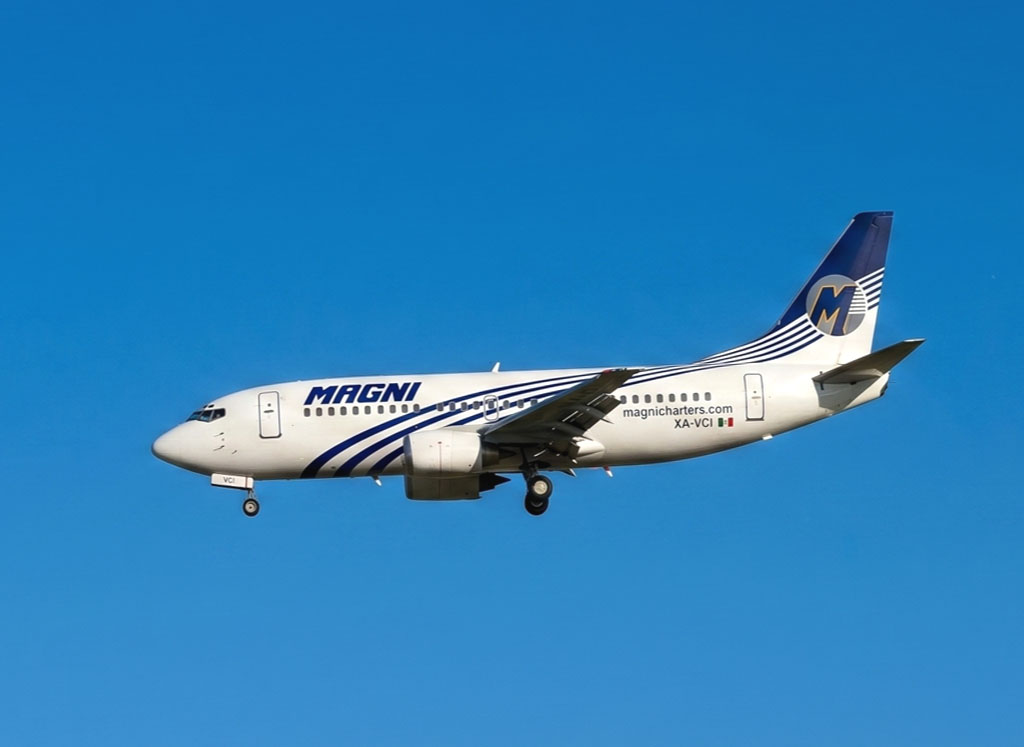
Founded in 1994, Magnicharters carved out a unique niche as Mexico’s first airline dedicated almost entirely to leisure and tour‑operator flights.
Magnicharters, one of Mexico’s longest-running low‑cost carriers, has formally filed for bankruptcy, becoming the latest casualty in an increasingly turbulent aviation landscape.
The airline, which abruptly suspended all flights on April 11, citing “logistical problems,” submitted a voluntary petition for commercial bankruptcy (concurso mercantil) on May 8.
For years, it served as the aviation arm for packages sold by Magnitur, offering affordable flights to beach destinations such as Cancún, Huatulco, Mérida, Puerto Vallarta, and the Riviera Maya. At its peak, the carrier operated a fleet of 12 Boeing 737s and carried more than one million passengers in 2015.
What Went Wrong
The airline’s decline was gradual, but the final descent was steep. By the end of 2025, Magnicharters’ fleet had shrunk to just four aging Boeing 737‑300s — nearly 30 years old on average, with one permanently grounded for maintenance. Passenger traffic plummeted in parallel: from 425,000 travelers in 2021 to just 208,583 in all of 2025, and a mere 20,558 in the first two months of 2026.
The immediate trigger was the skyrocketing price of jet fuel, which typically accounts for more than 30% of an airline’s operating expenses. For a low‑cost operator with razor‑thin margins, the surge proved fatal. Industry experts also point to a load factor of only 56%, meaning most flights left with nearly half their seats empty — a recipe for financial ruin.
Internal problems had been brewing for months. In December 2025, a pilot refused to take off from Mexico City to Cancún, publicly denouncing five months of unpaid wages for himself and the crew. The federal government had identified the carrier’s liquidity issues as early as January 2026, yet allowed it to continue flying until the mid‑April shutdown.
On April 15, the Federal Civil Aviation Agency (AFAC) suspended Magnicharters’ Air Operator Certificate, citing insufficient financial capacity that posed a “risk to operational safety”.
Today, the airline faces debts that may include unremitted airport usage fees (TUA) withheld from passengers and unpaid federal taxes. In 2023, it had already reached a settlement with Mexico City’s airport to repay 70 million pesos in past‑due TUA. If the bankruptcy court approves the petition, a judge will first seek a conciliation agreement with creditors; otherwise, Magnicharters could be liquidated.
The Bigger Picture: A Coming Duopoly
While Magnicharters fades into history, the Mexican airline industry is bracing for a seismic shift: the merger of the country’s two largest low‑cost carriers, Volaris and Viva Aerobus, into a holding company called Grupo Más Vuelos.
Together, Volaris and Viva already carried 73.5% of domestic air traffic in 2025, moving 63.5 million passengers. The merged entity would control an estimated 70–74% of the national market, leaving only Grupo Aeroméxico as a meaningful competitor. This would effectively create a duopoly, raising serious concerns about the cost of flying.
“Whenever there are fewer competitors, there are more opportunities for fares to rise,” Savanthi Syth, an analyst at Raymond James, warned Bloomberg. Critics fear that the two low‑cost giants will eventually coordinate schedules, set fares, and align discounts, reducing the price competition that has long benefited Mexican travelers.
A Troubled Comeback That Never Took Off
Against this backdrop of industry consolidation, the government’s own project to revive Mexicana de Aviación has been a conspicuous failure.
In a much‑hyped 2023 relaunch, the federal government, under then‑President Andrés Manuel López Obrador, resurrected the iconic brand under military administration.
Yet just one year later, in January 2025, Mexicana canceled eight of its 14 routes — more than half its network — including high‑profile destinations such as Acapulco, Guadalajara, Puerto Vallarta, and Campeche. The airline’s operational fleet shrank from four to two aircraft, and losses exceeded 930 million pesos (roughly US$53 million).
Magnicharters, one of Mexico’s longest-running low‑cost carriers, has formally filed for bankruptcy, becoming the latest casualty in an increasingly turbulent aviation landscape.
The airline, which abruptly suspended all flights on April 11, citing “logistical problems,” submitted a voluntary petition for commercial bankruptcy (concurso mercantil) on May 8.
For years, it served as the aviation arm for packages sold by Magnitur, offering affordable flights to beach destinations such as Cancún, Huatulco, Mérida, Puerto Vallarta, and the Riviera Maya. At its peak, the carrier operated a fleet of 12 Boeing 737s and carried more than one million passengers in 2015.
What Went Wrong
The airline’s decline was gradual, but the final descent was steep. By the end of 2025, Magnicharters’ fleet had shrunk to just four aging Boeing 737‑300s — nearly 30 years old on average, with one permanently grounded for maintenance. Passenger traffic plummeted in parallel: from 425,000 travelers in 2021 to just 208,583 in all of 2025, and a mere 20,558 in the first two months of 2026.
The immediate trigger was the skyrocketing price of jet fuel, which typically accounts for more than 30% of an airline’s operating expenses. For a low‑cost operator with razor‑thin margins, the surge proved fatal. Industry experts also point to a load factor of only 56%, meaning most flights left with nearly half their seats empty — a recipe for financial ruin.
Internal problems had been brewing for months. In December 2025, a pilot refused to take off from Mexico City to Cancún, publicly denouncing five months of unpaid wages for himself and the crew. The federal government had identified the carrier’s liquidity issues as early as January 2026, yet allowed it to continue flying until the mid‑April shutdown.
On April 15, the Federal Civil Aviation Agency (AFAC) suspended Magnicharters’ Air Operator Certificate, citing insufficient financial capacity that posed a “risk to operational safety”.
Today, the airline faces debts that may include unremitted airport usage fees (TUA) withheld from passengers and unpaid federal taxes. In 2023, it had already reached a settlement with Mexico City’s airport to repay 70 million pesos in past‑due TUA. If the bankruptcy court approves the petition, a judge will first seek a conciliation agreement with creditors; otherwise, Magnicharters could be liquidated.
The Bigger Picture: A Coming Duopoly
While Magnicharters fades into history, the Mexican airline industry is bracing for a seismic shift: the merger of the country’s two largest low‑cost carriers, Volaris and Viva Aerobus, into a holding company called Grupo Más Vuelos.
Together, Volaris and Viva already carried 73.5% of domestic air traffic in 2025, moving 63.5 million passengers. The merged entity would control an estimated 70–74% of the national market, leaving only Grupo Aeroméxico as a meaningful competitor. This would effectively create a duopoly, raising serious concerns about the cost of flying.
“Whenever there are fewer competitors, there are more opportunities for fares to rise,” Savanthi Syth, an analyst at Raymond James, warned Bloomberg. Critics fear that the two low‑cost giants will eventually coordinate schedules, set fares, and align discounts, reducing the price competition that has long benefited Mexican travelers.
A Troubled Comeback That Never Took Off
Against this backdrop of industry consolidation, the government’s own project to revive Mexicana de Aviación has been a conspicuous failure.
In a much‑hyped 2023 relaunch, the federal government, under then‑President Andrés Manuel López Obrador, resurrected the iconic brand under military administration.
Yet just one year later, in January 2025, Mexicana canceled eight of its 14 routes — more than half its network — including high‑profile destinations such as Acapulco, Guadalajara, Puerto Vallarta, and Campeche. The airline’s operational fleet shrank from four to two aircraft, and losses exceeded 930 million pesos (roughly US$53 million).