Mexico’s National Human Rights Commission has taken a sharp turn, going from championing UN oversight of the country’s disappearances crisis to denouncing it as foreign interference — a reversal that critics say leaves victims without one of their most important defenders.
The commission, known as the CNDH, spent several years actively calling on the federal government to accept supervision by the UN Committee on Enforced Disappearances (CED). In 2020, it warned that the widespread practice of enforced disappearance “constitutes a crime against humanity.” A year later, CNDH president Rosario Piedra Ibarra told the UN body directly that Mexico faced a “crisis of disappearances,” acknowledged “institutional weakness” in addressing it, and said the state had a “pending debt” to victims.
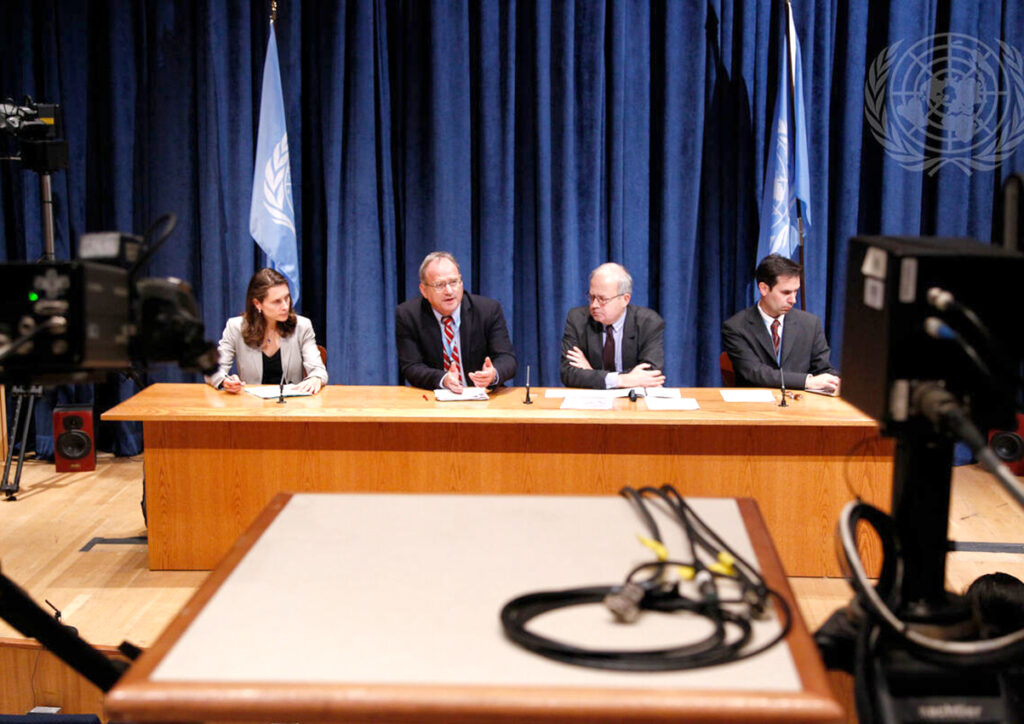
That language is gone now. By late 2025, the CNDH was warning against what it called attempts to “impose the idea” that foreign bodies should solve Mexico’s problems. Then, in early April 2026, the commission rejected the CED’s findings outright, calling them “biased” and “interventionist” and accusing civil society organizations of profiting from the human rights cause. The commission specifically criticized the CED for relying on input from groups like the Centro Prodh rather than weighing the government’s institutional efforts over the past seven years.
The timing matters. The CED on April 2 took the extraordinary step of asking the UN secretary-general to refer Mexico’s disappearances crisis to the General Assembly — the first time the committee has used that mechanism for any country. The committee said it had found well-founded indications that enforced disappearances in Mexico have been and continue to be committed as crimes against humanity. It cited the discovery of more than 4,500 clandestine graves containing over 6,200 bodies, alongside roughly 72,000 unidentified human remains nationwide.
Mexico’s official registry recorded 394,645 historical disappearance cases as of late March 2026, with 132,534 people still unaccounted for.
Activist Eunice Rendón, coordinator of Agenda Migrante, said the commission’s transformation has been fundamental. Under Piedra’s leadership, she said, the CNDH has effectively stopped acting as a counterweight to state power and started defending it — questioning organizations and discrediting international mechanisms that exist precisely to fill the gaps left by domestic institutions. “This is especially serious in a country that has accumulated more than 130,000 people disappeared without being located, where the crisis is not discursive but humanitarian,” she said.
Carolina Jasso González, a researcher at the Universidad Iberoamericana’s Citizen Security Program, noted the crisis predates any single administration. She traced its roots to the 1960s and said structural factors — including the militarization of public security and the evolution of criminal networks — have driven a steady increase in cases. Between January 2023 and April 2025 alone, nearly 29,000 new disappearances were registered.
Carlos Torres, an academic at the Universidad Nacional Autónoma de México’s school of political and social sciences, said the commission’s reversal carries institutional consequences beyond the immediate controversy. When an autonomous body stops being uncomfortable for those in power, he argued, it loses its reason for being and leaves victims more exposed. Closing the door to international mechanisms in the middle of a crisis of this scale, he said, does not strengthen national sovereignty — it undermines it. “What is needed is to add capacities, not subtract them,” Torres said.
The Mexico City Human Rights Commission has taken a notably different stance, publicly acknowledging the CED’s findings as a valuable tool for strengthening standards and access to international assistance — a contrast that several analysts pointed to as an example of how autonomous bodies can respond responsibly.
Cases involving missing foreigners in Mexico have periodically drawn international attention. A Texas woman was found alive in Monterrey after 27 years, a rare outcome in a country where answers for families of the disappeared are the exception, not the rule.
The federal government has also rejected the CED’s report, calling it “tendentious” and arguing it failed to credit recent institutional advances. President Claudia Sheinbaum has publicly denied that the state carries out enforced disappearances, attributing cases to organized crime.
At a Glance: Mexico’s Disappearances Crisis
- Mexico’s national registry lists 394,645 historical disappearance cases dating back to 1952
- 132,534 people remain unaccounted for as of March 26, 2026
- More than 4,500 clandestine graves have been found, containing over 6,200 bodies and 4,600 sets of human remains
- Roughly 72,000 human remains nationwide remain unidentified
- Approximately 29,000 new disappearances were recorded between January 2023 and April 2025
- The CNDH is led by Rosario Piedra Ibarra, appointed in 2019
- The UN’s CED invoked Article 34 of its founding convention — the first time in the committee’s history — to refer Mexico’s case to the UN General Assembly
Source: El Universal