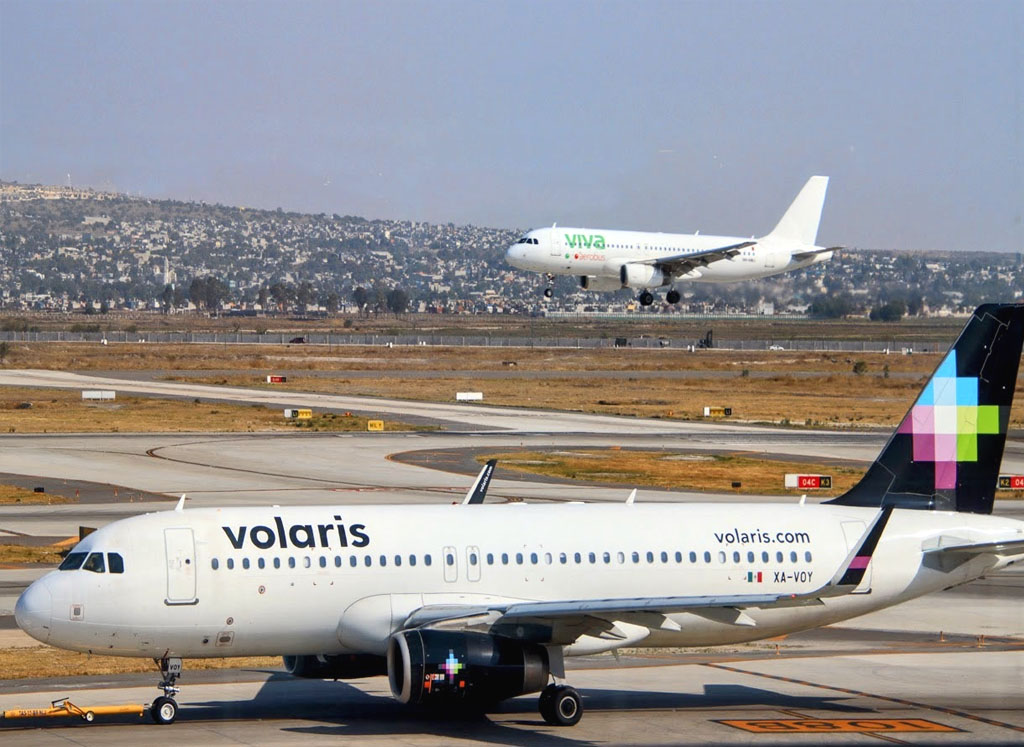
The plan to merge Mexico’s two main low-cost airlines, Viva, formerly Viva Aerobus, and Volaris, is encountering a major regulatory hurdle.
While the companies announced the deal last December, promising more low-cost flights and better connectivity, experts warn that creating a single budget airline giant could harm competition. This concern is amplified by the significant consolidation of Mexico’s low-cost market in recent years.
The current situation where Viva and Volaris dominate low-cost travel didn’t happen by accident. It followed the disappearance of other carriers that had once competed on many of the same routes. Notably, Interjet, a major hybrid carrier that offered many low-cost-style fares, ceased operations in 2020 due to severe financial difficulties. Before that, Aerocalifornia, which served many regional routes, also vanished from the skies. Their exits left Viva and Volaris as the primary players for budget-conscious travelers on numerous domestic and cross-border routes.
This history is central to the current regulatory challenge. Juan Carlos Machorro, a partner at the legal consultancy Santamarina & Steta, explains that the proposed merger qualifies as a monopoly under Mexico’s competition law.
With the two airlines already controlling nearly 100% of the dedicated low-cost market, regulators are on high alert. “This would set off red flags for any antitrust authority in the world,” Machorro said. The concern is that consolidating two competitors into one could lead to higher fares and fewer choices for passengers.
This kind of market consolidation is not unique to Mexico, and looking at how regulators in the United States and Europe have handled similar situations is informative. In the U.S., a wave of mergers over the past 15 years combined major carriers like Delta with Northwest, United with Continental, and American with US Airways. Regulators approved these but often required airlines to relinquish valuable takeoff and landing slots at congested airports such as New York and Washington, D.C., to other airlines to preserve some level of competition.
In Europe, the attempted 2000s merger between budget giants Ryanair and Aer Lingus is a direct parallel. European Union regulators blocked the deal multiple times, arguing that it would create a monopoly across many routes to and from Ireland and significantly reduce consumer choice. The EU’s strict stance was a clear example of regulators prioritizing market competition over corporate growth.
Now, the focus is on Mexico’s National Antitrust Commission. They must decide if the benefits of a stronger combined airline outweigh the risks of severely reduced competition. The decision is further complicated by international relations, specifically with the United States.
Recently, the U.S. Department of Transportation took a tough stance, removing the antitrust immunity that allowed the commercial alliance between Mexico’s Aeromexico and the U.S.’s Delta Air Lines. The U.S. argued that competitive conditions in Mexico had worsened since the alliance was first approved. This action creates a difficult context for the Viva-Volaris merger. If Mexican regulators approve it with few conditions, it could be seen by U.S. authorities as another step in reducing competition in Mexico’s aviation market, potentially leading to further diplomatic friction.
The CEOs of Viva and Volaris argue that their similar operations using Airbus A320 aircraft will create efficiencies and help democratize air travel in Mexico. However, the core issue is no longer just business logic. The merger’s fate now depends on a complex calculation by regulators who must consider a shrunken market, international precedent, and the warning from recent U.S. actions.
The coming months will reveal whether the desire for a larger national champion prevails, or whether concerns about competition and consumer prices ground the deal.