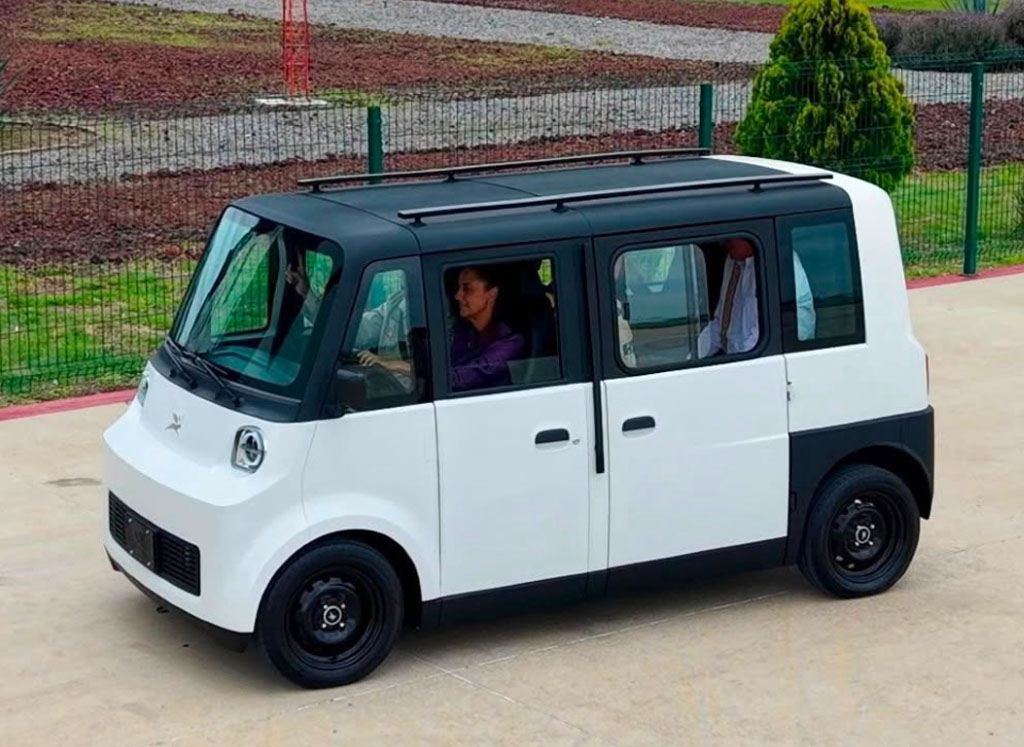
The recent unveiling of the first production model of Olinia, Mexico’s state-backed electric vehicle initiative, has ignited a national conversation that pits pragmatic engineering against its unorthodox look and specifications.
Olia, a Model Designed for the Neighborhood, Not the Showroom
On June 7, Olina project coordinator Roberto Capuano Tripp finally took the wraps off Olinia Uno, the first tangible result of a project announced by President Claudia Sheinbaum in October 2024.
With a maximum speed capped at 50 kilometers per hour and a per-charge range of 125 kilometers, the Olinia Uno is explicitly not designed for highway travel or long commutes.
Instead, its tall, boxy body and compact footprint are conceived as a solution for the daily reality of millions of Mexicans, where 70% of the population lives in urban areas and 80% of daily trips cover fewer than 30 kilometers.
The car can be recharged from any standard household outlet, eliminating the need for specialized public charging stations for daily use.
Designers explicitly drew inspiration from the ubiquitous mototaxis that navigate narrow streets across the country, aiming to offer a safer, enclosed alternative with space for four passengers or adapted configurations for people with disabilities.
While earlier plans spoke of three different models and a wide price range, Capuano confirmed that this initial version will retail for 150,000 pesos (roughly USD $7,500), a figure within reach of the country’s working class.
Government officials argue that the Olina’s operational cost, estimated at just half a peso per kilometer, will save owners up to 50,000 pesos annually compared to a conventional vehicle, making it cheaper to run than a motorcycle.
Olina, Sovereignty, Economy, and the Battle Against Chinese Imports
President Sheinbaum has been clear that the goal is for Mexico to move beyond its role as a low-cost assembly hub for foreign automakers and instead develop its own proprietary technology, a transition explicitly framed as a step toward technological sovereignty.
The project’s name, derived from the Nahuatl word for “movement,” is an intrinsic part of this narrative, embedding a cultural and linguistic identity directly into the engineering.
The Mexican EV market is projected to grow between 25% and 30% annually over the next five years, but that growth is currently being captured almost entirely by imported models, particularly from Chinese brands like BYD and Chery, which already account for nearly a tenth of new car sales in the country.
Reception: A Storm of Memes Meets a Pragmatic Defense
From the moment the first images of the Olina were shared by President Sheinbaum on social media, the aesthetic debate began in earnest. Critics were quick to pounce on the vehicle’s utilitarian, almost brutalist form.
On social media, the car was labeled Olina, “the ugliest thing I have ever seen,” and its design was sarcastically attributed to having been commissioned by a five-year-old child. Another user on X, formerly Twitter, quipped that the car was “perfect for crater-level potholes,” a biting reference to Mexico’s notoriously poor urban infrastructure.
The mockery has been widespread and relentless, with the vehicle’s slab-sided, industrial aesthetic becoming a primary target for those who see the project as a national embarrassment.
However, a strong countercurrent of support has emerged, arguing that critics have fundamentally misunderstood the project’s goals. Supporters point out that the Olinia Uno is not a luxury good or a status symbol, but a piece of industrial equipment designed for a specific and vital public purpose: affordable, sustainable mobility for the working class.
The director of the project himself stated that Olinia is “a project for the people,” not a bid for design awards.
As one Mexican columnist observed, her own mother wanted an Olina not because it was pretty, but because it promised to solve a real, daily logistical problem at a cost that was finally attainable.