Author: MxTrib Staff

  • 25 National Guard Members Killed After Mexico Takes Down ‘El Mencho’

    25 National Guard Members Killed After Mexico Takes Down ‘El Mencho’

    The death toll from Mexico’s operation to capture Jalisco New Generation Cartel (CJNG) leader Nemesio Rubén Oseguera Cervantes — known as “El Mencho” — has climbed sharply, with 25 National Guard members killed in six separate attacks in the state of Jalisco alone.

    Security Secretary Omar García Harfuch made the announcement Monday, visibly emotional, as the full scale of the violence following Sunday’s military operation came into view. Also killed were a prison guard, a state prosecutor’s agent, and an unidentified woman. About 30 cartel suspects were killed in Jalisco, and four more in the neighboring state of Michoacán. All told, authorities put the total death count at at least 73, including security forces, suspected cartel members, and civilians.

    As we reported yesterday, El Mencho — age 59 — was wounded during a military raid Sunday morning in the mountain town of Tapalpa, Jalisco, about two hours southwest of Guadalajara. Defense Secretary Ricardo Trevilla said troops had tracked Oseguera Cervantes to the location after following one of his romantic partners. When special forces moved in, they immediately came under fire. Eight gunmen were killed at the site. The cartel leader and two bodyguards fled into a wooded area, where all three were wounded in a firefight. They were airlifted out, but Oseguera Cervantes died en route to Mexico City.

    Trevilla also disclosed that in a separate location, soldiers killed another senior CJNG figure who had been coordinating the cartel’s violent response and reportedly offering more than $1,000 for every soldier killed.

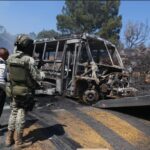
    The CJNG’s retaliation was swift and widespread. Cartel members set vehicles ablaze and threw up roadblocks across more than 20 states. Guadalajara, Mexico’s second-largest city, essentially shut down Sunday night. Smoke billowed over Puerto Vallarta, and travelers were seen running through the city’s international airport in a panic. More than 1,000 people were trapped overnight at the Guadalajara zoo, including families from neighboring states who could not safely return home.

    By Monday morning, authorities said all 250-plus roadblocks had been cleared, and Guadalajara was beginning to return to normal. Schools were canceled in several states, however, and both the U.S. and Canadian embassies advised their citizens to shelter in place in affected areas.

    President Claudia Sheinbaum publicly appealed for calm and praised the military’s efforts. The operation gave her government its biggest security win yet — and a tangible result to show the Trump administration, which has been pressing Mexico hard on drug trafficking and threatening additional tariffs if it doesn’t deliver results. White House press secretary Karoline Leavitt confirmed the U.S. provided intelligence support for the mission, calling El Mencho one of the top fentanyl traffickers targeting the United States.

    U.S. Ambassador Ron Johnson said the operation demonstrated that bilateral security cooperation had reached its highest level yet under both presidents.

    The CJNG is considered one of Mexico’s most powerful and aggressive criminal organizations, known for trafficking fentanyl, methamphetamine, and cocaine to the United States. The group was founded around 2009 and designated a foreign terrorist organization by the Trump administration in February 2025. It has a well-documented history of attacking the military, including using drones to drop explosives and planting mines. In 2020, the cartel carried out a brazen assassination attempt — using grenades and high-powered rifles — on the then-chief of Mexico City’s police force, who is now the country’s federal security secretary.

    With no clear successor identified within the CJNG, analysts caution that rival criminal groups may move quickly to fill the vacuum. For coverage of how this security situation could affect travelers to the Yucatán Peninsula and beyond, keep watching Mexico Tribune.


    Quick facts

    • El Mencho’s real name: Nemesio Rubén Oseguera Cervantes, age 59
    • Killed: Sunday, Feb. 22, 2026, in Tapalpa, Jalisco
    • Total death toll: at least 73, including 25 National Guard members
    • Roadblocks reported: more than 250 across 20 states, all cleared by Monday
    • U.S. reward offered before his death: up to $15 million
    • CJNG designated a foreign terrorist organization by the U.S. in February 2025
    • Countries issuing travel advisories: United States, Canada, India, among others
    • Schools canceled Monday in multiple Mexican states
  • Shelter-in-Place Warnings After Mexico Kills Top Cartel Boss
    Shelter-in-Place Warnings After Mexico Kills Top Cartel Boss

    The Mexican military killed the leader of the Jalisco New Generation Cartel on Sunday in a raid in western Mexico, setting off a wave of violence that prompted governments in Jalisco and several neighboring states — as well as the United States, Canada, the United Kingdom, and other countries — to issue shelter-in-place orders and travel warnings.

    Nemesio Rubén Oseguera Cervantes, known as “El Mencho,” was wounded during a military operation in the town of Tapalpa, in Jalisco state, and died while being airlifted to Mexico City. He had been one of the world’s most-wanted drug traffickers, with a U.S. bounty of up to $15 million on his head.

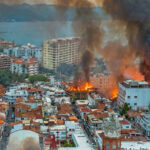
    Puerto Vallarta fires
    Puerto Vallarta is in flames after a cartel leader’s execution provoked acts of revenge. Photo: Social Media

    The operation was carried out by the Mexican Army, National Guard, and Air Force, with intelligence support from U.S. agencies. Six other cartel members were killed, and two were arrested. Three soldiers were wounded. Authorities seized armored vehicles, rocket launchers, and other weapons.

    The cartel’s response was swift. Gunmen torched buses, cars, and businesses, blocking highways across nearly a dozen states. Guadalajara, Jalisco’s capital and a city slated to host matches in the 2026 FIFA World Cup, emptied out as residents stayed indoors. Smoke was visible rising over Puerto Vallarta, the popular Pacific coast resort city. Delta, Alaska Airlines, American Airlines, and Air Canada all canceled flights to Puerto Vallarta and Guadalajara.

    Jalisco Governor Pablo Lemus declared a Code Red and suspended public transportation. He urged residents to remain at home until further notice. The governor of neighboring Nayarit, Miguel Ángel Navarro, issued a similar warning. Governors of Michoacán, Colima, and Tamaulipas also reported blockades and arson but stopped short of shelter-in-place orders, instead asking residents to monitor official channels. By early afternoon Sunday, Guanajuato reported its blockades had been cleared.

    The U.S. Embassy in Mexico told citizens via social media to shelter in place in Jalisco — including Puerto Vallarta, Chapala, and Guadalajara — as well as in parts of Tamaulipas, Michoacán, Guerrero, and Nuevo León. Canada told its citizens in Jalisco to “keep a low profile” and follow local authorities. The U.K. Embassy updated its Mexico travel guidance, warning against all but essential travel to parts of southern Jalisco and 11 municipalities in the north of the state. Australia and India also issued security alerts to their nationals in Mexico.

    U.S. Deputy Secretary of State Christopher Landau welcomed the operation, calling Oseguera “one of the bloodiest and most ruthless drug kingpins” and saying the killing was “a great development for Mexico, the U.S., Latin America, and the world.”

    President Claudia Sheinbaum praised Mexican security forces and called for calm. She has faced sustained pressure from the Trump administration to show results against drug trafficking since Trump took office last year. In February, the Trump administration formally designated the CJNG as a foreign terrorist organization.

    The CJNG was co-founded by Oseguera around 2007 and grew into what the FBI and DEA consider Mexico’s most powerful trafficking organization, with a presence in all 50 U.S. states. The cartel is responsible for moving large quantities of cocaine, methamphetamine, heroin, and fentanyl into the United States. It is known for particularly aggressive tactics, including attacks on military helicopters and the use of explosive-laden drones.

    Al Jazeera’s correspondent in Mexico City noted that there is “no obvious successor” to Oseguera, a situation that could trigger internal power struggles within the cartel. The Yucatán Peninsula, while largely insulated from CJNG activity, has not been entirely immune to the broader expansion of organized crime in Mexico — as recent incidents in eastern Yucatán have illustrated.

    As of Sunday evening, the situation in several states remained fluid.


    What you need to know

    • El Mencho, leader of the Jalisco New Generation Cartel (CJNG), was killed Feb. 22 in a Mexican Army operation in Tapalpa, Jalisco
    • The U.S. had offered a $15 million bounty for information leading to his arrest
    • Cartel reprisals triggered road blockades, arson, and unrest across nearly a dozen Mexican states
    • The U.S. Embassy issued shelter-in-place orders for Americans in Jalisco, Tamaulipas, parts of Michoacán, Guerrero, and Nuevo León
    • Canada, the U.K., Australia, and India also issued security alerts for their nationals
    • Jalisco Governor Pablo Lemus declared a Code Red and suspended public transportation
    • Multiple airlines, including Delta, American, Alaska, and Air Canada, canceled flights to Guadalajara and Puerto Vallarta
    • The CJNG was designated a foreign terrorist organization by the U.S. in February 2026
    • No obvious successor to Oseguera has been named, raising the possibility of further instability within the cartel
  • NASCAR at Tulum Airport: More Than 30,000 Fans Expected

    NASCAR at Tulum Airport: More Than 30,000 Fans Expected

    Stock cars are heading to the Caribbean coast, and the venue might surprise you: an active international airport. The Tulum airport, to be exact.

    Felipe Carrillo Puerto International Airport in Tulum, Quintana Roo, will be transformed into a temporary oval track on April 25 and 26 for rounds of the 2026 NASCAR México Series and Challenge Series. The races are part of the Tulum Air Show (Airshow Tulum 2026), a four-day event organized by the Mexican Air Force and the Mexico Aerospace Fair, known as Famex. Organizers are projecting more than 30,000 attendees across the full April 23–26 program.

    The combination of motorsport and military aviation is unusual by any standard. Along with the stock-car races, the air show will feature aerobatic displays by F-5 jets, helicopters, drones, and other aircraft. Aerospace exhibitions and safety workshops are also planned at Military Air Base No. 20, which adjoins the airport facilities.

    NASCAR México president Jimmy Morales said the invitation to race at Tulum came from Famex, not from his organization. “The project has accumulated over six months of joint work with the Air Force,” Morales said at a February news conference, “and the intention is to turn this participation into a recurring relationship with Famex.” He added that the event would position the Mexican Caribbean as “an international benchmark for motorsport.”

    The races in Tulum will be the third weekend of NASCAR México’s 12-race 2026 season. The series opener is scheduled for March 14–15 in San Luis Potosí, with the season finale set for November 14–15 in Puebla. Tickets for the Tulum races will be sold separately from the largely free air show programming.

    NASCAR México has long served as a proving ground for Mexican drivers. The series produced Daniel Suárez, who went on to compete in the NASCAR Cup Series in the United States — a path that has raised the profile of the Mexican series with fans on both sides of the border.

    This event is a different animal from last year’s high-profile NASCAR Cup race in Mexico City. That June 2025 race at Autódromo Hermanos Rodríguez was a points-scoring event featuring all of the top Cup Series talent. The Tulum races involve the domestic Mexican series rather than the premier Cup circuit, which dropped Mexico City from its 2026 schedule, citing scheduling conflicts around the FIFA World Cup and travel logistics.

    The airport itself has had a complicated few years since opening in December 2023. Airlines have scaled back service at the facility, which sits nearly 30 miles from the resort town of Tulum and has struggled to match initial demand projections. Whether a NASCAR weekend will give the airport some promotional momentum remains to be seen. For now, at least, the runways are getting a very different kind of use.

    Security, logistics, and hotel coordination are already being worked out, according to officials at the February announcement. Representatives from the federal tourism secretariat, the state government of Quintana Roo, and the Tulum tourism secretariat were all present, signaling broad government backing for the event.

    For more on NASCAR in Mexico, The Athletic has followed the series’ efforts to expand its footprint south of the border.


    Factbox: NASCAR at Tulum Airport 2026

    • Event: Airshow Tulum 2026 / Tulum Air Show
    • Dates: April 23–26, 2026 (NASCAR races: April 25–26)
    • Venue: Felipe Carrillo Puerto International Airport, Tulum, Quintana Roo
    • Organizers: Mexican Air Force and Famex (Mexico Aerospace Fair)
    • Racing: NASCAR México Series and NASCAR Challenge Series
    • Projected attendance: More than 30,000 across all four days
    • Admission: Air show is largely free; NASCAR race tickets are sold separately
    • NASCAR México 2026 season opener: March 14–15, San Luis Potosí
    • Season finale: November 14–15, Puebla
  • USMCA Review Countdown: What’s at Stake for US-Mexico Trade in July 2026?

    USMCA Review Countdown: What’s at Stake for US-Mexico Trade in July 2026?

    Photo: Fejuz / Unsplash

    On July 1, 2026, the United States-Mexico-Canada Agreement (USMCA) faces its first formal joint review, a built-in mechanism that will determine whether the trade deal that replaced NAFTA in 2020 survives for another 16 years or begins a decade-long countdown toward expiration. 

    For the roughly 1.6 million Americans living in Mexico and the millions more who visit each year, the outcome of this USMCA review in 2026 carries real consequences. Changes to trade rules could affect everything from the price of imported goods on supermarket shelves to the cost of shipping personal belongings across the border. If you run a small business that depends on cross-border commerce, or you receive a pension denominated in US dollars while paying rent in pesos, the renegotiation could reshape the economic landscape you depend on.

    The stakes are enormous by any measure. US-Mexico goods and services trade hit $935.1 billion in 2024, according to the Office of the US Trade Representative, making Mexico the largest US trading partner for the second consecutive year. The port of entry in Laredo, Texas alone processed $339 billion in two-way trade that year. Vehicles, auto parts, electrical machinery, and medical devices flow north, while US gasoline, corn, pork, and dairy products move south. This is not an abstract policy discussion. It is the plumbing of daily life on both sides of the border. 

    How the USMCA Review Process Works

    What was once expected to be a routine procedural check has transformed into a high-stakes negotiation. The Trumpadministration has signaled its intent to use the review as leverage on issues that extend well beyond tariffs, including migration enforcement, fentanyl trafficking, and Chinese investment in Mexican manufacturing. The Center for Strategic and International Studies (CSIS) has characterized the review as a potential “turning point” for North American integration. Whether it becomes a turning point or a breaking point depends largely on what happens over the next five months.

    Article 34.7 of the USMCA requires the three member countries to conduct a formal review on the sixth anniversary of the agreement’s entry into force. If all three governments agree to renew, the deal extends for another 16 years, with the next review falling in 2032. If any party refuses, the agreement enters annual reviews and ultimately expires on July 1, 2036.

    This is the first time any US trade agreement has included such a mechanism, so there is no precedent. The domestic process is already underway. The US Trade Representative (USTR) published a Federal Register notice in September 2025 inviting public comment and held three days of public hearings in Washington from December 3 to 5, 2025. Mexico’s government also opened its own public comment period. By January 2, 2026, USTR was required to submit a formal assessment to Congress outlining its position on whether to extend the agreement and any proposed changes.

    The Pressure Points on the Table

    Several flashpoints are expected to dominate negotiations. The automotive sector is chief among them. The USMCA requires that 75% of a vehicle’s content originate in North America to qualify for duty-free treatment, up from 62.5% under NAFTA. A labor value content rule mandates that a percentage of each vehicle’s value come from factories paying workers at least $16 per hour. The Independent Mexico Labor Expert Board, a body created by Congress to monitor compliance, reported in October 2025 that Mexico has failed to meet its labor obligations under the agreement. Mexican manufacturing wages sit at roughly $2.76 per hour, about 10% of the US equivalent.

    The auto industry’s anxiety is already showing. Foreign direct investment in Mexico’s automotive sector dropped 20% in the first three quarters of 2025, falling to $7.8 billion from $9.8 billion the previous year, according to Mexico Business News. Japanese automakers, who have invested $87 billion across North America, submitted coordinated comments to USTR urging preservation of the agreement’s integrated production framework.

    Then there is the China question. Chinese firms expanded their direct investment footprint in Mexico by as much as 288% through 2023, according to the Economic Policy Institute. US lawmakers from both parties have introduced legislation directing USTR to prioritize blocking Chinese companies from exploiting USMCA’s duty-free provisions. The review is expected to include new restrictions on content from non-market economies entering the North American supply chain.

    What’s It All Mean for Expats and Visitors?

    For Americans and Canadians living in Mexico, the practical implications range from grocery prices to healthcare access. The USMCA governs duty-free treatment for agricultural goods, which means the cost of imported cheese, pork, and dairy at stores like Costco Mexico and Walmart-owned Bodega Aurrera is directly tied to the agreement’s survival. Medical devices, many of which are assembled in Mexico under USMCA provisions, could see price increases if new tariffs are imposed on components.

    Small business owners who import US-made goods for resale, or who export Mexican-produced artisan goods northward, would be among the first to feel disruptions. Even the broader peso-dollar exchange rate could be affected by market uncertainty if the review goes sideways.

    The Road to July

    Most trade analysts expect the agreement to be extended in some form. Outright termination would be economically catastrophic for all three countries, and no government has publicly suggested walking away. The more likely scenario involves a conditional extension paired with targeted amendments, particularly around automotive rules of origin, digital trade provisions, and labor enforcement.

    The Baker Institute at Rice University has recommended that the review focus on confirming the agreement’s essential elements while making targeted updates. Others, including 105 House Democrats led by Representative Rosa DeLauro, have called for a complete overhaul of the labor and wage provisions.

    Whatever happens at the negotiating table, the July 2026 deadline is a fixed date. Anyone with financial ties to cross-border commerce, whether that means running a restaurant that imports US beef, operating a property rental that caters to tourists, or simply living on a fixed income paid in dollars, should be paying close attention.

  • Foundation Shoots Down Rumor of Elena Poniatowska’s Death

    Foundation Shoots Down Rumor of Elena Poniatowska’s Death

    A false report that Elena Poniatowska — Mexico’s most celebrated living writer — had died spread rapidly across social media on Wednesday, alarming readers, journalists, and public figures across Latin America before being quickly and firmly denied.

    The rumor originated on X, formerly Twitter, where a recently created account impersonating a publishing house posted a notice claiming the 93-year-old author had died. The post spread fast. Well-known writers and journalists shared condolences. Argentine author Martín Caparrós posted a farewell tribute, then had to delete it after learning the news was fake.

    The Fundación Elena Poniatowska Amor A.C. (Elena Poniatowska Amor Foundation) moved quickly to set the record straight. “Good morning, everyone — false information is circulating about Elena; she is perfectly fine and in excellent health,” she said.

    The false report even reached Mexican President Claudia Sheinbaum during her morning news conference, known as La Mañanera del Pueblo (The People’s Morning Conference). “¡Ay, no! Vamos a averiguar bien,” she said — something like “Oh no! Let’s find out properly.” Minutes later, after her staff confirmed the truth with the foundation, Sheinbaum was direct: “No es cierto. No asusten. Nuestro cariño a Elenita.” Translation: “It’s not true. Don’t scare people. Our love to little Elena.”

    The incident is part of a broader pattern of fake celebrity death announcements on social media. Italian prankster Tommaso Debenedetti has been linked to similar hoaxes in the past targeting prominent public figures. In recent months, false death reports have also circulated about other well-known personalities, including singer José Luis Perales and actor Damián Alcázar.

    Who is Elena Poniatowska?

    Poniatowska is a towering figure in Mexico — the kind of writer whose work helped shape how an entire nation understood itself. Born in Paris on May 19, 1932, she moved to Mexico at age 10 to escape World War II. Her father was of Polish nobility and her mother came from a prominent Mexican family that had fled the country during the Revolution.

    She started writing for the newspaper Excélsior at 18 and never really stopped. Over seven decades, she produced novels, essays, oral histories, and biography — more than 40 books in all, translated into over 20 languages. She was one of the founders of the newspaper La Jornada, now one of Mexico’s most-read dailies.

    Her most famous work, La noche de Tlatelolco (published in English as Massacre in Mexico), documents the 1968 massacre of student protesters by government forces — an event the Mexican government tried for years to suppress. The book is built almost entirely from testimonies, recorded and woven together by Poniatowska herself. It remains essential reading for anyone trying to understand modern Mexico.

    In 2013, she became the fourth woman to win the Premio Cervantes (Cervantes Prize), the most prestigious award in Spanish-language literature. She was also the first woman to receive Mexico’s National Journalism Prize, back in 1979.

    President Claudia Sheinbaum, who publicly defended Poniatowska on Wednesday, has long held the author in high regard. The two women are part of a left-leaning intellectual tradition that has shaped Mexican culture for generations.

    Despite her age, Poniatowska remains active. She still writes. She still gives interviews. The foundation that bears her name — and that issued Wednesday’s denial — recently launched a fiction writing competition.

    The fake account that sparked Wednesday’s panic was created less than a month before the incident. Experts who track disinformation say this is a common tactic: new accounts with credible-sounding names post alarming content designed to spread before anyone thinks to verify it. The speed of X’s retweet culture does the rest.

    For those who want to follow Poniatowska’s actual work and news, La Jornada — the newspaper she helped found — remains a reliable source.

    Quick Facts: Elena Poniatowska

    • Born May 19, 1932, in Paris, France; moved to Mexico in 1942
    • Began her journalism career in 1953 at the newspaper Excélsior
    • Author of more than 40 books, including novels, oral histories, and biography
    • Best known for La noche de Tlatelolco (1971), published in English as Massacre in Mexico
    • First woman to receive Mexico’s National Journalism Prize (1979)
    • Won the Premio Cervantes in 2013, the highest honor in Spanish-language literature
    • Co-founder of the Mexican newspaper La Jornada
    • Trilingual in Spanish, French, and English
    • Still active as a writer and public intellectual at age 93