
Author: MxTrib Staff

  • Sheinbaum Moves to Cap Mexico’s 7-Figure Government Pensions

    Sheinbaum Moves to Cap Mexico’s 7-Figure Government Pensions

    Mexican President Claudia Sheinbaum announced Wednesday that she will send a constitutional reform to Congress to eliminate what her government calls an entrenched system of excessive retirement payouts for former high-ranking officials at state-owned enterprises — some of whom collect more each month than the president herself earns.

    The announcement came during Sheinbaum’s morning press conference at the National Palace in Mexico City, where Raquel Buenrostro, head of the Secretariat for Anti-Corruption and Good Governance (Secretaría Anticorrupción y Buen Gobierno), laid out a detailed breakdown of the figures. What she presented was striking.

    At the now-defunct power utility Luz y Fuerza del Centro (Light and Power of the Center), more than 14,000 former employees collectively receive 28 billion pesos — about $1.6 billion — per year in pension payments. Nearly 9,500 of them, roughly 67%, take home between 100,000 and one million pesos a month. One individual receives just over one million pesos monthly — about $58,000. The federal government also subsidizes part of their income taxes, adding another 2.4 billion pesos to the annual bill. Buenrostro noted that Luz y Fuerza pensioners receive on average 140 times the national average pension.

    At Pemex, Mexico’s state oil company, the picture is similar. Some 22,000 former employees in the management tier (régimen de confianza) receive a combined 24.8 billion pesos a year. Of those, 544 collect more than the president — adding up to 1.8 billion pesos annually above her salary. Pemex pensioners average 39 times the national pension. At the Federal Electricity Commission (CFE), more than 2,100 retirees also out-earn Sheinbaum, costing an extra 4.5 billion pesos per year. Buenrostro flagged additional cases at development banks Nafin, Banobras, and Bancomext.

    For context, the national average monthly pension in Mexico is around 7,000 pesos — roughly $400.

    The reform, which Sheinbaum said she plans to submit to Congress on Feb. 23, would amend Article 127 of the constitution to cap future pensions at half the president’s salary — about 70,000 pesos per month. Payments already being received would not be touched retroactively, but any new or adjusted payouts would fall under the cap going forward. Sheinbaum made clear the measure targets only senior management-level former employees, not unionized workers or those with collective bargaining agreements.

    The government expects the reform to free up about 5 billion pesos annually, money Sheinbaum said will be redirected to the Programas del Bienestar (Welfare Programs), the administration’s social safety net. She said details on specific programs that will benefit will be announced on Feb. 23 alongside the legislation.

    This isn’t the first time the issue has surfaced. Buenrostro raised similar concerns publicly in August 2025, when the government first revealed the scope of the pension figures and said it was exploring constitutional changes. Critics of the Slim proposal and other pension reform debates have noted that Mexico’s pension policy for rank-and-file workers moves in one direction while executive-tier payouts remain in another category altogether.

    The reform effort fits into a broader anti-corruption push by the Sheinbaum administration. The Secretariat for Anti-Corruption and Good Governance has been active in reviewing legacy arrangements from prior administrations, which Sheinbaum’s government frequently refers to as products of the “neoliberal era.” Luz y Fuerza del Centro was shut down by then-President Felipe Calderón in 2009, a move that left many workers without jobs while a subset of high-ranking employees secured lucrative long-term pension arrangements in the liquidation process.

    Some pensioners have already organized in anticipation of reform, with groups at Pemex, CFE, and Luz y Fuerza consulting legal teams about possible injunctions. Constitutional amendments in Mexico require a two-thirds majority in Congress, which Sheinbaum’s Morena party and its allies currently hold, making passage likely.

    Factbox: Key Numbers in Mexico’s Pension Reform Proposal

    • The constitutional reform targets former senior-level (régimen de confianza) employees, not rank-and-file or unionized workers
    • Proposed pension cap: 50% of the president’s salary, or about 70,000 pesos per month
    • President Sheinbaum’s monthly salary: approximately 133,000 pesos net
    • Luz y Fuerza del Centro: over 14,000 pensioners, costing 28 billion pesos per year; top pension exceeds 1 million pesos per month
    • Pemex: 22,000-plus management-tier retirees; 544 out-earn the president; annual cost roughly 24.8 billion pesos
    • CFE: more than 2,100 retirees earn more than the president; extra cost about 4.5 billion pesos per year
    • National average monthly pension in Mexico: roughly 7,000 pesos
    • Projected annual savings from the reform: approximately 5 billion pesos
    • Savings earmarked for: Programas del Bienestar social welfare programs
    • Reform submission to Congress: expected Feb. 23, 2026
  • Marx Arriaga Leaves SEP After 5-Day Standoff Over Mexico’s Free Textbooks

    Marx Arriaga Leaves SEP After 5-Day Standoff Over Mexico’s Free Textbooks

    It took five days, a small crowd of supporters outside the building, and an official dismissal notice to finally get Marx Arriaga out of his office at Mexico’s Secretariat of Public Education (SEP). When he left on Feb. 18, backpack over his shoulder, he headed for the Metro and then home to Texcoco — and announced he would return to teaching in Ciudad Juárez, Chihuahua.

    The episode, clumsy from start to finish, exposed deep fractures inside President Claudia Sheinbaum’s ruling Morena movement over who controls Mexico’s public school textbooks and what they should say.

    Arriaga had served since the López Obrador era as director general of Educational Materials at the SEP, overseeing production of 107 new free textbooks under the Nueva Escuela Mexicana (New Mexican School), or NEM, the education reform model launched in 2019. The books were praised by the left as a break from privatized, market-driven education — and attacked by conservatives, parents, and educators who said they contained ideological content, factual errors, and cut core subjects like mathematics.

    The conflict began last October, when the SEP’s Undersecretary of Basic Education, Angélica Noemí Juárez Pérez, sent Arriaga official orders to revise the materials for the 2026-2027 school year. Documents obtained by the magazine Proceso show the ministry flagged 192 specific contents for elimination or revision, including sections on the 1968 Tlatelolco massacre, the forced disappearance of the 43 Ayotzinapa students, and what it called material that was “not relevant,” “confusing,” or “not didactic.” Arriaga refused, saying the changes would gut the pedagogical logic of the entire curriculum.

    When the SEP moved to remove him on Feb. 13, he didn’t go quietly. He held press conferences from inside his office. He broadcast live on social media, wearing the same clothes for days. He signed employment papers for contract staff before leaving, a move his critics said was intended to entrench his team and complicate things for his successor. Supporters rallied outside, chanting “Education first for the worker’s son.”

    The government’s handling of it all was widely criticized. Education Secretary Mario Delgado said little publicly. President Sheinbaum, appearing to minimize the controversy, said the only change requested had been to include more women in the textbooks. That statement drew scorn: official memos showed the requested changes went much further. Sheinbaum also seemed to criticize how her own ministry had notified Arriaga of his removal. Delgado later admitted the dismissal notice had been “very poorly handled.”

    Reforma opinion writer Gabriela Warkentin, one of Mexico’s most prominent media voices, was blunt in a column published today. “For five days,” she wrote, “the government ceded the narrative and we still do not know how large the damage will be.” Warkentin argued that what should have been a clear political win — replacing a controversial holdover from the previous administration with a fresh face — became a self-inflicted wound. “Handled well,” she wrote, the transition “would have been a resounding triumph for the President.”

    The new director, Nadia López García, has a markedly different profile from her predecessor. Born in Oaxaca’s Mixteca Alta region to agricultural workers and a native speaker of the Mixtec language Ñuu Savi, she holds a degree in pedagogy from UNAM and has published 11 books translated into 10 languages. She previously served as national coordinator of literature at the National Institute of Fine Arts and Literature (INBAL). The SEP said her priorities will include adding more women to history lessons, expanding materials in indigenous languages, and producing formats in Braille and large print.

    Sheinbaum has since stated the core of the NEM model will not change. That declaration, Warkentin argues in Reforma, amounts to a political concession. “Any change this government now wants to make to the textbooks will be scrutinized and blocked by the hard-line wing of the Movement,” she wrote.

    The textbook controversy has been building for years. Since the NEM books first appeared in 2023, they have been challenged in courts, pulled from some state classrooms, and criticized by academic groups, parents, and education nonprofits. Education advocacy group Mexicanos Primero noted last year that the model had been implemented without sufficient teacher training or independent learning assessments. Mexico spends around $2,790 per student at the basic education level annually, well below the OECD average of roughly $10,000.

    For more on the debate over Mexico’s public education system and its ongoing reforms, see our coverage of education policy in Mexico.


    Factbox: Key Players and Timeline

    • Marx Arriaga Navarro — Former Director General of Educational Materials, SEP; oversaw the creation of 107 free textbooks under the NEM model; refused to revise content ordered by the ministry; barricaded in his office Feb. 13–18, 2026; announced return to classroom teaching in Ciudad Juárez
    • Nadia López García — Arriaga’s successor, effective Feb. 16; Oaxacan pedagogue, poet, and indigenous rights activist; native Mixtec speaker; previously coordinated national literature programs at INBAL; author of 11 books translated into 10 languages
    • Mario Delgado — Secretary of Education; acknowledged the dismissal process was “very poorly handled”; said Arriaga refused to change “a single comma” in the textbooks
    • Claudia Sheinbaum — President of Mexico; said the only change requested was the inclusion of more women in the textbooks; stated the NEM model will remain intact
    • Nueva Escuela Mexicana (NEM) — Education reform model launched under former President López Obrador in 2019; replaced traditional subject-based curriculum with project-based learning; the 107 free textbooks it produced have faced sustained controversy over content, quality, and ideological framing
    • The disputed content — Official documents show the SEP requested elimination or revision of 192 specific items, including references to the 1968 Tlatelolco massacre, the Ayotzinapa disappearances, and the “Dirty War” period of political repression
  • AMLO’s Ex-Aide Takes No Prisoners in Scathing New Book
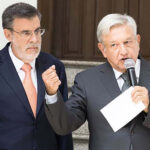
    AMLO’s Ex-Aide Takes No Prisoners in Scathing New Book

    A new book by a former top legal official in Mexico’s federal government is causing headaches for the ruling Morena party, with opposition senators calling for criminal investigations and key party figures firing back with denials.

    The book, Ni venganza ni perdón: Una amistad al filo del poder — “Neither Revenge Nor Forgiveness: A Friendship at the Edge of Power” — was written by Julio Scherer Ibarra, who served as Legal Counsel to former President Andrés Manuel López Obrador from 2018 until he resigned in September 2021. Co-authored with journalist Jorge Fernández Menéndez, the book draws on Scherer’s nearly 30-year relationship with López Obrador and alleges, among other things, that organized crime money was used to finance Morena campaign operations in multiple states.

    The book names Sergio Carmona, known as the “rey del huachicol” — king of fuel theft — as a key financier who allegedly funneled money into Morena campaigns in states including Tamaulipas, Sinaloa, and Sonora, beginning in 2018. Carmona was killed in November 2021. The book also levels accusations at Jesús Ramírez, who served as presidential spokesperson and is currently a senior adviser in President Claudia Sheinbaum’s government.

    Opposition senator Ricardo Anaya, who leads the National Action Party (PAN) bloc in the Senate, said the allegations are serious enough that authorities are legally obligated to act — no formal complaint required.

    “Much of what he is pointing out involves crimes that are prosecuted on the state’s own authority,” Anaya said. “The authorities are obligated to open investigation files.”

    Anaya went further, saying that if no investigation is opened, it would amount to confirmation of the alleged ties between Morena and organized crime.

    President Sheinbaum pushed back during her daily press conference on Feb. 17, saying she does not see any need for the Attorney General’s Office (FGR, in Spanish) to investigate Scherer. When reporters asked whether it would be desirable for the FGR to look into the matter, Sheinbaum redirected attention to Genaro García Luna, the former security secretary under President Felipe Calderón, who is now in a U.S. prison for drug trafficking ties. Sheinbaum has also said she does not plan to read the book.

    Clara Brugada, head of government of Mexico City, also pushed back, calling the allegations about her and Ramírez false.

    “I reject what this person has said,” Brugada stated. “That is a lie and an attempt to damage the image of people, like Jesús Ramírez and me, and I do not accept it.” She vouched for Ramírez as a person of integrity and challenged Scherer to produce evidence.

    Morena senator Guadalupe Chavira called the book “irresponsible,” accusing Scherer of aiming to “confuse and speculate” following his departure from government.

    Scherer’s exit from government was itself controversial. He resigned after facing accusations of extortion and running an influence-peddling network — charges that ultimately did not result in convictions. Various government bodies launched legal proceedings against him after he left, none of which succeeded.

    The book has stirred a broader political debate about the 2030 presidential succession inside Morena. Some political analysts have noted that the figures targeted by Scherer’s allegations are generally aligned against Security Secretary Omar García Harfuch, a potential future presidential contender. Scherer, for his part, has denied that the book makes direct personal imputations — telling Sonora Governor Alfonso Durazo, who sought clarification about references to his state, that the passages in question refer to events in 2018 and contain no direct accusations against him.

    Scherer is the son of Julio Scherer García, the legendary journalist who founded the news magazine Proceso after being pushed out of the newspaper Excélsior under government pressure in the 1970s. That family history adds an extra layer of resonance to the current controversy in Mexican media and political circles.

    For more on Mexico’s security landscape, see Yucatán’s safety rankings at Yucatán Daily News. For a detailed overview of the book itself, see its Wikipedia entry.

    Fast Facts

    • Ni venganza ni perdón was co-written by Julio Scherer Ibarra and journalist Jorge Fernández Menéndez
    • Scherer served as Legal Counsel to the President under López Obrador from 2018 to September 2021
    • The book alleges that organized crime funds, linked to a figure known as the “rey del huachicol,” financed Morena campaigns in northern Mexico starting in 2018
    • Opposition senator Ricardo Anaya (PAN) has called for formal investigations, arguing the alleged crimes are prosecutable without a complaint from Scherer
    • President Sheinbaum said she sees no need for the FGR to investigate, and has stated she will not read the book
    • Mexico City head of government Clara Brugada and former presidential spokesman Jesús Ramírez both denied the allegations against them
    • Morena senator Guadalupe Chavira dismissed the book as irresponsible speculation
    • Sergio Carmona, the alleged financier named in the book, was killed in November 2021
    • Scherer’s father founded the news magazine Proceso after being ousted from Excélsior under government pressure in 1976
  • Canada Sends Its Biggest-Ever Trade Mission to Mexico — but Wants Security Guarantees First

    Canada Sends Its Biggest-Ever Trade Mission to Mexico — but Wants Security Guarantees First

    Canada wants to deepen its economic ties with Mexico, but it has a condition: the Mexican government needs to show that security is a real priority.

    That was the message from Dominic LeBlanc, Canada’s minister responsible for trade, during the largest Canadian trade mission ever sent to Mexico. The six-day trip, running Feb. 15 to 20, brought more than 370 delegates and roughly 250 businesses to Mexico City, Monterrey and Guadalajara.

    “If we want investment and businesses to keep growing, they need to see the government working on priorities like security,” LeBlanc said during the mission’s opening events in Mexico City on Sunday.

    The timing is no accident. The mission comes weeks after 10 employees of Vancouver-based Vizsla Silver Corp. were kidnapped from the company’s Panuco silver-gold project in Concordia, Sinaloa, on Jan. 23. Five of the workers were later found dead. The abduction, linked to a faction of the Sinaloa cartel, forced the company to suspend operations and sent its stock price tumbling more than 40%.

    LeBlanc said Canada’s Royal Canadian Mounted Police plans to double the number of officers working at the Canadian Embassy in Mexico this year. He pointed to existing intelligence-sharing between Canadian and Mexican security agencies as a positive sign, but made clear that more is needed.

    “It is very important to continue the solid and reliable relationship that Canada and Mexico have between security agencies and military organizations,” he said.

    Mexico’s Economy Secretary Marcelo Ebrard, speaking after meeting with LeBlanc, confirmed that Canada has proposed folding security into a new bilateral action plan. That plan, which Ebrard said would be presented in the second half of 2026, will also cover critical minerals, port infrastructure, supply chains and opportunities for young workers in both countries.

    Ebrard framed the initiative as separate from the United States-Mexico-Canada Agreement, known as the USMCA or T-MEC. With the trade deal’s mandatory review looming this year and American officials floating the idea of scrapping the trilateral pact in favor of separate bilateral deals, both Canada and Mexico have reasons to strengthen their direct relationship.

    “This meeting, and the dialogue, and everything we want to achieve with the action plan is for a reason,” Ebrard told reporters. He said bilateral merchandise trade between the two countries has grown twelvefold since the original NAFTA took effect in 1994, topping $56 billion in 2024.

    The trade mission is part of a broader push by Prime Minister Mark Carney to diversify Canada’s trade beyond the United States. Mexico is already Canada’s third-largest single-country trading partner after the U.S. and China, and Canadian direct investment in Mexico reached $46.3 billion in 2024. More than 60 Canadian auto parts companies and nearly 140 Canadian mining firms operate in the country.

    During the mission’s opening, the Canadian Business Council and Mexico’s Consejo Coordinador Empresarial signed a memorandum of understanding to coordinate business cooperation. The five sectors targeted for growth include agriculture and food, advanced manufacturing, clean technology, information and communications technology, and creative industries.

    Asked about the Vizsla Silver kidnappings, Ebrard said the topic did not come up during meetings with the Canadian delegation and insisted it would not damage the bilateral relationship. But security consultants say incidents like these weigh heavily on corporate investment committees and the insurers who cover operations in high-risk areas.

    Mexico has been working to strengthen trade ties and position itself as a reliable partner for North American supply chains, even as persistent violence in states like Sinaloa, Guerrero and Michoacán complicates that pitch.

    The Canada-Mexico Comprehensive Strategic Partnership, launched in September 2025 during a visit by Carney to Mexico City, provides the framework for the bilateral action plan now under development.

    Canada-Mexico Trade: By the Numbers

    • Bilateral merchandise trade topped $56 billion in 2024, a twelvefold increase since NAFTA took effect in 1994
    • Canadian direct investment in Mexico totaled $46.3 billion in 2024
    • More than 60 Canadian auto parts companies operate in Mexico
    • Nearly 140 Canadian mining companies have operations in the country
    • The February 2026 trade mission included 370-plus delegates and about 250 businesses
    • Five priority sectors: agriculture, advanced manufacturing, clean tech, IT and communications, and creative industries
  • Mexico’s 2026 Residency Rules for Expats Updated, Financial Requirements Increase

    Mexico’s 2026 Residency Rules for Expats Updated, Financial Requirements Increase

    If you are planning to apply for legal residency in Mexico in 2026, you will need to meet higher financial thresholds than at any point in recent memory. 

    The country’s immigration system underwent a significant shift in July 2025 when the federal government published updated guidelines directing Mexican Consulates abroad to calculate residency qualification criteria using UMA (Unidad de Medida y Actualización), rather than the daily minimum wage formula used for decades. That change, combined with a stronger peso and sharply increased government processing fees, means the cost of establishing yourself legally in Mexico has risen considerably.

    For context, the monthly income needed to qualify for temporary residency was roughly US$2,000 in 2022. By 2025, that figure had climbed to around US$4,150. Under the 2026 UMA-based calculations, applicants now need approximately US$4,400 to US$5,000 per month in net income, depending on which consulate handles the application and the prevailing exchange rate.

    Residency Rules for Expats in 2026

    The value of UMA for 2026 was published by INEGI (Mexico’s national statistics agency) on January 8 at $117.31 pesos per day, a 3.69% increase over the 2025 rate of $113.14. That sounds modest, but the real impact comes from the higher multiples of UMA that consulates must now apply when assessing economic solvency. The updated multiples, laid out in the July 2025 guidelines, effectively rebased residency requirements to 2025 income and savings levels.

    The good news is that UMA increases are far more predictable than the old minimum wage model. While Mexico’s minimum wage jumped 13% in 2026 alone to $315.04 pesos per day, UMA typically rises only 3% to 5% each year in line with official inflation. That means future requirements should be easier to plan around. 

    What the Numbers Look Like 

    There are four principal routes to qualify for residency based on economic solvency: monthly income, savings or investments, ownership of a debt-free property in Mexico, or a capital investment in a Mexican company. You must qualify under one route alone; mixing income with savings is not permitted.

    For Temporary Residency (Residente Temporal), the approximate requirements for 2026 are: a monthly net income of around US$4,400 to US$5,000, or a minimum balance of approximately US$70,000 to US$75,000 in savings or investments maintained over the preceding 12 months. Applicants can include 401(k) balances and certain other investment accounts, though cryptocurrency holdings are not accepted.

    For Permanent Residency (Residente Permanente), generally reserved for retirees, the bar is higher: approximately US$7,500 to US$8,000 per month in income, or roughly US$280,000 to US$300,000 in savings. These represent increases of 25% to 30% compared with 2025 thresholds. The Instituto Nacional de Migración (INM) fees paid inside Mexico after consular approval have seen some of the largest increases in years. A one-year Temporary Resident card jumped from $5,570 pesos in 2025 to $11,140 pesos in 2026. A Permanent Resident card went from $6,789 to $13,578 pesos. These fees are fixed in pesos, so applicants paying from US or Canadian dollar accounts should budget for currency fluctuations. 

    Consulate Differences Still Matter

    One persistent frustration of the Mexican residency process is that requirements vary from one consulate to the next. While the UMA formula is consistent nationwide, individual consulates retain discretion over how strictly they apply thresholds, what exchange rate they use, and what documentation they require. Some ask to see six months of income statements; others want 12.

    Appointment availability is also becoming an issue. Several consulates in the United States and Canada are booking months in advance. Applicants close to the minimum financial thresholds are advised to confirm exact requirements directly with their chosen consulate before scheduling an appointment.

    Practical Tips for 2026 Applicants

    Early preparation is key. UMA updates tend to trigger a surge in applications starting in February, and appointment slots fill quickly. Applicants whose income falls near the borderline may find the savings-based route easier to document and less vulnerable to scrutiny.

    The consulate application fee remains relatively low at US$56 in the United States and C$80 in Canada, though it is non-refundable regardless of the outcome. Many applicants choose to work with an immigration facilitator, typically costing between US$250 and US$600, to ensure their documentation meets the strictest consulate standards.