
Author: MxTrib Staff

  • Mexican Remittances Drop by $3 Billion as US Policies Take Effect

    Mexican Remittances Drop by $3 Billion as US Policies Take Effect

    New White House immigration and economic policies are putting serious financial pressure on Mexican migrants in the United States and the families who depend on the money they send home.

    Nearly 4.5 million Mexican households receive remittances. For many, especially in rural areas and among households headed by women, these monthly transfers cover food, medicine, rent, and school supplies. 

    In 2025, Mexico received 61.8 billion dollars in remittances. That was a drop of nearly 3 billion dollars from the 64.7 billion sent in 2024. It marked the first annual decline in 11 years. Prior to this, remittances had increased every year since 2013. The streak was broken. Analysts at BBVA and Banorte expect the downward trend to continue through 2026 and 2027.

    The reasons are multiple. One direct blow came on January 1, 2026, when a new federal tax on remittances took effect. It is a 1% excise tax on money sent abroad using cash, money orders, or cashier’s checks. The tax is part of the One Big Beautiful Bill Act, which President Trump signed into law in July 2025. It applies only to physical money transfers, not to digital payments from bank accounts. But this means it hits undocumented migrants the hardest. 

    Migrants rely largely on wire services and money orders. The remittance sender in the United States pays the tax in addition to regular fees. BBVA estimates that Mexican migrants could pay up to US$3 billion in this tax alone between 2026 and 2034.

    The tax is only one part of the problem. Immigration enforcement has ramped up sharply. In the first year of Trump’s second term, more than 390,000 people were deported. Other estimates place the figure at 320,000 or 146,000, depending on the dataset, but all indicate a significant increase. In November 2025, the number of remittance transfers was 7.9% lower than in the same month the previous year. It was even lower than in November 2023.

    Those who remain in the United States face a cooler labor market. Unemployment rose to 4.4% at the end of 2025, one of the highest levels since 2021. Job cuts announced in January 2026 were the highest monthly total since 2009. Sectors that employ large numbers of Mexican migrants, such as construction, hospitality, and agriculture, have slowed their growth. Some migrants have lost hours or wages. Advocates and economists argue that the climate of fear has discouraged some from sending money home as they once did.

    While deportations have increased, the government has also expanded guest worker programs. The H2A agricultural visa program and the H2B seasonal visa program are both growing. The H-2A program has no cap and admits nearly 400,000 workers annually. The Trump administration lowered the minimum wage that farmers must pay these workers. The United Farm Workers union is suing to stop the wage cut. At the same time, the H2B program is being doubled, adding 65,000 additional visas in 2026. These guest workers are tied to a single employer and cannot easily change jobs or organize for better pay. 

    Meanwhile, the purchasing power of every dollar sent is declining. The Mexican peso has strengthened against the US dollar. In early 2025, one dollar bought about 20 pesos. By early 2026, it bought about 17.30 pesos. This 10-12% appreciation means that families in Mexico receive fewer pesos per dollar sent. Inflation in Mexico adds another layer of discomfort. 

    Together, these factors have reduced the purchasing power of remittances by roughly 16%. The Center for Latin American Monetary Studies calculates that 500 dollars sent in October 2025 bought only what 355 dollars bought in December 2020. To match the 2020 standard, a family would need to receive 702 dollars today. 

  • Measles Crisis in Jalisco Raises Health Concerns Ahead of 2026 World Cup

    Measles Crisis in Jalisco Raises Health Concerns Ahead of 2026 World Cup

    Photo:

    The state of Jalisco has declared a health alert as Mexico‘s worst measles outbreak in decades tightens its grip on the capital, Guadalajara. And it’s bad timing, with just four months to go before the city welcomes tens of thousands of international soccer fans for the 2026 FIFA World Cup.

    According to Mexico’s federal government, Jalisco has recorded 1,163 confirmed measles cases so far in 2026, along with more than 2,000 suspected cases. The state accounts for the bulk of the country’s total, which the Pan American Health Organization (PAHO) pegged at 1,981 confirmed and over 5,200 suspected cases as of early February.

    The outbreak traces back to 2025, when a child from a Mennonite community in the northern state of Chihuahua contracted the virus while visiting family in Texas during an active outbreak there. The disease then spread rapidly through Mennonite communities, where vaccine hesitancy runs high, before reaching the broader population in what has become Mexico’s largest measles event in more than 30 years.

    Schools Shut Down, Masks Mandated

    On February 5, Jalisco’s health authorities ordered face masks to be worn in schools across seven neighborhoods in Guadalajara for a minimum of 30 days. The directive makes Jalisco the first Mexican state to impose a public health mandate of this kind since the COVID-19 pandemic.

    Fifteen schools in Jalisco and the central state of Aguascalientes have already suspended in-person classes due to localized outbreaks. Schools in ZapopanAtlacomulcoTlaquepaque, and Tonalá all reported sharp increases in January.

    In response, the Jalisco Ministry of Health, the Mexican Social Security Institute (IMSS), and other providers have ramped up a mass vaccination campaign across the Guadalajara Metropolitan Area. The effort includes house-to-house healthcare brigades, 670 fixed vaccination centers statewide, and 40 mobile units stationed in high-traffic public spaces. By mid-January, the campaign was delivering up to 12,000 doses per day.

    A Continental Problem, a Global Event

    The timing is particularly concerning. Guadalajara’s Estadio Akron, home to Chivas of Liga MX, is set to host four group-stage matches beginning June 11, including Mexico vs. South Korea on June 18 and a high-profile Uruguay vs. Spain fixture on June 26. The city is expected to draw large international crowds to a region already under heavy epidemiological strain.

    With the World Cup bringing visitors from dozens of countries to the three co-host nations, all of which are dealing with rising case counts, the risk of introducing new chains of transmission is real.

    Canada lost its measles-free status in November 2025. Both the U.S. and Mexico now face the same prospect and have requested a two-month extension from global health authorities to bring their outbreaks under control. That request comes at a complicated moment after President Donald J. Trump took the US out of the World Health Organization in January, the parent body of PAHO.

    What Expats and Travelers Should Know

    PAHO reported that in the first three weeks of 2026 alone, 1,031 new measles cases were confirmed across seven countries in the Americas with no reported deaths. That figure is 43 times higher than the same period last year.

    Mexico’s federal government has set up vaccination stations in airports and bus terminals across the country and continues to urge residents and visitors alike to ensure they have received both doses of the MMR vaccine. Measles is preventable with two doses, but declining vaccination rates across the hemisphere have allowed the disease to regain a foothold in communities that were once considered protected.

    For expats living in Mexico and those planning to travel for the World Cup, checking immunization records and consulting a healthcare provider before June would be a wise precaution.

  • Mexico Sends 814 Tons of Aid to Cuba Amid Energy Crisis

    Mexico Sends 814 Tons of Aid to Cuba Amid Energy Crisis

    Two Mexican Navy ships departed from the Port of Veracruz on Sunday carrying more than 814 tons of food and supplies to Cuba, as the island nation grapples with acute fuel shortages and widespread blackouts.

    The Buque Papaloapan left Veracruz at 8 a.m. carrying 536 tons of essentials, including liquid milk, meat products, beans, rice, canned tuna and sardines, vegetable oil, cookies and personal hygiene items. The Buque Isla Holbox followed at noon with 277 tons of powdered milk. Both vessels are expected to arrive in Cuba within four days.

    Mexico’s Foreign Ministry said the shipment represents the country’s commitment to regional solidarity, particularly with Cuba. More than 1,500 additional tons of powdered milk and beans await future transport.

    The aid comes as Cuba faces what President Miguel Díaz-Canel called an “acute fuel shortage” during a televised address last week. The crisis has triggered rolling blackouts across the island, forced fuel rationing, and prompted the government to limit administrative activities to four days a week to conserve energy.

    Cuba’s difficulties intensified after the United States cut off Venezuelan oil supplies in January following a military operation that removed President Nicolás Maduro from power. The Trump administration subsequently threatened tariffs on any country supplying oil to Cuba, leaving the island scrambling for alternatives.

    Nine international airports in Cuba will have no jet fuel available from Feb. 10 through at least March 11, according to an official aviation notice. Foreign airlines must either carry extra fuel from their origin points or make technical stops elsewhere to refuel.

    Mexico has emerged as Cuba’s primary fuel supplier since Venezuela stopped shipments, though President Claudia Sheinbaum recently paused oil deliveries while seeking diplomatic solutions to avoid U.S. tariffs. She emphasized that humanitarian aid would continue regardless.

    “The people of Mexico maintain their tradition of solidarity with the peoples of Latin America and particularly with the people of Cuba,” the Foreign Ministry said in a statement.

    The United Nations has warned of a potential humanitarian collapse if Cuba’s energy needs go unmet. U.N. Secretary-General António Guterres expressed “extreme concern” about the situation last week, noting that fuel shortages have pushed up food and transportation costs while causing prolonged blackouts even in Havana.

    Cuba has relied on connections with Mexico for decades, including proposals for maritime routes between the Yucatán Peninsula and Cuba. The Mexican government has provided aid during previous crises, including sending 100,000 barrels of fuel after widespread protests in 2021 and more than 400,000 barrels following severe blackouts in 2024.

    The U.S. trade embargo against Cuba, in place since 1962, has contributed to the island’s ongoing economic difficulties. Trump recently threatened additional pressure on Cuba, though he has not specified what kind of agreement he seeks.

    Cuban authorities have responded to the crisis by prioritizing electricity for hospitals, elderly care centers and isolated regions while ramping up solar power generation. The government is also working to increase domestic crude oil extraction and storage capacity.

    For ordinary Cubans, the shortages mean limited fuel purchases — currently capped at 20 liters of gasoline in U.S. dollars only — and uncertain access to basic goods. Universities have suspended classes, and interprovincial transportation has been curtailed in some provinces.

    The Sheinbaum administration has described oil as “fundamental” humanitarian aid for Cuba, but acknowledged it cannot risk additional tariffs on Mexican exports to the United States.

    Key Facts:

    • Two Mexican Navy vessels departed Veracruz on Feb. 8 with 814 tons of humanitarian aid
    • Shipment includes food staples, personal hygiene items and powdered milk
    • Cuba faces acute fuel shortage after U.S. cut Venezuelan oil supplies in January
    • Nine Cuban airports will lack jet fuel from Feb. 10 through at least March 11
    • More than 1,500 additional tons of aid await future shipment from Mexico
    • U.N. warns of potential humanitarian collapse without fuel supplies
  • Vaquita Protection Zones Reduced by 86%, Critics Call It Surrender to Cartels
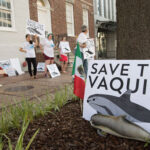
    Vaquita Protection Zones Reduced by 86%, Critics Call It Surrender to Cartels

    Conservation groups are sounding alarms after Mexico announced plans to slash protection zones for the critically endangered vaquita marina by 86%, opening thousands of square kilometers of the Gulf of California to the same gillnets that have driven the world’s smallest porpoise to the brink of extinction.

    The Mexican government’s decision would eliminate most of a 2020 regulatory agreement that prohibited gillnet fishing across 11,594 square kilometers (4,477 square miles) of the Upper Gulf of California. Under the proposed changes, only 1,562 square kilometers would remain off-limits to the deadly nets, creating a fishing zone roughly 6.6 times the size of Mexico City.

    “If we compare the map presented by Mexican authorities with the 2020 Regulatory Agreement, around 86% of the area where gillnet use is currently prohibited is being cut,” said Alejandro Olivera, Mexico representative for the Center for Biological Diversity. “In practice, this means reopening thousands of square kilometers to the fishing gear, pushing the vaquita marina toward extinction.”

    The vaquita exists nowhere else on Earth. The small porpoise, distinguished by dark rings around its eyes and lips, inhabits only the northern Gulf of California between Baja California and Sonora. Latest population estimates place their numbers at just seven to 10 individuals, down from 567 in 1997.

    The species faces extinction not from direct hunting, but as accidental victims of illegal fishing for another endangered species: the totoaba. This large fish’s swim bladder, called a buche in Spanish, commands extraordinary prices on Chinese black markets, where it can fetch $20,000 to $80,000 per kilogram for use in traditional medicine and as a status symbol among wealthy buyers.

    Criminal networks have transformed totoaba trafficking into what investigators call an organized environmental crime. Earth League International has identified 17 major trafficking networks and more than 160 suspected perpetrators, many of them Chinese traders based in Mexican cities like Ensenada and Tijuana who work with local cartels for protection and logistics.

    “This represents Mexico’s surrender to the cartels and illegal fishermen who for decades have illegally caught and trafficked totoaba and other species, practically causing the vaquita marina’s disappearance,” said DJ Schubert, senior wildlife biologist at the Animal Welfare Institute.

    Both the vaquita and totoaba drown when trapped in gillnets, unable to surface for air. The nets remain the primary threat despite decades of warnings from scientists and multiple international sanctions against Mexico for failing to enforce fishing bans.

    The reduction would also shrink the historic Vaquita Marina Refuge Area by nearly 85%, freeing 278 square kilometers in the southwest portion of the polygon where nets have been illegal.

    “Reducing protection polygons is a risk the vaquita marina cannot afford, given that the latest population estimate shows only seven to 10 individuals remain,” Olivera said.

    Conservation organizations point out that vaquitas don’t recognize boundary lines on maps. Multiple sightings have been recorded outside established protection zones, including in areas that would become open to gillnet fishing under the new proposal.

    The Mexican government has struggled for years to enforce existing regulations. Just 16 convictions for totoaba trafficking were recorded between 2016 and 2022, despite seizures of 26,000 to 30,000 swim bladders during the same period. In 2023, the Convention on International Trade in Endangered Species sanctioned Mexico for inadequate protection efforts.

    Recent monitoring offers a glimmer of hope. A 2025 survey confirmed sightings of seven to 10 vaquitas, including newborn calves, suggesting the population has stabilized after years of steep decline. Scientists emphasize the remaining animals appear healthy and continue to reproduce.

    But conservationists warn that shrinking protection zones could reverse this fragile stability. They’re urging Mexico to reconsider what they call a “potentially disastrous” proposal that would leave the vaquita practically defenseless.

    The fight to save the vaquita extends beyond Mexico. The United States serves as both a transit point and destination for totoaba products, while China drives demand despite a 2020 ban on wild animal trade. Environmental groups say only coordinated enforcement across all three nations can dismantle the trafficking networks keeping gillnets in vaquita waters.

    For the vaquita, time has nearly run out. What happens next in Mexico’s northern gulf may determine whether this unique species survives or becomes another cautionary tale of extinction driven by organized crime and enforcement failures.

    Key Facts About the Vaquita Crisis

    • Population: 7-10 individuals remain as of 2025, down from 567 in 1997
    • Habitat: Found only in northern Gulf of California, smallest range of any cetacean
    • Main threat: Gillnets used for illegal totoaba fishing 
    • Totoaba value: Swim bladders sell for $20,000-$80,000 per kilogram in China 
    • Protection reduction: From 11,594 sq km to 1,562 sq km (86% decrease) 
    • Criminal networks: At least 17 major trafficking organizations identified 
    • Enforcement record: Only 16 convictions from 2016-2022 despite thousands of seizures

  • Real Madrid Foundation Brings Elite Soccer Training to Tulum Country Club

    Real Madrid Foundation Brings Elite Soccer Training to Tulum Country Club

    Photos courtesy Tulum Country Club

    Tulum Country Club has launched a partnership with the Real Madrid Foundation, bringing world-class soccer training to Mexico‘s Caribbean coast. The collaboration kicked off with the first Real Madrid Foundation Clinics from January 30 to February 2, combining professional-level coaching with character development for young athletes.

    The four-day program attracted approximately 60 participants aged 6 to 17 from Mexico, the United States, and Argentina, offering more than 20 hours of intensive field training at the resort’s facilities.

    Rodrigo Blanco Robles, Technical Coach for Schools and Clinics of the Real Madrid Foundation and a UEFA PRO licensed coach, led the training sessions. Blanco Robles coordinated a team of certified coaches who implemented the Foundation’s methodology, which emphasizes collective play and cognitive development through real game situations rather than isolated drills.

    Each participant received individual evaluation throughout the program, with coaches focusing on technical skills, tactical awareness, and habits of discipline and continuous improvement.

    Values-Based Training Philosophy

    “At Tulum Country Club we are committed to sports as a lifestyle, because we trust in its transformative power, especially for young people, and particularly with a partner like the Real Madrid Foundation, with whom we share values such as effort, teamwork, improvement, and never giving up,” commented Álvaro Moya, Country Manager of Tulum Country Club.

    The program integrated eight core values promoted by the Real Madrid Foundation: respect, commitment, companionship, solidarity, sportsmanship, discipline, responsibility, and health and well-being. This approach mirrors the training philosophy used at Real Madrid’s youth academies in Spain.

    Building Long-Term Development

    Pablo Gil Sarrión, technical director of Real Madrid Foundation Tulum, emphasized the comprehensive nature of the program. 

    “The objective of these Clinics is for each boy and girl to have a complete experience: improve their game with a recognized methodology and, at the same time, take away tools and values that serve them in their daily lives. At Tulum Country Club we take this first step with a clear foundation: respect, commitment, and companionship as part of the training,” he stated.

    The clinic represents the first of what Tulum Country Club plans as an ongoing sports initiative. The partnership positions the resort as a destination for families seeking high-quality athletic programs alongside traditional vacation amenities.

    About the Partnership

    The Real Madrid Foundation operates soccer training programs in more than 80 countries worldwide, serving over 70,000 children annually through its network of schools, clinics, and social programs. The Foundation’s methodology has been developed over decades at Real Madrid’s La Fábrica youth academy, which has produced players including Raúl GonzálezIker Casillas, and Dani Carvajal.

    Tulum Country Club’s commitment to this partnership demonstrates the resort’s broader strategy of offering experiences that extend beyond beach activities and spa services, appealing to families prioritizing active lifestyles and youth development during their travels to the Riviera Maya region.