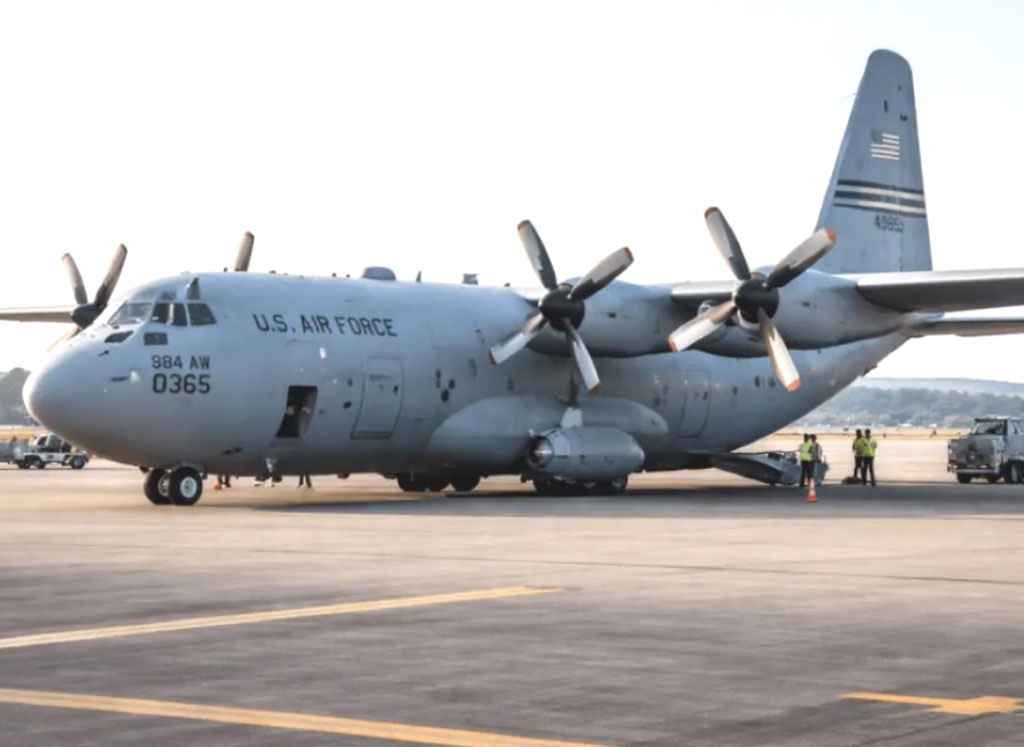
A recent event at the Toluca Airport in Mexico State caused a significant stir in Mexico. It involved the arrival of a United States military aircraft, a C-130 Hercules, leading to discussion over national sovereignty and the transparency of military agreements with foreign nations.
This is especially the case after the actions taken by the US military in Venezuela at the beginning of the year.
The controversy began when images of the large, camouflaged U.S. Air Force plane parked at the civilian Toluca airport spread rapidly on social media. Mexico has a long and deeply held principle of non-intervention, rooted in its history and constitution. The presence of a foreign military aircraft, especially one as recognizable as a Hercules, immediately raised questions and concerns about why it was there and what it was doing.
The reaction forced President Claudia Sheinbaum to address the issue publicly. During her January 19 morning press conference, she explained, clarifying what she called part of the “mystery.” According to the President, the aircraft was not carrying U.S. troops into Mexico for any operational mission. Instead, she stated that it was a logistical flight for a training exercise approved months earlier.
Her explanation, based on the government’s account, was detailed. She said the aircraft landed in Toluca to pick up Mexican public officials. These officials were then flown to the United States to participate in a training program “related to their work,” regulated by Mexico’s National Security System. She specified that the U.S. Northern Command was involved in these trainings, which are part of existing bilateral agreements between the two countries.
A key point in her defense was the timeline for authorization. Sheinbaum emphasized that the Mexican Senate had granted permission for this specific flight in October. She argued that because no foreign troops were entering Mexican territory—only Mexican officials were boarding the plane to leave—the event did not require new public consultation. The only unusual detail, she noted, was that the aircraft used Toluca Airport rather than another entry point, though she did not give a reason for the change.
The explanation did not fully calm the political waters. The incident shed light on the broader and often contentious process of military cooperation between Mexico and the United States. Sheinbaum used the opportunity to clarify a separate, pending issue. She mentioned that her administration had previously sent a request to the Senate’s Permanent Commission to authorize the temporary entry of U.S. military personnel—specifically 29 members of the U.S. Navy SEALs and Special Forces—for a joint training program planned for early 2026.
This revealed a complex bureaucratic process. Sheinbaum stated that such authorizations must be approved by the full Senate during its ordinary sessions, not just by the smaller Permanent Commission. She addressed rumors head-on, denying that a recent Senate delay in voting on that larger troop request was related to political events in Venezuela or done on her orders. She said the senators simply decided to wait until the next ordinary session in February to vote, as is their constitutional right.
The reactions from other political leaders and analysts were mixed. Some accepted the president’s logistical explanation for the Toluca flight. Others, particularly from opposition parties, remained skeptical. They argued that the event highlighted the government’s lack of transparency and proactive communication. Critics asked why, if the flight was routine and pre-authorized, its occurrence came as such a surprise to the public.

Leave a Reply