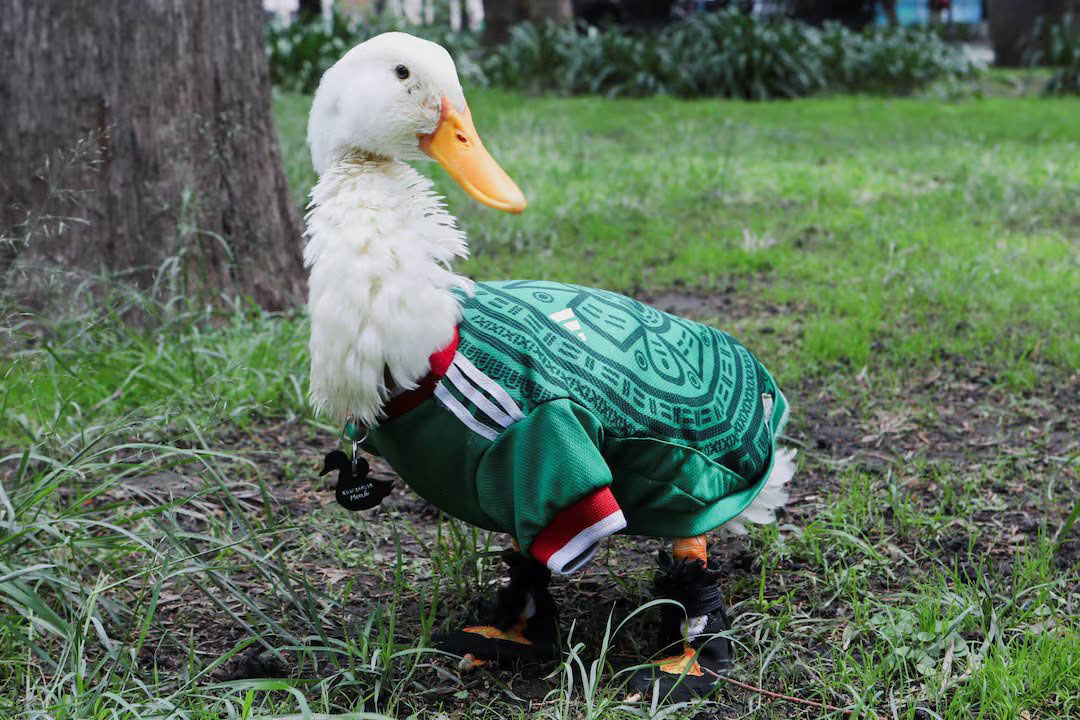
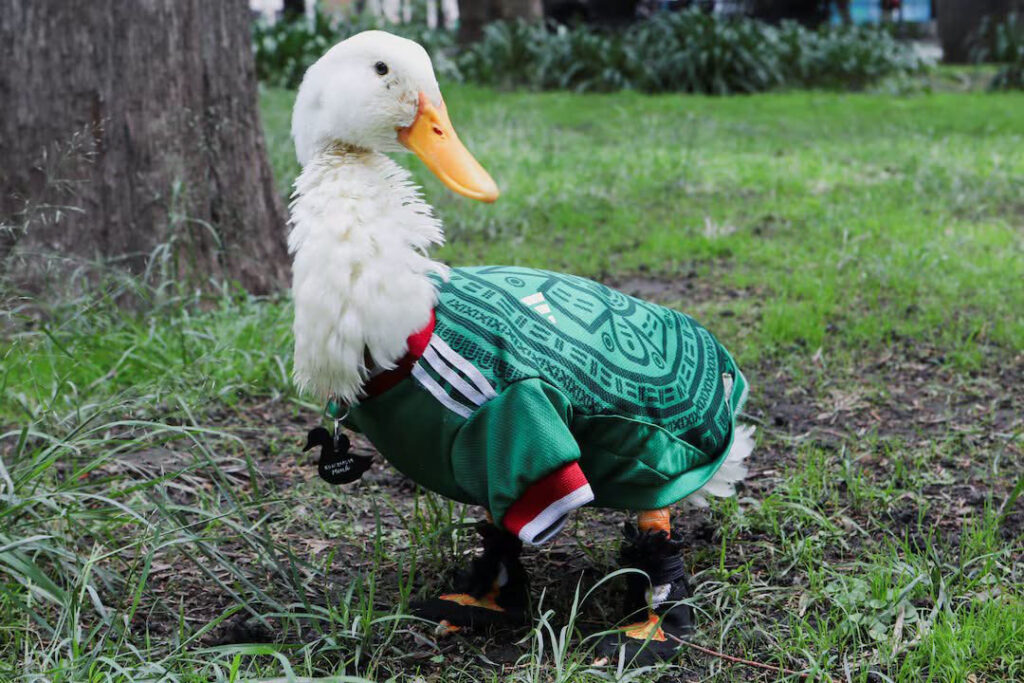
A Mérida resident filed paperwork to claim the brand rights to Merlín, the duck who became Mexico’s unofficial mascot of the 2026 FIFA World Cup — a move that drew a swift rebuke from President Claudia Sheinbaum, who called it an abuse.
David Sides Fuentes, who lives in the Santa Gertrudis Copó neighborhood of Mérida, submitted a trademark application to the Mexican Institute of Industrial Property (IMPI) on June 17, according to official records. The filing — expediente 3643308 — sought a 10-year registration for the brand and logo of “El Pato Merlín. El pato de la suerte” (Merlín the Duck. The Lucky Duck). The proposed trademark, records show, would cover advertising, political campaigns, business incubators, and management services for artists and athletes. The submitted logo depicts a duck wearing a green jersey with a Quetzalcóatl design, similar to the one worn by Mexico’s national soccer team, with the Aztec Calendar in the background.
Sheinbaum made the application public and wasted no time in condemning it. “It’s an abuse,” she said during her morning press conference at the National Palace.
A Street Vendor’s Duck Goes National
Merlín’s rise from neighborhood pet to national symbol happened fast. The two-year-old Pekin duck first appeared in public during street celebrations after Mexico defeated South Africa 2-0 on June 11 in the tournament’s opening match at Estadio Azteca — the same stadium that will become the first venue ever to host matches in three separate World Cups. Videos of Merlín waddling through the crowds on Reforma Avenue spread across social media within hours, and the duck hasn’t been out of the spotlight since.
His owner is Carla Gómez, a street vendor who sells beverages at a sidewalk stall. She was gifted the duck by a customer and, by her own account, never imagined the attention that would follow. “We thought we were passing by unnoticed,” she said in one interview. “It was a normal day for us.” She jokingly calls Merlín the “boss” of the family business and says he has a balanced diet — though he is allowed a pork taco on Sundays. As for footwear, Merlín typically wears shoes because, she says, “he likes to walk.”
Merlín Meets the President
On June 22, Gómez and her sons brought Merlín to the National Palace, where Sheinbaum had invited the family to appear at her daily press briefing. The duck arrived in his now-familiar green jersey and a FIFA tie, sat beside his owner at the podium, quacked occasionally, and reportedly attempted to peck the president when she tried to pet him. Sheinbaum used the moment to frame Merlín as more than a viral curiosity. “He has been a symbol of the World Cup, a symbol of what Mexican families stand for, of who we are as Mexican families,” she said.
At the same event, Sheinbaum announced that the federal government would help Gómez’s family file their own trademark application with IMPI — and the family has since initiated that process.
How Mexico’s Trademark System Works
The timing of the Mérida resident’s filing puts into sharp relief a basic fact of Mexican intellectual property law: trademark rights in Mexico go to whoever registers first, not whoever uses a name or image first. IMPI, the autonomous federal agency that administers the country’s industrial property system, operates on a first-to-file basis. An application is published for a public opposition period of about one month before advancing to substantive examination, a process that typically takes between four and eight months in total. Third parties — including Gómez’s family — can file an opposition to block a registration they believe conflicts with their rights.
Mexico has tightened its rules against marca piratas, or trademark squatting, in recent years, including a 2018 reform that requires trademark holders to file a formal declaration proving active commercial use within three years of registration or lose their rights. Whether the Merlín application proceeds, or is blocked by the family’s counterfiling or public opposition, remains to be seen.
Those following the World Cup in Yucatán can keep up with the latest from the tournament and its cultural moments through Yucatán Magazine. For more on the mechanics of Mexican trademark law, the AP’s reporting on the Merlín story offers useful context from the family’s perspective.
Fast Facts
- Merlín is a two-year-old Pekin duck owned by Mexico City street vendor Carla Gómez
- He went viral after appearing in crowd celebrations following Mexico’s 2–0 opening win over South Africa on June 11
- David Sides Fuentes of Mérida’s Santa Gertrudis Copó neighborhood filed IMPI application expediente 3643308 on June 17
- The application sought 10-year rights to use the Merlín brand for advertising, political campaigns, and artist management services
- President Sheinbaum called the filing “an abuse” and pledged government support to help Gómez’s family register the trademark themselves
- Mexico’s trademark system is first-to-file; prior use alone does not establish legal ownership
- IMPI allows third parties to oppose trademark applications during a roughly one-month public comment window
- The full trademark process in Mexico typically takes four to eight months if uncontested
Sources: Diario de Yucatán, El Universal, Associated Press, Reuters, Gulf News